
Toward the Practical Use of Next-Generation Maritime Communication System “VDES” Effectiveness Confirmed in Demonstration of Route Exchange
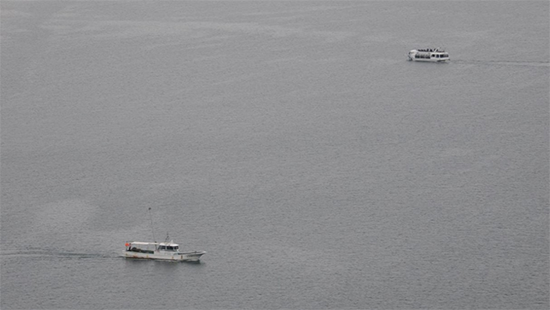
IHI conducted a demonstration in Mikawa Bay, Aichi Prefecture, using vessels equipped with domestically developed terminals for VDES*1, a next-generation maritime communication system under development. In the demonstration, vessels navigated in accordance with recommended routes transmitted from shore.
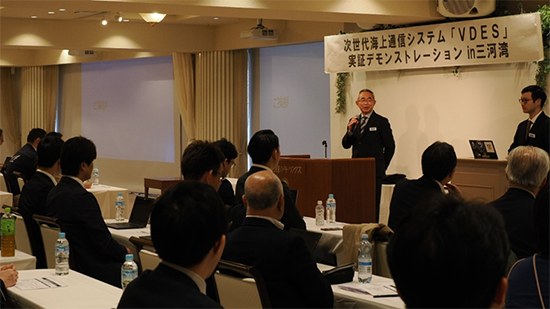
The demonstration was carried out over two days, on Wednesday, November 4 and Thursday, November 5, 2026, to confirm the applicability of VDES to route exchange, with a view to autonomous operation and reduced manning of future vessels. As a result, IHI gained a technical outlook for the use of VDES in route exchange.
Background
In the shipping sector, addressing the shortage of seafarers has become an issue, and autonomous operation and reduced manning are expected to advance in future vessel operations. Accordingly, situations are expected to increase in which Vessel Traffic Services (VTS) personnel and seafarers must simultaneously monitor the status of multiple vessels and make the necessary adjustments to ensure safe navigation.
At present, recommended routes and warnings needed to avoid obstacles are communicated mainly verbally between VTS centers and vessels. If this information could be transmitted as digital data to multiple vessels and displayed on screens aboard ship, VTS centers could provide information to multiple vessels more efficiently, and vessel crews could visually confirm recommended routes, warnings, and the status of vessels navigating in the vicinity. This route exchange is expected to reduce the workload of VTS personnel and seafarers and contribute to safer and more efficient vessel operations.
VDES is a communication system that adds the capability to transmit and receive digital data among vessels, shore stations, and satellites to the functions of AIS*2, which has long been in widespread use for reporting a vessel’s position and related information. With VDES, data such as recommended routes, which AIS is not designed to exchange, can be transmitted and received, and VDES is also expected to contribute to more efficient traffic management. VDES technology is under development in various countries. VDES terminals are expected to be approved under the SOLAS Convention*3 as alternative equipment to AIS terminals for carriage on board ships in 2028, and their adoption is expected to expand. Ahead of this adoption, the demonstration confirmed the applicability of VDES to route exchange.
The Demonstration
The demonstration was conducted as part of the “Development and Demonstration of Maritime Domain Awareness Technology Using a Communication Satellite Constellation for Ships,” under the Key and Advanced Technology R&D through Cross Community Collaboration Program*4 (K Program) implemented by the New Energy and Industrial Technology Development Organization (NEDO). ArkEdge Space Inc. (Koto-ku, Tokyo) and LocationMind Inc. (Chiyoda-ku, Tokyo) cooperated in the demonstration. Officials from the Japanese government and related agencies, as well as private-sector participants from the shipping industry, observed the demonstration.
In the demonstration, recommended-route data were transmitted via VDES from a shore station simulating a VTS center to two target vessels navigating in Mikawa Bay, using domestically developed VDES terminals. Each vessel confirmed the received recommended route on an application screen, shared its acceptance or non-acceptance with the shore station and the other vessel, and then maneuvered in accordance with the recommended route. The demonstration confirmed that displaying recommended routes on screen and sharing acceptance status among the parties concerned supported decision-making during maneuvering and was effective in reducing workload. It also provided a technical outlook for the use of VDES in route exchange.
Future Plans
Under the K Program, IHI is responsible for overall coordination, the development of VDES linking vessels, shore stations, and satellites, and the operational design and demonstration for the use of VDES shore stations and shipboard terminals.
Based on the results of this demonstration, IHI will proceed with the study of specific use cases for VDES and continue demonstrations of communication among vessels, shore stations, and satellites, aiming to establish VDES technology by the end of fiscal 2029. Looking further ahead, IHI will pursue the construction and commercial deployment of an integrated space-maritime network with VDES at its core, and promote the adoption of VDES in Japan and overseas. IHI also positions VDES satellites as one component of the multiple satellite constellations it envisions. By collecting information across land, sea, air, and space and providing data and services tailored to user needs, IHI will contribute to the realization of a safe and secure society.
*1 VDES (VHF Data Exchange System)
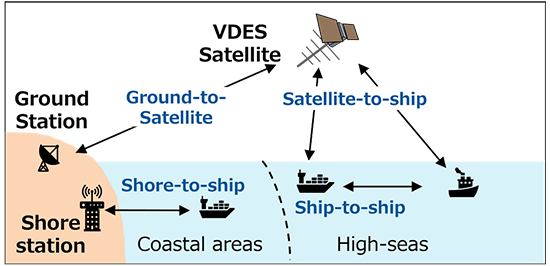
VDES, known as the next-generation AIS, is a maritime communication system utilizing the VHF frequency band, aiming to build a two-way digital communication network among vessels, ground stations, and satellites. In 2019, the VHF frequency band capable of satellite transmission and reception was allocated, and demonstration tests using VDES satellites are currently underway worldwide. In Japan, technology demonstrations of VDES systems, including terrestrial components, have begun under the “Key and Advanced Technology R&D through Cross Community Collaboration Program (K Program)*3.”
*2 AIS (Automatic Identification System)
AIS is an automatic identification system for vessels. Since 2002, the IMO has mandated its installation on vessels above a certain size. Vessels automatically send and receive identification numbers, positions, speeds, and courses by radio waves, and AIS is used to monitor the movements of nearby vessels and avoid collisions.
*3 SOLAS Convention (International Convention for the Safety of Life at Sea)
An international convention adopted and administered by the IMO for the safety of life at sea. It sets safety standards for the structure, equipment, and operation of ships. For the purpose of navigational safety, it stipulates requirements for the carriage of various navigational and communication equipment, including AIS. VDES is also expected to be designated as mandatory shipboard equipment in the future.
*4 Key and Advanced Technology R&D through Cross Community Collaboration Program (K Program)
A program promoted under the Economic Security Promotion Council and the Integrated Innovation Strategy Promotion Council, in which the Cabinet Office, the Ministry of Education, Culture, Sports, Science and Technology (MEXT), and the Ministry of Economy, Trade and Industry (METI) take the lead in advancing cross-ministerial research and development of advanced technologies important for economic security. The project “Development and Demonstration of Maritime Domain Awareness Technology Using a Communication Satellite Constellation for Ships” involves research and development of satellite technologies for maritime domain awareness that comprehensively collect vessel traffic information from space, including through VDES, as well as data platform technologies that aggregate and share maritime information via two-way communications.