
LH₂ BOG Compressor Selected for Use at Kawasaki LH₂ Terminal
-Contributing to Stable Operations at the World’s First Commercial-Scale Liquefied Hydrogen Terminal-
IHI Rotating Machinery Engineering Co., Ltd. (“IRM”), a wholly owned subsidiary of IHI Corporation based in Koto-ku, Tokyo and headed by President Keiichi Morikawa, today announced that its liquefied hydrogen boil-off gas (LH₂ BOG) compressor has been selected for use at the Kawasaki LH₂ Terminal, a liquefied hydrogen terminal currently being developed by Kawasaki Heavy Industries, Ltd. on Ogishima Island in Kawasaki City, Kanagawa Prefecture.
The Kawasaki LH₂ Terminal is a core facility in Japan Suiso Energy Ltd.’s Commercialization Demonstration of a liquefied hydrogen supply chain, supported by the Green Innovation Fund of the New Energy and Industrial Technology Development Organization (NEDO), and is the world’s first commercial-scale liquefied hydrogen receiving terminal.
Contributing to Stable Terminal Operations through BOG Handling
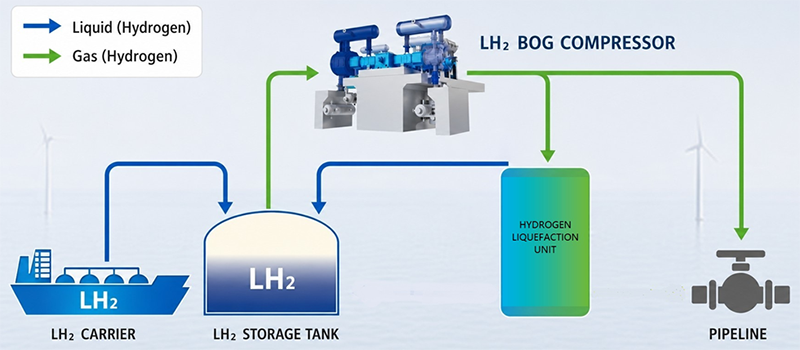
IRM’s LH₂ BOG compressor directly draws in and compresses boil-off gas (BOG) from the LH₂ storage tank. By keeping tank pressure within an appropriate range and supporting gas supply to customers via pipelines, the compressor helps ensure stable operation of the LH₂ terminal.
Compression Technology for Cryogenic Hydrogen
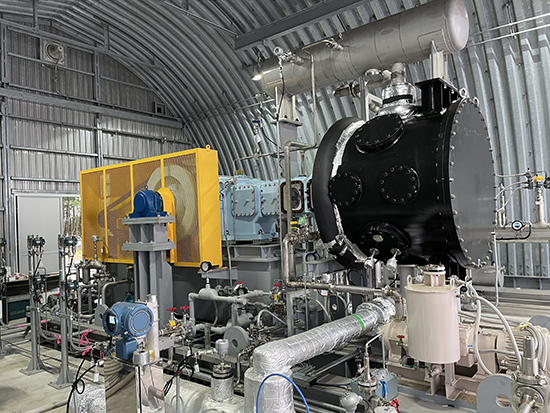
Building on its experience with LNG BOG compressors, which are critical equipment at liquefied natural gas (LNG) receiving terminals, together with the results of its in-house prototype compressor, IRM has continued to develop an LH₂ BOG compressor capable of directly receiving and compressing cryogenic hydrogen gas. This compression technology enables the safe and efficient processing of BOG generated during the storage of liquefied hydrogen in LH₂ storage tanks and will play an important role in the deployment of decarbonized energy supply networks.
Principal Features of the LH₂ BOG Compressor
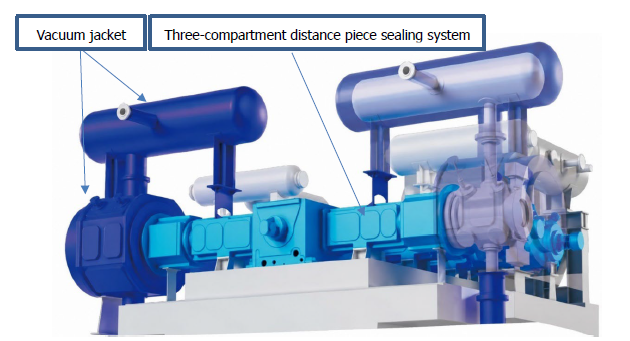
-Vacuum jacket
The cylinder incorporates a vacuum-insulated jacket to limit heat ingress from the surrounding environment and prevent air liquefaction on the outer surface. This enables the compressor to directly receive cryogenic hydrogen gas at approximately -240°C. By taking advantage of the compression characteristics of hydrogen in the cryogenic temperature range, the compressor helps achieve high energy efficiency across the overall unit.
-Three-compartment distance piece sealing system
To prevent hydrogen gas leakage and the ingress of hydrogen into the lubricating oil, the distance piece uses a three-compartment configuration that separates the hydrogen gas system from the lubricating oil system in stages. (Patent No. JP 6781795; patent applications pending in other countries.)
-Materials suitable for cryogenic hydrogen service
To ensure durability and reliability in a cryogenic hydrogen environment, key components that come into contact with the gas are made of materials suitable for cryogenic hydrogen service.
Through the selection of its LH₂ BOG compressor for the Kawasaki LH₂ Terminal, IRM will support the deployment of decarbonized energy infrastructure. The company will continue to work with customers and partners to further enhance the value of this compressor as critical equipment for decarbonized energy infrastructure and to contribute to the transition to a low-carbon society.
[Company Profile]
IHI Rotating Machinery Engineering Co., Ltd. https://www.linkedin.com/company/ihi-rme/
- Location: 7-12 Shinonome 1-chome, Koto-ku, Tokyo 135-0062, Japan
- Representative: Keiichi Morikawa, President
- Capital: JPY 1,033,500,000
- Business Description: Development, manufacture and sale of compressors, separators, marine turbochargers and gear devices; plant engineering and maintenance; and after-sales services.