The IHI Group implements management that embraces ESG values.
Until fiscal 2025, the Group had identified three key environmental issues—climate change, conservation of the global environment, and circular economy—and had continuously worked to reduce the environmental impacts on the entire social system. Beginning in fiscal 2026, in light of recent social trends, the Group has expanded the concept of the conservation of the global environment, which had guided its efforts to date, and redefined it as the conservation of natural capital.
Among these key environmental issues, the IHI Group has also positioned climate change as one of its material issues. Using greenhouse gas (GHG) emissions across the lifecycle of its products and services as a key indicator, the Group proposes businesses that contribute to achieving carbon neutrality throughout the value chain. The Group has established the IHI Group Basic Environmental Policy as a guideline for action in addressing these key environmental issues.
Policy
IHI Group Basic Environmental Policy
The IHI Group establishes action guidelines as follows pursuant to Article 7 (Responsibility for the global environment) of “IHI Group Basic Code of Conduct,” and acts independently and actively.
Article 1. Establishment of Environmental Management System
To ensure continuous improvement of environmental management, the IHI Group establishes an environmental management system, sets specific objectives and executes an action and a performance evaluation.
Article 2. Compliance with Environmental Laws and Regulations
The IHI Group complies with environmental-related laws and regulations/agreements, policies/plans in related industries, and strives to stipulate and apply independent management standards to enhance environmental management.
Article 3. Provision of Environmentally-Friendly Products, etc.
The IHI Group provides society with products, services, and technologies that contribute to the conservation of the global environment and the reduction of environmental burdens.
Article 4. Conservation of Global Environment and Reduction of Environmental Burdens in Business Activities
The IHI Group strives to conserve the global environment and reduce environmental burdens in all of its business activities as follows.
Conservation of the global environment Control of air, water, and soil pollution, and reduction of impact on biodiversity and conservation of biodiversity, in order to achieve a sustainable society
Reduction of environmental burdens Reduction of energy consumption, greenhouse gas emissions, and water consumption, improvement of the efficiency of global resource use, and reduction of waste generation, in order to achieve a decarbonized and resource-recycling society
Article 5. Environmental Education
The IHI Group, through environmental education, raises awareness of all people engaging in operations, including officers, employees, and temporary staff of IHI Group companies, thereby they are able to act having concern with environmental problems on their own.
Article 6. Disclosure of Information
The IHI Group actively participates in social activities, discloses appropriate and timely environmental information, and communicates with stakeholders to harmonize with local communities, conserve regional environments, and reduce environmental burdens.
Governance
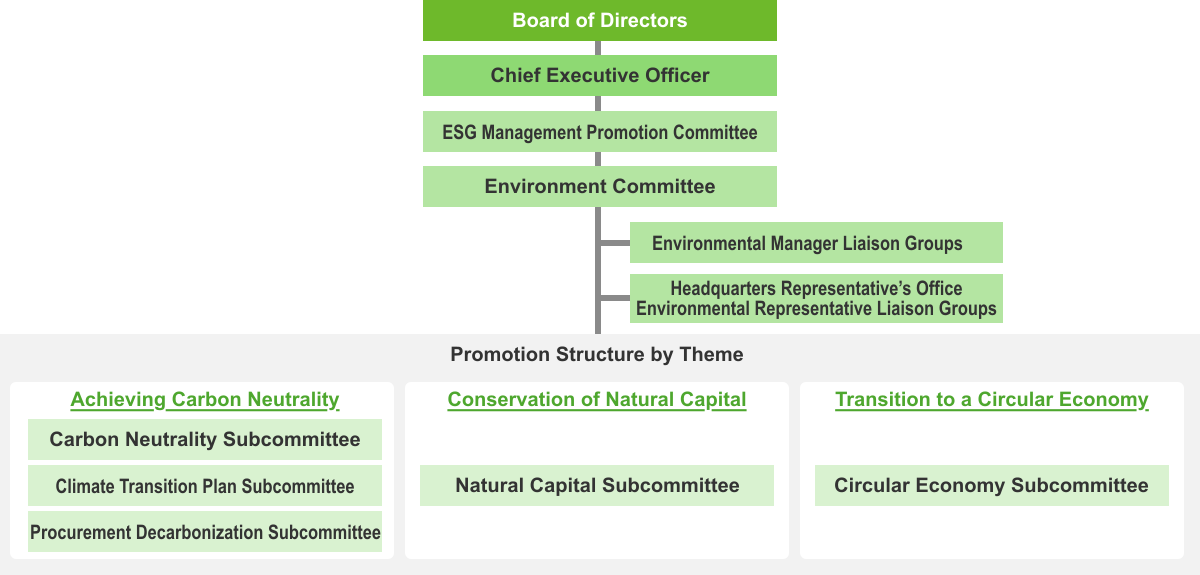
The IHI Group promotes environmental activities under the direction of the ESG Management Promotion Committee, with the Environment Committee playing a central role. The Environment Committee is chaired by the Officer in charge of Group ESG, with Vice Presidents of business areas and General Managers of their Planning & Control Departments serving as Committee members. In addition, the Environmental Manager Liaison Groups and various subcommittees have been established under the Environment Committee to promote activities related to its key environmental issues.
For each of the three key issues—climate change, conservation of the global environment (redefined as conservation of natural capital from fiscal 2026), and circular economy—the Environment Committee deliberates and decides on activity strategies, plans, and targets, and provides progress reports. With regard to climate change, which is one of its material issues, the Committee is drawing up a roadmap for reducing the amount of GHG emissions generated during product use, and is monitoring the implementation status of capital investment aimed at reducing GHG emissions from plants and offices, with the goal of realizing carbon neutrality throughout the value chain.
The details of discussions by the Environment Committee are reported to the ESG Management Promotion Committee, and feedback received from management is used in the Environment Committee’s decision-making and disseminated to Group companies both within and outside Japan.
Of the matters discussed by the Environment Committee, those matters related to important management decision-making are deliberated on by the Management Committee, which serves as the decision-making body for management execution, and are then submitted to the Board of Directors.
The Environmental Manager Liaison Groups are mainly engaged in ensuring compliance with environmental legislation at the level of individual plants and offices, and in initiatives aimed at reducing the environmental burden on the local community. The content of these activities is reported to the Environment Committee. The Environment Committee also receives reports on the activities of the various subcommittees.
Environmental Management and Activity Promotion Structure
Overview of Committees and Meeting Bodies
Committees and Meeting Bodies
Purpose
Participants
Number of meetings convened (FY2025)
Environment Committee
Planning and promotion of environmental activities
Chairperson: Officer in charge of Group ESG Members: General Environmental Officers in business areas, offices, and the corporate divisions
3
Environmental Manager Liaison Groups
Promotion of environmental improvement activities tailored to the characteristics of each business area and office
Members: Environmental Management Officers in the business divisions, offices, and the corporate divisions Secretariat: Administration Division
3
Headquarters Representative’s Office Environmental Representative Liaison Groups
Information sharing and discussion on environmental activities among operational personnel
Members: Environmental Representatives at IHI's major offices Secretariat: Administration Division
2
Carbon Neutrality Subcommittee
Developing and implementing carbon neutrality initiatives tailored to the characteristics of production plants in each business area
Members: Business areas Secretariat: Administration Division
Transitioned from task force activities in FY2026
Climate Transition Plan Subcommittee
Assessing climate-related risks and opportunities and developing a climate transition plan
Members: Business areas Secretariat: Administration Division
Individual meetings: 10 General meetings: 1
Procurement Decarbonization Subcommittee
Developing and implementing GHG emissions reduction initiatives in procurement activities
Developing the basic policy on natural capital and biodiversity and planning and implementing initiatives for natural capital conservation
Members: Environmental Representatives in business areas and offices Secretariat: Administration Division
From FY2026
Circular Economy Subcommittee
Promotion of businesses incorporating circular economy principles
Members: Business areas, corporate divisions Secretariat: Administration Division
Meetings: 2 Workshops: 4
Strategy
The IHI Group sets targets for environmental activities in the short term (one-year), the medium term (three-year), and the long term (up to fiscal 2040) time horizons. For the medium term, the Group drafts its environmental action plans every three years and establishes short-term targets based on the plans, while pursuing comprehensive environmental initiatives. The environmental action plans are formulated based on the IHI Group Basic Environmental Policy, keeping in mind the provision of environmental value demanded by society.
The IHI Group Environmental Action Plan 2023 creates three major pillars for environmental initiatives from fiscal 2023 to fiscal 2025: climate change, conservation of the global environment, and circular economy.
The new three-year plan beginning in fiscal 2026 is structured around three pillars: climate change, conservation of natural capital and biodiversity, and circular economy.
Environmental Initiatives in Each Business Process
Business process
Initiatives
Reference
Research and development
Shortening development periods by the introduction of model-based development
Technological development in the clean energy field
Development of automation and labor-saving technologies
Incorporating environmental themes (climate change countermeasures, proper management of water resources, chemical substances, and waste, and biodiversity conservation) into the IHI Group Code of Conduct for Business Partners
The IHI Group strives to reduce the Group’s environmental impact—a Group-wide risk management initiative—through capital investments to mitigate environmental risks, legal and regulatory compliance, energy saving, waste emission reductions, and more. Each business area and business unit (SBU) drafts action plans at the beginning of the fiscal year in line with each material subject and tracks progress as well as providing support using a PDCA cycle through the Environment Committee. In addition, environmental incidents and regulatory violations are reported to the Risk Management Conference.
The Group also evaluates the environmental impact of its products and services to provide superior environmental performance.
Collection and Monitoring of Environmental Information
The IHI Group has designated locations subject to environmental management, including overseas Group companies. Each site has appointed a person in charge to carry out environmental activities and ensure appropriate management by collecting and monitoring environmental information.
The Group companies encompassed by environmental management engage in a variety of different businesses. These entities include companies with production plants, companies overseeing engineering and on-site construction work, as well as companies focused on only administration. Therefore, each company conducts environmental management based on its own characteristics. The Group companies are building a system to efficiently collect environmental data by checking the management system for GHG emissions, energy, and water use, etc. at each site.
In addition, regarding GHG emissions in category 11 of Scope 3, the Group performed calculations for all target products of the IHI Group in fiscal 2023, and identified products for which data should be collected and monitored. In fiscal 2024, the Group set to work on drawing up a roadmap for reducing their Scope 3 emissions associated with these products. In fiscal 2025, each business conducted studies on long-term emission reduction action plans, assessed risks and opportunities as well as their potential financial impacts, and estimated emissions over the short, medium, and long term.
Energy Management
The IHI Group implements timely and appropriate monitoring of environmental data in order to reduce energy usage. The Group has adopted a system that enables real-time visualization and monitoring of energy use, focusing primarily on plants with high energy usage. In addition, the Group is constantly implementing energy-saving activities based on energy use status, such as implementing energy-saving diagnostics by third parties at individual plants.
Since fiscal 2023, the IHI Group has been conducting workshops at its plants and offices with the participation of external experts. These workshops review the operating conditions of major facilities and identify opportunities for energy conservation and efficiency improvements.
ISO 14001 (Environmental Management System)
The IHI Group has put in place Environmental Management Systems (EMS) at each primary production plant and other environmental management centers to manage environmental efforts with a PDCA cycle. Each of these environmental management centers is acquiring the ISO 14001 certification to ensure each established EMS satisfies international standards for environmental management.
These environmental management centers acquire the ISO 14001 certification through the most suitable review board based on each center’s business activities.
The IHI Group always strives to enhance the level of environmental management through regular internal and external audits of each environmental management center. These audits evaluate the fitness and effectiveness of each EMS in accordance with ISO 14001 standards.
External audits conducted in fiscal 2025 did not find deficiencies at any of the ISO 14001-certified environmental management centers and affirmed that each EMS complied with all of the ISO 14001 requirements.
Reduction of the Environmental Impact of Products and Services
The IHI Group conducts its business activities with consideration for reducing environmental impacts throughout the entire lifecycle of its product and services, from design and materials procurement to manufacturing, use, and disposal.
In particular, for large-scale investment projects, the Group requires the submission of an environmental checklist as part of the investment review process to confirm that the proposed business activities will not impose significant environmental impacts.
In addition, for each stage of the product lifecycle (including research, development, design, procurement, manufacturing, use, after-sales service provision, and disposal), the Group implements assessment to confirm whether an environmentally-friendly approach has been followed (in terms of saving energy, reducing greenhouse gas emissions, conserving resources, and reducing environmental risk).
The IHI Group provides the following products to reduce environmental impact.
Energy-related equipment
Co-generation systems, components for nuclear power plants, facilities for nuclear fuel cycle plants, flue gas treatment system (DeSOx/DeNOx equipment), large-sized cooling towers for geothermal power generation
Disaster prevention/mitigation
Water gate equipment for rivers and dams, vibration control systems, seismic isolation floor systems
Mobility
Turbochargers for vehicles, aero engines, marine engines
Other
Anaerobic wastewater treatment equipment, environmentally-friendly building
Metrics and Targets
Targets and Results (IHI Group Environmental Action Plan 2023 [FY2023–2025])
Action Plans
FY2025 Target
FY2025 Implementation Status and Results
Climate change
Reduction of 12,000 t-CO2e in total Scope 1 and 2 emissions through capital investment from that in FY2022
Reduced 14,400 t-CO2e equivalent in total Scope 1 and 2 emissions through capital investment
Reduce energy consumption intensity by 3% from that in FY2022
Compared to FY2022 energy consumption intensity of 17.0 TJ/10 billion yen, FY2025 result was 13.3 TJ/10 billion yen, representing a 22% reduction from FY2022.
Circular economy
Reduce waste emissions by 3% or more from that in FY2022
Compared to FY2022 waste emissions of 23,044 tons, FY2025 result was 20,254 tons, representing a 12% reduction from FY2022.
Review the definition of recycling rate,and determine the amount of final disposal to be at least 90 wt% of total waste
Definition of a new management indicator to replace the recycling rate completed
Reduce water withdrawal by 3% or more from that in FY2022
Compared to FY2022 water withdrawal of 4,037 thousand m3, FY2025 result was 4,289 thousand m3, representing a 6% increase from FY2022. (Overall water withdrawals increased due to increased production and a decrease resulting from boundary changes.)
Conservation of the global environment
Zero environmental accidents and environmental law violations
Zero environmental accidents and environmental law violations
IHI Group Environmental Action Plan 2026 (FY2026–2028)
(Scope: IHI and consolidated subsidiaries)
Three-Year Targets
FY2026 Target
Climate change
Scope 1 and 2 emissions of 150,000 t-CO2e or less (a reduction of 41% or more from that in FY2019)
Scope 1 and 2 emissions of 173,000 t-CO2e or less (a reduction of 32% or more in FY2026 from that in FY2019)
Reduce energy consumption intensity by 3% from that in FY2025
Reduce energy consumption intensity by 1% in FY2026 from that in FY2025
Formulate and implement a climate transition plan
Formulate a climate transition plan and incorporate it into business plans
Improve the accuracy of Scope 3 Category 1 and 11 emissions calculations
Obtain third-party verification of Scope 3 Category 1 emissions (FY2025 actual results), in addition to Scope 3 Category 11 emissions
Communicate GHG emissions reduction contributions achieved through products
Select products for calculating GHG emissions reduction contributions, and establish estimation and calculation methodologies
Conservation of natural capital and biodiversity
Zero environmental accidents and environmental law violations
Zero environmental accidents and environmental law violations
Enhance employee awareness and understanding of natural capital conservation and clarify the Group’s approach to natural capital
Conduct biodiversity surveys at plants and offices, and prepare for registration as Nationally Certified Sustainably Managed Natural Sites, etc.
Circular economy
Reduce water withdrawal by 3% or more from that in FY2025
Reduce water withdrawal by 1% or more from that in FY2025
Examine business models using business processes that incorporate circular economy principles Establish lifecycle businesses (LCBs) based on these business models
Improve the accuracy of waste recycling rate calculations using electronic manifests
Increase the adoption rate of electronic manifests
ISO 14001 Certification Status
Target
Item
FY2022
FY2023
FY2024
FY2025
IHI and consolidated subsidiaries
Total number of sites
75
73
71
73
Number of certified sites
45
45
46
45
Coverage rate (based on amount of energy consumption) (%)
81.3
81.0
85.1
85.7
Coverage rate (based on number of sites) (%)
60.0
61.6
64.8
61.6
IHI and affiliated companies in Japan
Total number of sites
62
60
60
59
Number of certified sites
37
36
36
33
Coverage rate (based on amount of energy consumption) (%)
─
84.8
83.7
84.5
Coverage rate (based on number of sites) (%)
59.7
60.0
60.0
55.9
Affiliated companies overseas
Total number of sites
13
13
11
14
Number of certified sites
8
9
10
12
Coverage rate (based on amount of energy consumption) (%)
─
60.5
97.1
96.1
Coverage rate (based on number of sites) (%)
61.5
69.2
90.9
85.7
Initiatives
Education/Awareness Building
Environmental Education
The IHI Group conducts environmental education which includes education and awareness building for all employees and everyone in charge of environmental management at each environmental management center.
Environmental education is provided through e-learning with the theme of Sustainability and ESG. The Group has also designated every June as environment month. To enhance environmental awareness among employees, the Group conducts quizzes on environmental topics for all employees and shares information on internal initiatives related to carbon neutrality through its internal newsletter.
In addition, its environmental management centers that have acquired the ISO 14001 certification provide education and training according to these ISO standards, and work to strengthen awareness regarding saving water, waste management, energy saving, etc.
Environmental Education and Training Participants
(Unit: People, Scope: IHI and affiliated companies in Japan)
Eligible Participants
Curriculum
FY2022
FY2023
FY2024
FY2025
Employees
e-learning
─
─
─
─
Environmental Quiz
1,992
2,674
2,554
2,324
Carbon Neutrality Card Game Education
─
─
30
156
Environmental Representatives
Group Energy Efficiency Training, etc.
88
68
114
125
Circular Economy Training, etc.
56
51
86
71
Reduction of the Environmental Impact
Costs to Reduce the Environmental Impact
(Unit: Millions of yen, Scope: IHI plants and offices)
Item
FY2022
FY2023
FY2024
FY2025
Investments
563
1,048
1,377
2,179
Expenditures
151
365
778
591
Environment-related Capital Investments (FY2025)
(Unit: Millions of yen, Scope: IHI plants and offices)
Category
Amount Invested
Main Items
Investment Effect
Total
2,179
Energy-saving / climate change measures*
1,543
Installation of solar power systems and individual air-conditioning systems in factories, etc.
Energy consumption and CO2 emission reductions
Environmental risk measures
636
Renewal of aged equipment, etc.
Zero environmental accidents and environmental law violations
When consolidated subsidiaries are included, the amount is 1,925 million yen.