As stated in the IHI Group Basic Code of Conduct, the IHI Group gives due consideration to the safety of its products and services, confirms whether they meet the satisfaction of customers and users, and continually seeks to improve their quality. The quality of the products and services is the bond of trust that connects the IHI Group with its customers and society, and the Group believes that ensuring quality is fundamental to its social mission and existence as a company.
Additionally, in response to an incident of inappropriate conduct in a Civil Aero Engine Maintenance Business in 2019, the Group established the IHI Group Quality Declaration, which states that it prioritizes quality as well as safety. This reiterates the Group’s basic approach to manufacturing and its actions and awareness of quality.
Policy
IHI Group Quality Declaration
We, the IHI Group, shall:
Always put quality first.
Continue improving quality via Sangen-Shugi and communication.
Listen sincerely to issues, swiftly take action and share accurate information.
Provide quality assurance through compliance with rules and working appropriately.
All strive for the satisfaction of our customers.
Governance
Quality Assurance Framework
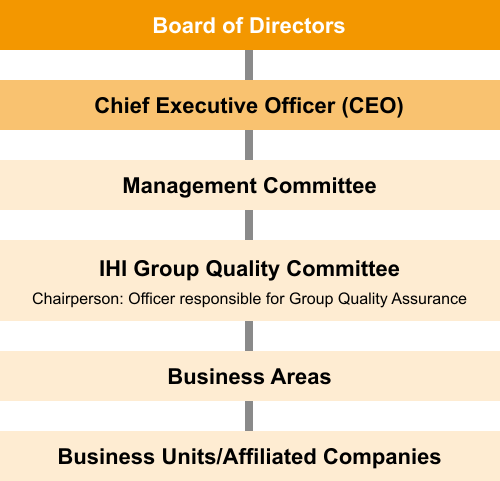
The IHI Group has established the IHI Group Quality Committee as a Group-wide committee on quality. The Committee confirms that important policies related to quality have been translated into specific initiatives. The Officer responsible for Group Quality Assurance acts as the Committee chairperson. Committee members consist of Presidents of Business Areas, Executives responsible for quality for Business Areas, and Executives of Corporate Divisions. Until fiscal 2025, the Committee met twice a year in principle. From fiscal 2026, the meeting frequency will be increased to four times a year in principle. In fiscal 2025, the Committee met a total of four times, including ad hoc meetings, in light of the status of quality assurance risks. The Committee also deliberates on the quality policy for the next year at the final meeting of the fiscal year.
Quality Improvement Promotion System
IHI Group Quality Committee
Chairperson
Officer responsible for Group Quality Assurance
Members
Presidents of Business Areas, Executives responsible for quality for Business Areas, and Executives of Corporate Divisions
Secretariat
Monozukuri System Transformation Division
Number of meetings convened in FY2025
4 (including ad hoc meetings)
Strategy
Risks
The IHI Group has built a Quality Assurance Framework and has put in place a quality management system (QMS) to ensure quality in order to provide products and services that achieve customer satisfaction, safety, and peace of mind. The Group strives to maintain the QMS in an appropriate state at all times by reviewing it in a timely and appropriate manner in response to changes in customer expectations for products and services and changes in the external environment, including legal requirements.
However, if an unexpected situation were to occur, it could compromise customer safety and undermine public trust and reputation, as well as compensation for damages, which could have a negative impact on the IHI Group’s business performance and financial condition.
Opportunities
Ensuring quality and product safety provides the IHI Group with great opportunities to improve customer satisfaction, strengthen its brand image, and improve market competitiveness.
Also, rigorous approach to the quality management system will enhance the quality assurance capabilities of the entire organization and enable timely and appropriate responses to environmental changes, thereby promoting product innovation. In addition, the IHI Group is advancing initiatives to enhance quality management through the use of AI and digital technologies. Specifically, in certain businesses, past cases accumulated in nonconformity information databases and other sources are referenced, and generative AI is used to support the identification of key considerations and preventive measures for upcoming projects. The resulting insights are utilized as reference information during the design phase, including design reviews.
In another Business Area, efforts are underway to clarify and make more accessible its QMS which has become increasingly complex through years of revisions and additions. By utilizing generative AI, rules and requirements are organized and classified according to business processes, thereby supporting the identification of applicable rules. Through these efforts, an environment is being developed in which personnel can easily access, understand, and apply the relevant rules and requirements.
Risk Management
Quality Assurance Activities
The IHI Group carries out its business activities under obtaining Quality Management System (QMS) certification based on public standards such as ISO 9001 at its sites that provide products and services. QMSs that have been certified may be required to obtain certification other than ISO 9001 due to customer requests, and due to the nature of their business, there may be cases in which they intentionally do not obtain third-party certification.
Of the 61 locations of IHI and its consolidated subsidiary companies in Japan and overseas, 49 locations have acquired the QMS certification for fiscal 2025 (certification attainment rate: 80.3%). The breakdown is 28 of 34 locations in Japan (certification attainment rate: 82.4%) and 21 of 27 locations overseas (certification attainment rate: 77.8%).
To maintain and improve the effectiveness of the QMS, business units themselves verify the implementation status of the QMS in daily operations through internal audits. Rather than merely obtaining third-party certification, Corporate divisions at headquarters also take the lead in reviewing and verifying how QMS processes have been established and operated based on QMS implementation requirements standardized across the IHI Group, thereby promoting continuous improvement.
In line with the IHI Group quality policy and key quality measures and based on annual and medium-term plans of each operating company and business area, the IHI Group sets quantitative quality objectives and target dates according to product characteristics and business operations. Progress toward these objectives is monitored through the operation of the QMS and the objectives are regularly reviewed and revised through internal audits and management reviews. For example, in the Industrial Systems & General-Purpose Machinery Business Area, quality costs associated with addressing defects (an internal management indicator: warranty and service costs) and the ratio of such costs to cost of sales (warranty and service cost ratio) are monitored. These indicators are used for non-mass-produced models, with certain exceptions, to capture the occurrence and impact of quality defects on a monetary basis and to verify the effectiveness of quality improvements. For fiscal 2026, the targets have been set at 944 million yen and a warranty and service cost ratio of 0.52% (cost-of-sales basis). In this business area, the Group aims to achieve a warranty and service cost ratio of less than 0.5% over the medium term.
In addition, in order to make Quality Assurance Activities using QMS more effective, the IHI Group has been continuing activities since 2019 to create a comfortable workplace by solving problems that arise in the workplace.
The Group aims to disseminate outstanding initiatives throughout the entire company by announcing them at Group-wide results reporting meetings.
Ensuring Product Safety
To ensure product safety, the IHI Group has established systems tailored to each stage from design and development through manufacturing and post-delivery response, and operates them systematically. The key systems and processes for ensuring product safety are outlined below.
(1) Risk mitigation during the design and development stage
The IHI Group conducts lifecycle risk assessments during product development and implements design measures to reduce risk as much as possible. The Group then provides residual risk information to its customers.
(2) Quality and safety requirements for suppliers
Under its procurement policies and related rules based on the IHI Group Code of Action, the IHI Group sets standards for its suppliers regarding the quality, performance, reliability, and safety of products and services.
The Group communicates these standards to suppliers through procurement requirements, contract terms, and other means, and deploys these standards and verifies compliance with them in procurement and contracting processes to ensure that the quality standards expected by the Group are continuously met. To ensure quality, it is important to communicate requirements, including applicable laws and regulations, to suppliers appropriately and specifically. Accordingly, the Corporate Divisions conduct reviews to confirm that each Business Area fully understands and appropriately cascades requirements to suppliers.
(3) Prevention of nonconformities and their release in each process
Based on its Quality Management System, the IHI Group conducts activities to verify the quality of outputs, including design drawings, products, and records, throughout each process from design and development to procurement, manufacturing, inspection, and shipment (delivery), according to product characteristics and business operations. Through these activities, the Group works to prevent the occurrence of nonconformities (conditions that fail to satisfy customer requirements, laws and regulations, standards, or internal rules) and their release to subsequent processes or external parties. If a nonconformity is detected, the Group identifies and segregates it to prevent unintended use or delivery. The Group then takes measures depending on the nature and impact of the nonconformity, including correction, repair, disposal, suspension of shipment, notification to customers, and acceptance under concession with customer approval, where necessary. The Group also takes corrective actions (to prevent recurrence).
Key initiatives at each stage are as follows:
Design stage: Reviewing and verifying design outputs (design reviews) to ensure conformity with requirements and prevent the occurrence of nonconformities.
Procurement stage: Promoting Group-wide efforts to directly verify supplier understanding of and compliance with critical requirements such as legal and regulatory requirements, rather than relying solely on suppliers, to prevent the occurrence and escape of nonconformities.
Manufacturing and production stage: Conducting quality verification at each stage of manufacturing, production, inspection, and testing and, if a nonconformity is detected, identifying and segregating it and taking prescribed measures to prevent its escape.
Final verification stage: Conducting final quality verification prior to delivery and, if a nonconformity is detected, identifying and segregating it and taking measures, including suspension of shipment, to prevent its escape.
(4) Customer Complaint Handling Process
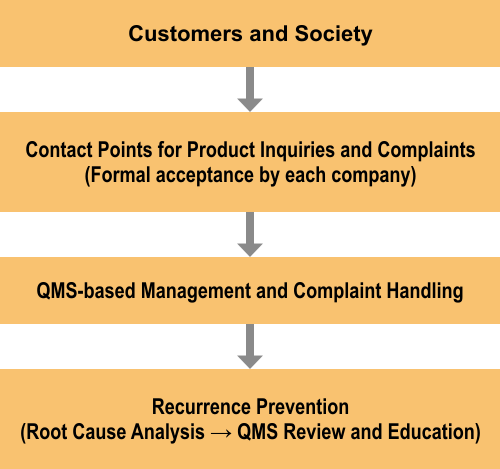
If an incident (nonconformity) occurs in which a product provided to a customer does not meet the requirements of the customer or society, including issues related to product safety, each organization provides contact points for product inquiries through which customers can submit complaints and request resolution. In addition to general inquiries, these contact points formally accept complaints and concerns regarding products, and the nonconformity is handled in accordance with the procedures defined in each organization’s QMS. Information received through these contact points is also addressed in coordination with relevant divisions and appropriately handled, including notifying customers upon receipt (acknowledgment of receipt). Where necessary, customers are informed of response policies and expected response timeframes. Certain businesses have developed response systems through service sites and other locations, enabling customer inquiries and requests to be addressed in coordination with relevant divisions.
(5) Recurrence prevention and incorporation into management systems
To prevent the recurrence of previous nonconformities, the Group conducts a thorough investigation of the problem, which may include issues with systems and procedures, their management and operation, competence management, education and quality awareness. Based on the investigation results, the Group reviews the Quality Management System (QMS) that encompasses these elements and conducts the necessary education and training, thereby leading to more reliable recurrence prevention.
Customer Complaint Response Process (Overview)
This diagram illustrates the common approach and framework for customer complaint handling across the IHI Group. Specific operating methods and procedures may vary across companies and organizations.
(6) Response to significant quality issues and information disclosure
When quality issues or instances of quality misconduct are identified, the IHI Group conducts root cause analysis and implements corrective and recurrence prevention measures, managing such matters within its quality management and crisis management frameworks.
The Group also makes appropriate external disclosures regarding significant quality issues or quality misconduct, taking into consideration laws, regulations, and potential social impact.
Customer Satisfaction Surveys
The IHI Group offers a broad range of products and services. Therefore, customer satisfaction surveys are tailored to the unique needs of each business. The content and methods of these surveys also vary depending on the characteristics of each business. The results of these surveys, including website inquiries, are analyzed and shared with related divisions and are reflected in product and service design processes and other relevant activities, thereby contributing to quality improvement.
Initiatives at IHI Rotating Machinery Engineering Co., Ltd.
IHI Rotating Machinery Engineering Co., Ltd. (IRM), a comprehensive engineering company specializing in rotating machinery, operates an integrated business covering product development, manufacturing, sales, and maintenance, providing products and services to a wide range of customers both in Japan and overseas. To deliver services that earn the trust of its customers, IRM conducts customer satisfaction surveys tailored to the characteristics of its products and services.
Among these surveys, the customer satisfaction survey for general-purpose compressors (screw, centrifugal, and reciprocating compressors) for the Japanese market recorded a result of 93.3% in fiscal 2025, based on the combined responses of “satisfied” and “somewhat satisfied.” IRM shares the results of these surveys internally and uses them to assess how well products and services meet customers’ needs and expectations. IRM also continuously improves quality and enhances customer satisfaction.
Results of the Customer Satisfaction Survey for General-Purpose Compressors for the Japanese Market
Metric
FY2022
FY2023
FY2024
FY2025
Percentage of customers who responded “satisfied” or “somewhat satisfied”
87.5%
87.9%
87.9%
93.3%
The percentage of customers who responded “satisfied” or “somewhat satisfied” is calculated as the number of customers who selected either response (numerator) divided by the total number of customers who responded to the survey (denominator).
Metrics and Targets
Number of Law Violations
Item
Scope
Unit
FY2022
FY2023
FY2024
FY2025
Laws/regulations relating to PR activities
IHI and consolidated subsidiaries
Incidents
0
0
0
0
Quality-Related Training Participants
Item
Scope
Unit
FY2022
FY2023
FY2024
FY2025
IHI Group Quality Declaration
IHI and affiliated companies in Japan
Persons
262
384
852
1,012
Quality Compliance Training Based on Case Studies*
IHI and affiliated companies in Japan
Persons
―
―
―
2,600
Quality Assurance Training for Officers
IHI and affiliated companies in Japan
Persons
―
―
―
196
Limited to the Quality Assurance Division until FY2023
Initiatives
Employee Education and Awareness Building
The IHI Group provides education and training, etc. tailored to each employee’s career and job position, with the aim of raising employee awareness of the importance of product and service quality and safety.
Training is provided for new employees to help them understand the IHI Group Quality Declaration.
In fiscal 2025, the Group introduced a new case study-based education program on quality and compliance using past quality incidents. This program is intended to encourage employees to relate quality to their own work and reflect quality considerations in their daily actions and decision-making, and is being rolled out in stages according to organizational circumstances. The Group also conducts workshops for management to deepen their understanding of the relationship between management and quality assurance, as well as the importance of quality in management decision-making.
Disclosure of Information about Products and Services
The IHI Group provides information about its products and services through various media, such as television commercials and newspaper advertisements, the Group website and social media. Through these channels, the Group communicates information on its products and services to help a broad range of stakeholders deepen their understanding of its business activities. The Group cooperates with all relevant internal departments to provide accurate information in accordance with copyrights and trademark laws and other relevant laws, regulations and industry rules. The effectiveness of these advertisements is evaluated to examine opportunities for areas of improvement.