STEP 1: Identification of Matters
The IHI Group identified sustainability matters relevant to the Group by referring to international sustainability standards and guidelines, including the SASB Standards.

Change
Location
Currently Using The English Site.
Regional HQ’s Websites
Other
In FY2026, the IHI Group revised its material issues. Through this revision, the Group identified the key management issues it should address to realize its desired state for 2040, as set forth in its Medium-to-Longer-Term Direction announced in May 2026: “Supporting the safety, security, and prosperity of people worldwide at its core.”
In revising its material issues, the Group applied a double materiality approach and identified the sustainability matters that are material to the Group from two perspectives: the impact of the IHI Group’s business activities on the environment and society, and the impact of sustainability-related risks and opportunities for the IHI Group’s business activities. Based on these sustainability matters, the Group designated the key management issues the Group should address to realize its desired state in 2040 as its material issues.
| Material issue | Rationale for the selection |
|---|---|
| Realizing a Safe and Secure Society | Amid rapid changes in the global environment and increasing geopolitical complexity, demand for resilient social infrastructure is growing worldwide. Looking toward 2040, the IHI Group will leverage the advanced technological capabilities it has cultivated since its founding to contribute to the economic, national, and energy security of countries around the world across fields such as aerospace, energy, and infrastructure. In doing so, the IHI Group will underpin the safety, security, and prosperity of people worldwide and strive to realize its desired state. |
| Addressing Climate Change | The IHI Group has continuously advanced its climate-related initiatives, recognizing that climate change is a key issue that significantly affects the environment, society, and the economy, and consequently has a major impact on corporate sustainability. The Group positions the provision of social and industrial infrastructure that contributes to climate change mitigation and adaptation as a driver of its sustainable growth. By contributing to the realization of a carbon-neutral society and to adapting to societal changes resulting from climate change, the IHI Group will underpin the safety, security, and prosperity of people worldwide and strive to realize its desired state. |
| Building a Sustainable Value Chain | Collaboration with a wide range of stakeholders is essential for the IHI Group to realize its desired state. Such collaboration will build a sustainable value chain that generates social and environmental value while driving corporate growth. This not only creates new markets that enhance the Group’s competitiveness but also contributes to society by realizing a safe and secure society and addressing climate change. Through these efforts, the IHI Group will continue to create value for society. |
| Creating Innovation | Technology and talent, which lie at the core of the IHI Group’s Management Philosophy, drive value creation aimed at realizing its desired state. Continuous innovation is essential for the IHI Group to achieve sustainable growth. To this end, it is crucial that the Group focuses resources through technology management on key technologies that drive competitive advantage, and builds exceptional technical strength. By strengthening its capability for value creation through innovation, the IHI Group will strive for sustainable growth. |
| Collaboration with Diverse Talent | Technology and talent, which lie at the core of the IHI Group’s Management Philosophy, drive value creation aimed at realizing its desired state. Sustainable growth depends on collaboration among diverse talent. To enable this, the IHI Group must secure the necessary talent and foster a culture that encourages continuous challenge and mutual support. By enabling diverse talent, both within and outside the Group, to collaborate and fully leverage their capabilities, the IHI Group will strive for sustainable growth. |
| Securing and Maintaining Stakeholder Trust | To realize its desired state, the IHI Group must place rigorous compliance at the core of its operations and continue to live up to the trust placed in it by stakeholders. Compliance underpins all business activities and must take precedence over profit and efficiency. Even as the social and business environment grows increasingly complex, the importance of continuing to act with integrity as a company remains unchanged. The IHI Group will work to secure and maintain stakeholder trust by ensuring rigorous compliance, continuously strengthening risk management and governance, and fostering an organizational culture in which every individual can choose the right course of action. |
The IHI Group identified sustainability matters relevant to the Group by referring to international sustainability standards and guidelines, including the SASB Standards.
The IHI Group identified Group-wide impacts, risks, and opportunities associated with the sustainability matters identified in STEP 1 and assessed the significance of each item by having relevant internal divisions score them. The assessment was conducted from two perspectives: the impact of the Group’s business activities on the environment and society (external impact assessment), and the impact of sustainability-related risks and opportunities on the Group’s business activities (financial impact assessment). The assessment time horizons were defined as one year for the short term, three years for the medium term, and fifteen years for the long term.
Based on the results, the Group identified sustainability matters exceeding the thresholds under both perspectives. These material sustainability matters were then used to determine the Group’s material issues as the key management issues it should address to realize its desired state in 2040 set out in its Medium-to-Longer-Term Direction.
The IHI Group conducted a dialogue with external experts on February 12, 2026, to objectively confirm the appropriateness of the materiality assessment. Details of the dialogue are as follows:
Dialogue Topics
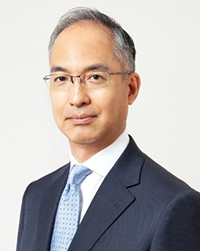
Hiroki Sampei
Founder & Principal, Astonering Advisor LLC
It is worthwhile that the IHI Group has identified material issues in light of the direction it aims to pursue. The Group should ensure that it clearly communicates to external stakeholders not only what it intends to do but also why it is pursuing those initiatives, in order to enhance the persuasiveness of its communication.
For example, when explaining the rationale behind its material issues, the Group could clarify why each issue is important by referring to the IHI Group's Management Philosophy as well as the interrelationships among the material issues. This would make the definitions and positioning of each material issue easier to understand.
Furthermore, the vision of positioning national security as a strategic priority is commendable. However, explaining the Group’s recognition of, and approach to addressing, the risks of fragmentation associated with realizing that vision – such as geopolitical fragmentation and social division – would further strengthen information users’ conviction in the IHI Group’s ability to realize its desired state in 2040.
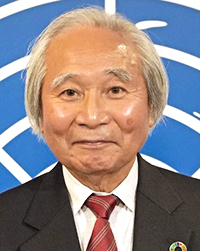
Toshihiko Goto
Director and Special Advisor, Former Representative Director (2003-2025), Sustainability Forum Japan
Executive Director, Global Compact Network Japan
The identification of the material issues is generally appropriate. However, it is desirable for the IHI Group to use terminology aligned with global standards to the extent possible, as clear communication with both internal and external stakeholders is essential for the effective implementation of the Group's business strategies based on these material issues. For example, the term "value chain" used in "Building a Sustainable Value Chain" means globally, “The full range of interactions, resources and relationships related to a reporting entity’s business model and the external environment in which it operates.” The IHI activities are essential parts of it. It is necessary to provide clear and careful explanations to stakeholders.
It is also important to note that the significance of sustainability matters such as the circular economy, Al utilization, and human rights, which relate to multiple material issues, appears to have been assessed as relatively low. It would be beneficial for the Group to clearly explain its rationale for the positioning of these matters.
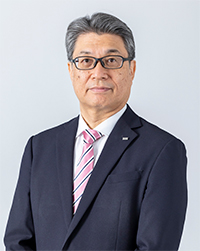
Akihiro Seo
Managing Executive Officer (Officer in charge of Group ESG)
The comments received from the two external experts each raise important issues. While these topics have already been discussed internally, we recognize the need to further deepen our consideration going forward.
For example, regarding the management of risks associated with fragmentation, we recognize this as a highly important issue for the IHI Group and will work to communicate our recognition and response measures more clearly in future disclosures. In addition, “Building a Sustainable Value Chain,” one of our material issues, is intended not only to appropriately manage risks and social and environmental impacts in the IHI Group’s value chain, but also to create new markets, generate new demand, and expand our business broadly—from manufacturing through product use—thereby achieving both the provision of social and environmental value and corporate growth. We will continue to explain this concept clearly in future disclosures.
It should also be noted that sustainability matters such as the circular economy, AI utilization, and human rights, which have cross-cutting impacts across multiple material issues, are embedded within the Group’s six material issues. As the Group advances initiatives related to these six material issues, its efforts to address these cross-cutting issues will also progress in parallel. Taking these points into account, we will strive to communicate more clearly in future disclosures why each material issue is important to the Group and how the issues are interrelated.
The IHI Group finalized its updated material issues based on the outcomes of the dialogue with external experts, following deliberation and approval by the directors.
The IHI Group is currently developing KPIs linked to the revised material issues. The departments responsible for each material issue will regularly monitor and evaluate the progress and refine initiatives as needed to implement appropriate PDCA management for the material issues.