
Development and On-Board Demonstration of Marine Ammonia Engine
The world's first commercial ammonia-fueled ship enters service
IHI Power Systems Co., Ltd.

IHI Power Systems Co., Ltd. has developed an ammonia-fueled reciprocating engine that reduces greenhouse gas (GHG) emissions by over 90%. As a result, IHI Power Systems achieved the International Maritime Organization’s GHG reduction target by 2040. Furthermore, the tugboat with the ammonia engine installed demonstrated the ability to operate safely and stably using ammonia as a fuel.
Introduction
IHI Power Systems Co., Ltd. (IPS) is developing and manufacturing four-stroke reciprocating engines that use ammonia as a fuel. Ammonia fuel emits no carbon dioxide (CO₂) during combustion and has a higher calorific value per unit volume compared to hydrogen. For this reason, ammonia has a greater potential of using as an alternative fuel, which can reduce greenhouse gas (GHG) emissions in the marine industry. Specifically, it is mentioned as an effective fuel for achieving the GHG reduction targets set by the International Maritime Organization (IMO): reducing GHG emissions by at least 70% by 2040 compared to 2008 levels and achieving net-zero GHG emissions by around 2050. The IHI Group is focusing on achieving carbon neutrality throughout the entire ammonia value chain, from production and storage to transportation and utilization. IPS is focusing on the use of ammonia within the shipping industry as part of this value chain. Also, IPS participates in a consortium, developing vessels equipped with domestically produced ammonia-fueled engines under the Green Innovation (GI) Fund of the New Energy and Industrial Technology Development Organization (NEDO). IPS is developing a propulsion engine for an ammonia-fueled tugboat, scheduled to enter service in 2024, and a power generation engine for an ammonia-fueled ammonia gas carrier, scheduled to enter service in 2026.
Combustion characteristics and ignition method of ammonia fuel
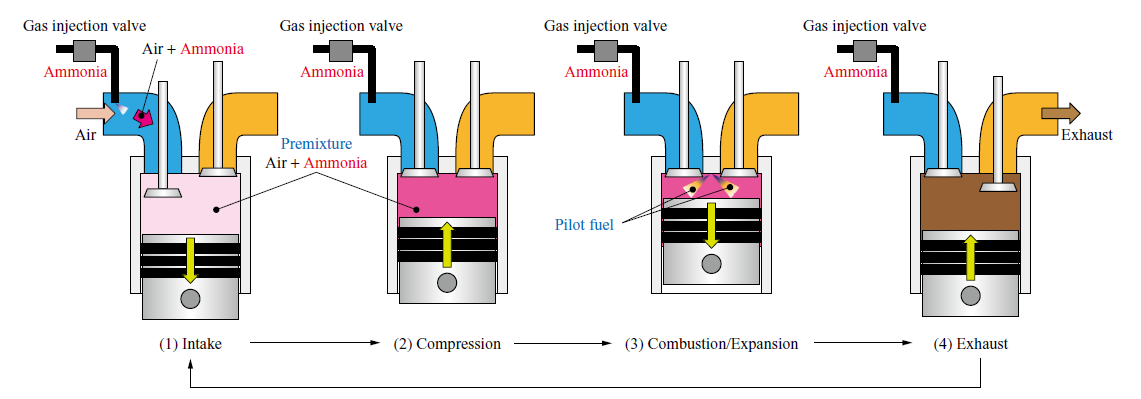
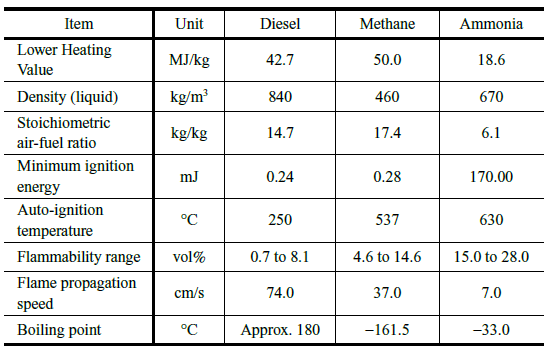
To use ammonia as a fuel for a reciprocating engine, the ignition and combustion conditions within the combustion chamber must be appropriately adjusted for stable combustion of ammonia. Ammonia has a property of slower combustion speed and a higher minimum ignition energy compared to diesel fuel and methane, which poses significant challenges for its use in reciprocating engines. Ammonia’s high auto-ignition temperature makes it difficult to ignite, but on the other hand, it has a higher knocking resistance. Therefore, the pilot fuel method, which is the same as the LNG dual fuel engine, was adopted to realize a stable combustion. The concept is to achieve combustion in a short period of time by injecting a small amount of diesel fuel into the combustion chamber to ignite the ammonia premixture supplied from the intake manifold.
Development goals
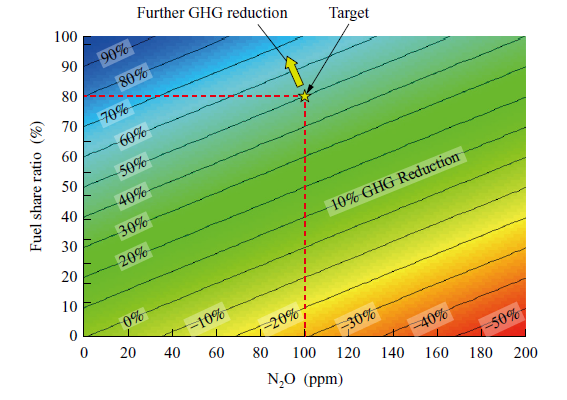
Using ammonia fuel can achieve GHG reduction specified by IMO. However, this requires reducing the consumption of liquid fuels (pilot fuels) which emit CO₂, and lowering emissions of nitrous oxide (N2O) from ammonia combustion, which has a significant greenhouse effect.
The higher the fuel share ratio (the heat value ratio between ammonia fuel and diesel fuel) is, the higher the GHG reduction can be achieved. However, N2O emissions from ammonia fuel combustion reduce the overall GHG reduction effect. N2O has a greenhouse effect 265 times greater than CO₂, thus even small amount of N2O emission will significantly reduce the GHG reduction. In this development, the GHG reduction target was set at 50%, with a fuel share ratio of at least 80% and N2O emissions of 100 ppm or less.
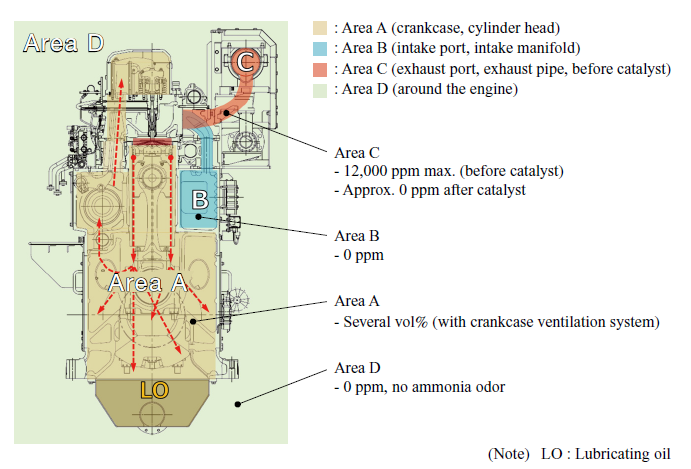
Even a small amount of ammonia is toxic to the human body. Humans can detect the odor at concentrations of 5 to 53 ppm. The exposure limit set by the Japan Society for Occupational Health is 25 ppm. Therefore, the ammonia concentrations around the engine where people may enter, such as engine rooms, must be kept below 25 ppm. The exposure limit is the concentration at which no health effects are expected to occur in workers. Ammonia fuel is supplied to the engine using double-walled piping to prevent leakage from piping joints, as in conventional gas engines. Ammonia gas supplied to the engine in pre-mixture condition is combusted then exhausted. However, some of the supplied ammonia pre-mixture flows into the crankcase through the gap in the piston ring as a blow-by gas. The crankcase is connected to the cylinder head via the cam case and valve train, and due to the pressure difference from the engine room, a small amount of ammonia gas may leak out of the engine while the engine is in operation. Therefore, an oil mist separator (ventilation system) equipped with an exhaust fan is installed to constantly maintain negative pressure inside the crankcase, and to prevent ammonia gas from leaking out of the engine into the engine room (surrounding area).
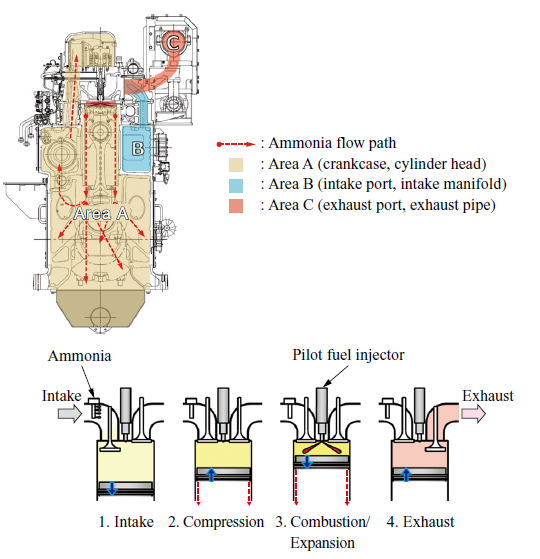
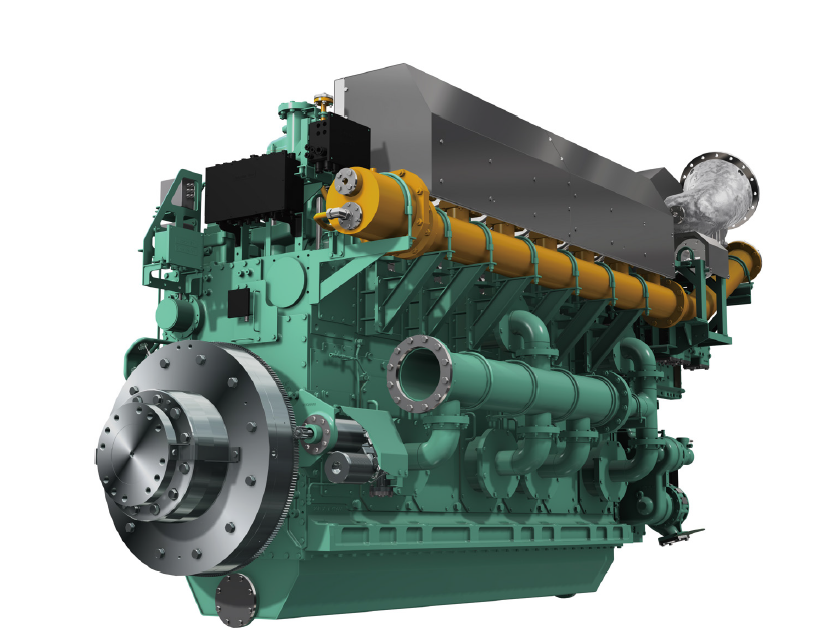
A modification to 6-cylinder LNG dual fuel engine (6L28AHX-DF) was carried out to meet the requirements for ammonia-fueled engine. The detailed design modifications included such as increasing the geometric compression ratio, optimizing the intake and exhaust systems, enlarging the fuel gas supply system, and enhancing the pilot fuel supply system.
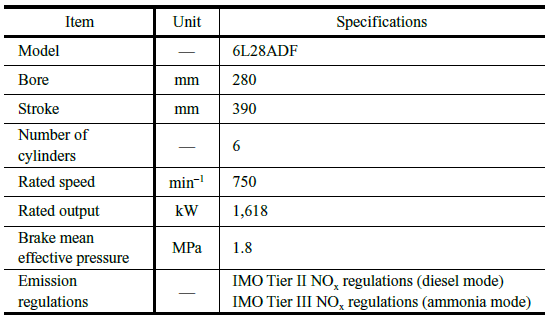
Engine test results
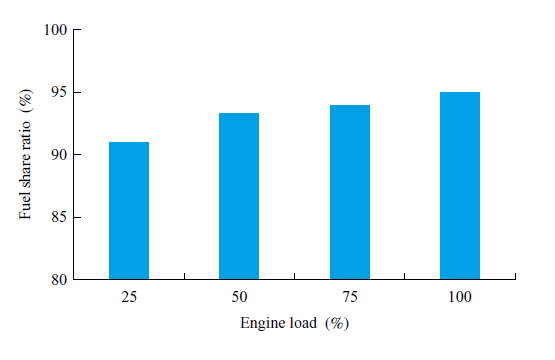
The fuel share ratio of over 95% was achieved during ammonia-fueled operation (ammonia mode) in the test cycle for marine engines (E3 mode). A certain amount of pilot fuel is required to ignite the ammonia gas, therefore the fuel share ratio declines as engine output decreases.
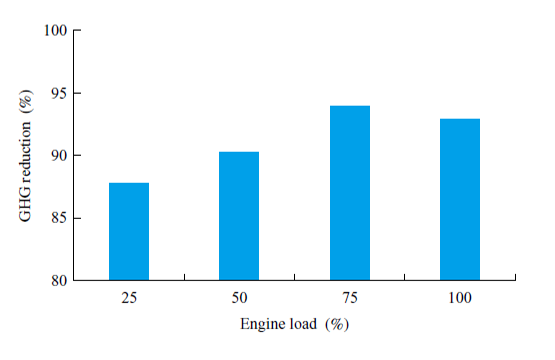
Even considering N2O emissions from ammonia combustion, GHG reduction of over 90% have been achieved, demonstrating that the IMO’s 2040 target can be fully realized. The 6L28ADF engine complies IMO Tier III NOx (nitrogen oxides) emission regulations in ammonia mode and is the first in the world to receive type approval for an ammonia-fueled engine from ClassNK.
Ammonia gas and odor around the engine
Ammonia concentrations in various areas during ammonia mode were evaluated. While ammonia concentrations in the crankcase reached up to several vol% due to blow-by gas, the engine surroundings (e.g., engine room) were measured at 0 ppm, and no ammonia odor was detected. This indicates that the crankcase ventilation system is effective for maintaining safety when using ammonia as a fuel.
Field demonstration voyage
In January 2024, two ammonia-fueled engines were delivered to a shipyard and installed in a tugboat. Sakigake, an existing LNG-fueled tugboat, was modified to accommodate the ammonia-fueled engines and ammonia fuel system. The ammonia-fueled tugboat was delivered to the shipowner on August 23, 2024, becoming the world’s first commercial ammonia-fueled vessel.
After completion, the world’s first demonstration voyage and analysis during actual operation was conducted, achieving a GHG reduction of approximately 95% compared to heavy fuel oil. Field demonstration voyages are ongoing, and the knowledge gained will be fed back to the development of the next power generation engines.
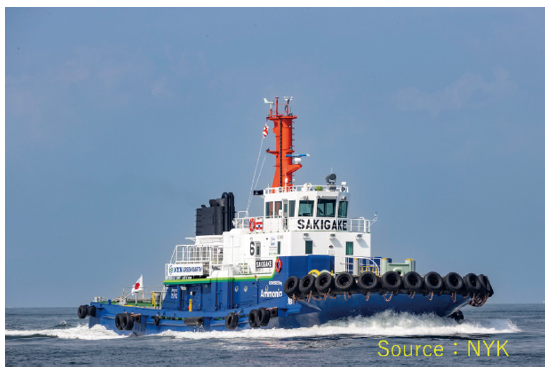
(Courtesy of Nippon Yusen Kabushiki Kaisha)
Achievements and prospects of ammonia-fueled engine development
IPS has developed the world’s first marine ammonia engine to address GHG reduction needs in the maritime cluster. The following are the results achieved from this development:
- The marine ammonia engine (6L28ADF) obtained type approval from ClassNK and met IMO Tier III NOx regulations in ammonia mode.
- The maximum fuel share ratio for ammonia fuel is over 95%, realizing GHG reduction of over 90%. This fulfils the IMO’s 2040 GHG reduction target of over 70%.
- Successful on-board demonstration voyage was conducted on the world’s first commercial ammonia-fueled vessel.
In the future, we will address technical challenges identified during the demonstration operation of engines installed in the ammonia-fueled tugboat, while integrating the knowledge gained to the development of ammonia gas carrier. Through this development, IPS will pave the way to carbon neutrality by 2050, reduce GHG emissions in the marine industry, and enhance the international competitiveness of Japan’s maritime cluster.