
Unmanned Vehicle for Understanding and Protecting the Ocean
Deep-sea autonomous underwater vehicle (AUV) for unmanned deep-sea surveys
IHI Corporation
In recent years, deep-sea autonomous underwater vehicles (AUVs) have attracted attention as a technology with great potential to reduce the manpower required for marine resource utilization. This article provides an overview of the deep-sea AUV designed and manufactured by IHI and used for the Japan Coast Guard’s marine survey missions.
Introduction
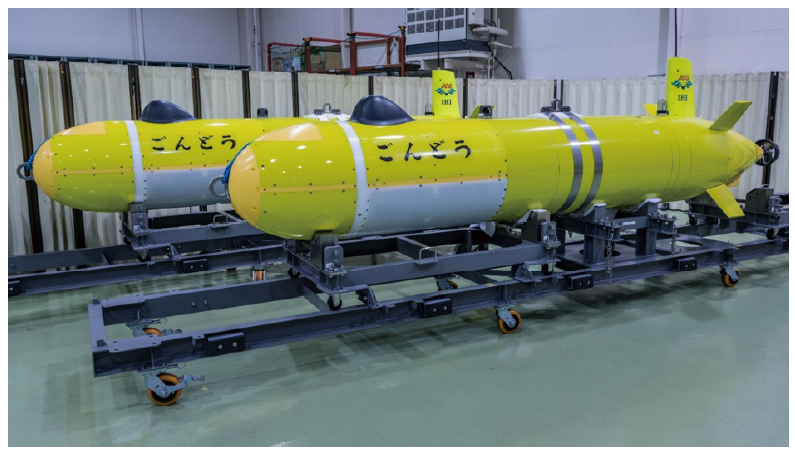
According to the Basic Act on Ocean Policy and the Basic Plan on Ocean Policy, the Japan Coast Guard is responsible for collecting and organizing fundamental information, such as seafloor topography, which is necessary for safeguarding Japan’s maritime rights and interests and for the comprehensive management of the oceans within Japan’s jurisdictional waters. The agency has operated survey vessels to collect information, including seafloor topography. As the need arose to collect more precise information about the seafloor, the agency introduced the AUV “Gondou” and began operating it. IHI delivered two units in 2018, which were installed on the survey vessel “Heiyo” commissioned in 2020 and are currently in operation. This article outlines the AUV, for which IHI has provided operational support to the Japan Coast Guard since its delivery.
Deep-sea autonomous underwater vehicle (AUV)
The AUV is approximately 4.8 m long, weighs about 900 kg in the air, and has a cruising speed of approximately 3 knots (about 5.6 km/h). It is designed to withstand water pressure at depths exceeding 1,000 m. It has a built-in rechargeable battery that enables repeated use and provides over 12 hours of operating time when fully charged. It is equipped with acoustic observation instruments for investigating seafloor topography, including: (1) a multi-beam echo sounder to measure seafloor depth; (2) a side-scan sonar to measure the undulations and properties of the seafloor; and (3) a sub-bottom profiler to gather information from beneath the seafloor. It is also equipped with measuring instruments such as a depth meter and a CTD sensor, which measures electrical conductivity, water temperature, and pressure (depth), enabling the measurement of seawater properties.
Autonomous navigation for seafloor surveys
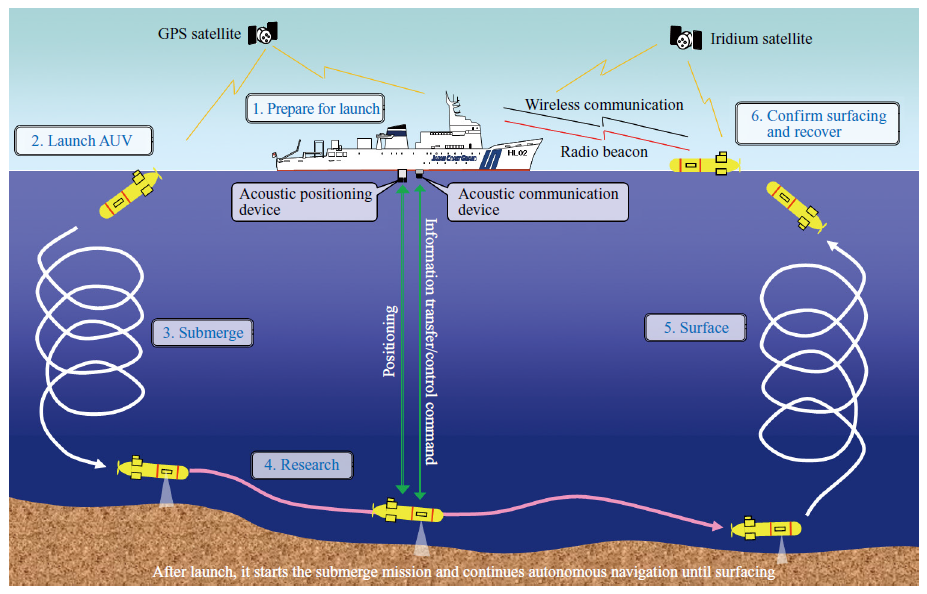
After being launched from a survey vessel (mother ship) serving as a base station, AUVs submerge and navigate along a survey line connecting preset waypoints across an observation range of several by several kilometers. AUVs autonomously navigate, avoid obstacles, and control their attitude while conducting surveys using an inertial navigation system, a ground speed indicator, and a forward-looking sonar. Seafloor surveys conducted by mother ships exhibit reduced data resolution as water depth increases. However, AUVs can dive close to the seafloor and acquire more precise, higher-resolution data. AUVs can precisely adjust their altitude, horizontal position, and attitude using motion control based on a motion model, enabling more stable seafloor surveys. The AUV and the mother ship communicate via satellite or radio communication while on the surface, and via acoustic communication while submerged. The mother ship can monitor the AUV’s position and navigation status and issue commands to the AUV.
In addition, the AUV is equipped with functions to reduce the risk of loss. For instance, if it encounters a situation that makes it difficult to execute the mission during navigation, such as a power loss, it will recognize the situation as abnormal and perform an emergency surfacing.
(Courtesy of the Hydrographic and Oceanographic Department, Japan Coast Guard)
Conclusion
The IHI Group will continue to support the Japan Coast Guard’s operations in safeguarding Japan’s maritime rights and interests. In recent years, the domestic production and industrialization of AUVs has attracted attention and anticipation as a high-value technology, not only for the seafloor surveys introduced in this article, but also for the unmanned maintenance and inspection of marine facilities such as offshore wind power generation equipment. The “AUV Strategy” specified in the Fourth Basic Plan on Ocean Policy was discussed by members of the public and private sectors, relevant organizations, and official bodies, including the IHI Group, and it was adopted at the 21st meeting of the Headquarters for Ocean Policy under the Cabinet Office in December 2023. In response to these national policies and domestic and international market needs, the IHI Group will continue to research and develop AUV-related technologies and enhance its technological capabilities to provide products applicable to the marine industry, security, and other fields.