
Enhancing Expressway Safety with 3D Laser Radar and AI
Detection and warning of wrong-way driving and mistaken entries at expressway entrances and exits
IHI Corporation
On expressways, wrong-way driving and the mistaken entries of pedestrians and cyclists pose major safety challenges. IHI has combined its accumulated sensing technologies with AI-based shape matching to develop a system that accurately detects and warns of wrong-way driving and mistaken entries.
Current situation surrounding road traffic
Improvements in road infrastructure and automobile safety technologies have led to a continued decline in the number of traffic accidents and fatalities in Japan over the past 20 years. However, the environment surrounding road traffic continues to diversify and grow increasingly complex, encompassing road traffic laws and regulations, driver and pedestrian backgrounds, automotive safety technologies, and autonomous driving technologies.
Particularly at expressway entrances and exits, wrong-way driving, that is, vehicles entering the expressway from the exit lane, and mistaken entry by bicycles and pedestrians, which are prohibited from using the expressway, are major issues. On expressways, it is necessary to prevent these incidents and, if they do occur, to detect and promptly report them.
IHI has applied its sensing technologies cultivated through the development of three-dimensional laser radar (3DLR) used in the level crossing obstacle detection system to address this issue.
What is 3DLR ?
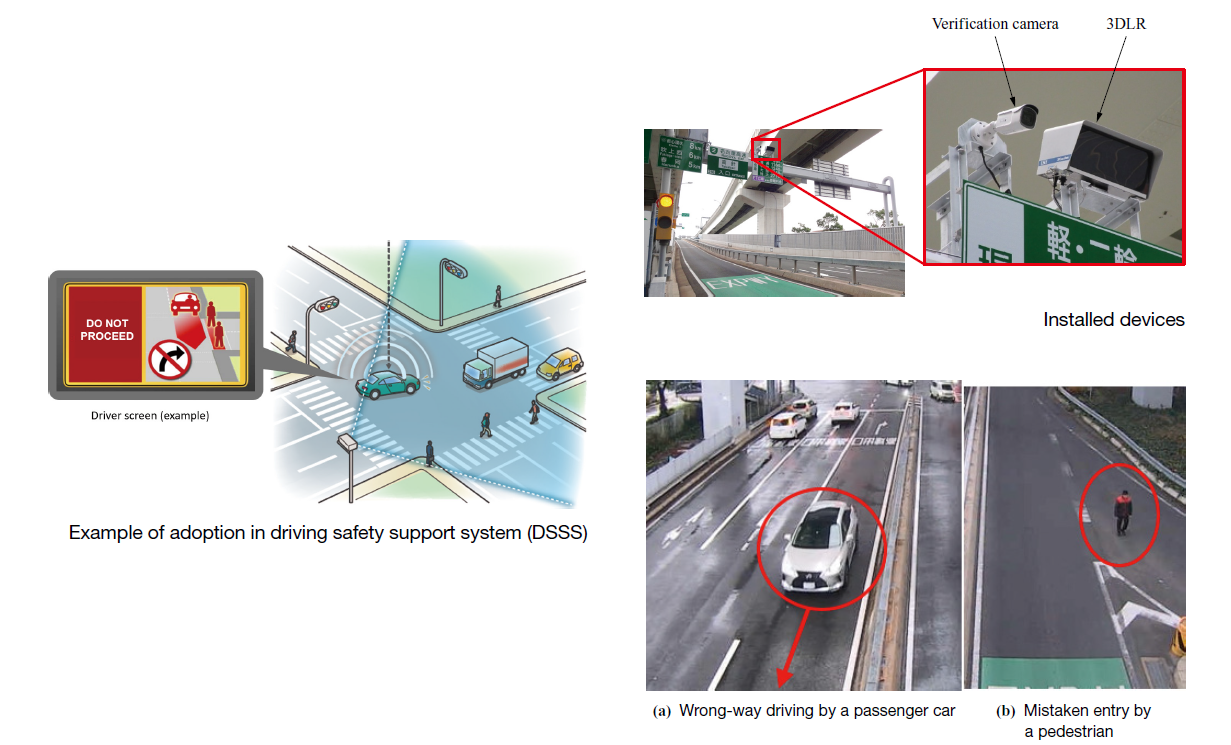
3DLR is a device of light detection and ranging (LiDAR) technologies that IHI has been developing since the 1990s. By using a LiDAR device, it is possible to measure the distance to an object by emitting a laser pulse and measuring the time it takes for the pulse to be reflected by the object and return. Compared to image-processing sensors, LiDAR has the advantage of maintaining its performance even at night. 3DLR enables three-dimensional measurement of objects by scanning them with laser pulses. Currently, it is adopted as a railroad crossing obstacle detection device both in Japan and overseas, with approximately 3,200 units sold to date.
It is also adopted in intelligent transport systems (ITS) as a roadside sensor installed on poles along the road. It detects and transmits various information such as the type, position, speed, and direction of travel of objects on the road or sidewalk.
In recent years, IHI has participated in autonomous driving demonstration tests conducted by government agencies, research institutions, and companies in Japan. IHI provides various types of LiDAR devices, including 3DLR, as roadside sensors to detect objects in areas that autonomous vehicles cannot recognize and to support their driving.
Challenges in expressway traffic safety
Wrong-way driving and mistaken entries on expressways can lead to serious traffic accidents. If such incidents can be detected quickly and warnings can be issued promptly, it can help prevent accidents and reduce the damage they may cause.
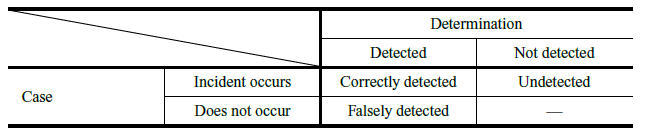
Nagoya Expressway Public Corporation has experience conducting experiments to detect wrong-way driving and mistaken entries using image-processing sensors. However, there were problems: frequent false detections, in which the sensor indicated an incident had occurred even though none actually had, and reduced detection accuracy at night.
Application to expressways
To address this issue, IHI received a proposal for joint research applying sensing technology using 3DLR. Starting in FY2022, we began tests to verify whether it is possible to detect incidents with high accuracy and to display warnings in a way that is easy for anyone to understand.
For the verification test site, we selected expressway entrances and exits where the frequency of wrong-way driving and mistaken entries has been high in recent years and where the road structure makes it easy to install sensors and conduct verification. We then proceeded with the development of logic and systems using 3DLR.
Detect wrong-way driving with high accuracy
Verification tests revealed that a high frequency of false detections occurred during traffic congestion. Conventional logic estimates an object’s position from the shape of the point cloud generated by infrared pulses reflected from the object. Then, it determines the object’s direction of travel based on how its position changes over time. However, in congested traffic, the sensor’s field of view can be obstructed by objects in front of it, making it difficult to accurately determine the object’s position from the point cloud shape. This resulted in incorrect detection of the direction of travel.
To address this issue, we developed logic that more accurately estimates the position and changes in position of objects from point cloud shapes. Through verification based on test data and test operations, we confirmed that it achieved detection accuracy sufficient for practical use.
Incidentally, no “undetected” occurred with the conventional logic, and this remained true after the development of the logic for eliminating false detections mentioned above.
Improving classification accuracy in mistaken entry detection
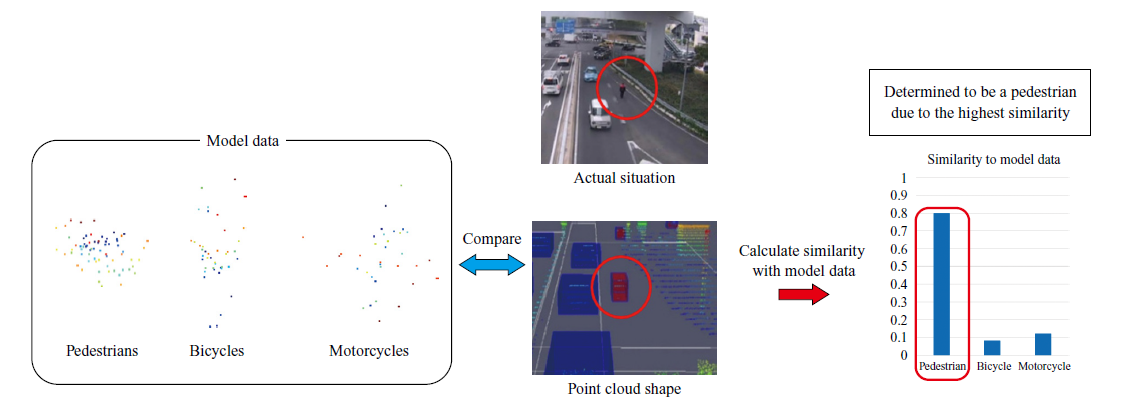
Accurate object classification was a challenge in mistaken entry detection. Conventional detection logic distinguished among passenger cars, large vehicles, motorcycles, bicycles, and pedestrians primarily based on object size, but its accuracy was insufficient.
Therefore, we added logic to estimate the object type using AI-based shape matching. In this logic, sets of point cloud shapes of passing objects, which are measured by the 3DLR already installed and operating on public roads, and object types, which are visually confirmed via camera footage, are input into the AI as training data to create model data. Then, the point cloud shapes of the target object measured by 3DLR are compared with the model data, and the object type is estimated based on a combination of similarity and information such as size and speed. Based on test data and verification through test operations, we confirmed that applying this logic provides accuracy sufficient for practical use.
Realization of warning and notification functions
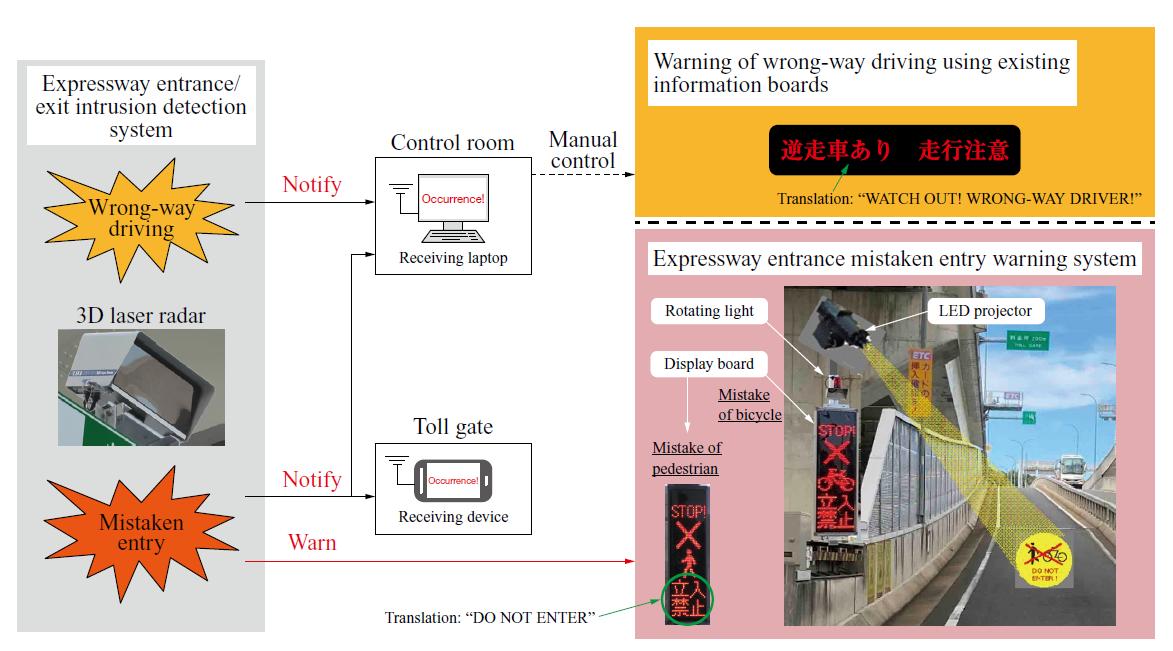
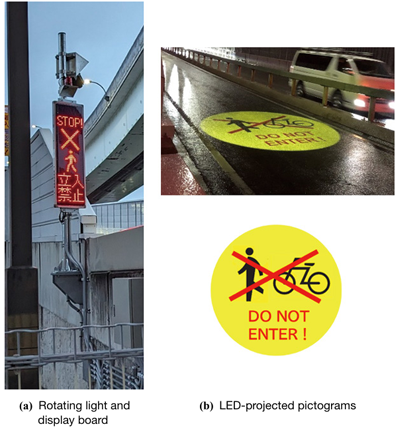
In response to an increase in mistaken entries by drivers and pedestrians who may have difficulty understanding Japanese warnings, such as foreign residents and inbound tourists, we examined methods of displaying warnings that are easy for anyone to understand. As a result, we adopted a method that simultaneously activates rotating lights, displays pictograms on display boards, and projects pictograms onto the road surface using an LED projector.
In particular, the use of LED projectors for warnings is a first for Nagoya Expressway Public Corporation, and it is expected to make it easier for individuals who have mistakenly entered the expressway to notice and understand the warning.
Furthermore, to prevent wrong-way driving and mistaken entries onto the main through lanes of the expressway and to communicate information to vehicles traveling on the main through lanes, it is necessary to notify the road administrator’s control room and toll gate of such occurrences. Therefore, we implemented a function that continuously transmits information on wrong-way driving and mistaken entries, as well as the system’s operational status, via a 4G network. In the event of such incidents, or system malfunctions, notifications will be provided by on-screen displays and voice alerts.
Achievements and future improvement plans
As a result of this development and verification, we confirmed that the system has achieved detection accuracy sufficient for practical use in detecting wrong-way driving and mistaken entries at expressway entrances and exits.
We plan to deploy this system to other entrances and exits in the future. We will continue to develop the system, as additional features or adjustments may be required depending on the road layout and surrounding environment at each entrance and exit.
We are also continuing logic development and verification testing, with an eye toward adding a function to determine whether entering motorcycles fall within the categories permitted to use the expressway.
Toward further adoption
In addition to wrong-way driving and mistaken entries at entrances and exits, hazardous incidents also frequently occur on main lanes, at merging sections, in construction zones, and in various other locations. Particularly in high-risk situations such as complex road layouts, numerous sharp curves with poor visibility, or short acceleration lanes, roadside sensors are expected to improve traffic safety by detecting hazardous events and issuing warnings or notifications to passing vehicles and road administrators.
IHI will further develop and enhance the expertise and know-how it has cultivated in LiDAR-based sensing technologies for objects and hazardous incidents to effectively achieve road safety in a wide variety of situations and address the challenges and needs of a new mobility society.