
Improving Work Efficiency and Productivity Using Line Simulation
Optimization of construction period and staffing through virtual site modeling for bridge deck slab replacement
IHI Corporation
Line simulation is a tool to estimate work progress, flow of goods, and people’s movement on manufacturing lines, in logistics warehouses, and at on-site work. This tool contributes to a reduction in lead times and costs by evaluating the efficiency and productivity of the entire process. The application of line simulation to bridge deck slab replacement projects has established an environment that enables shorter quotation time and supports cost reduction through optimized construction planning.
Introduction
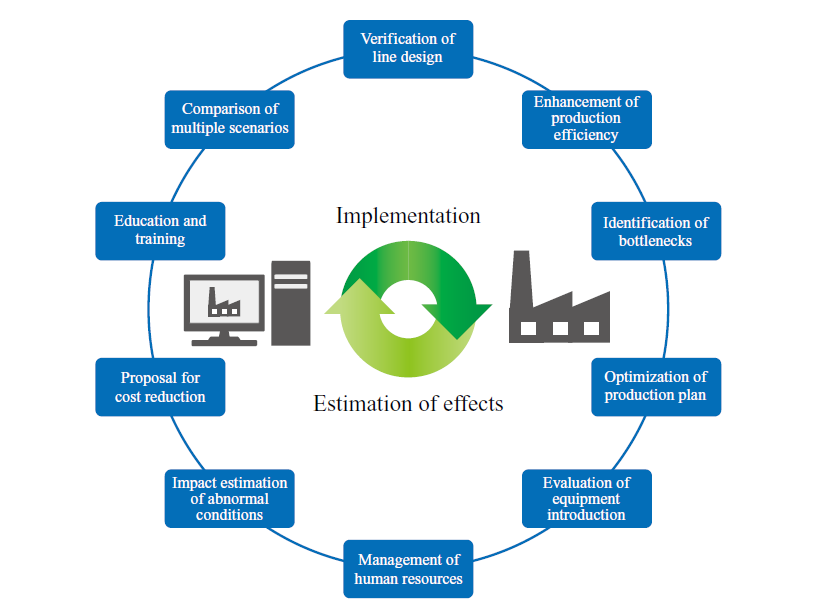
Line simulation is a tool that digitally reproduces work processes on manufacturing lines, in logistics warehouses, and construction sites to help find the optimal workflow and staffing. Users input data such as work details, processing time, work sequence and the number of workers, and specify variable factors, including variations in processing time, equipment failures, and constraints such as conflicts regarding people, locations, and equipment. Based on such information, work progress, flow of goods, and people’s movement are estimated and the efficiency and productivity of the entire process are evaluated.
Line simulation can be used to test improvement proposals such as increasing production volume or reducing lead times to reduce trial and error in the real world for quick selection and implementation. It also allows for the provision of products and services with shorter lead times at reasonable prices.
Application to bridge deck slab replacement work
As road bridges constructed during Japan’s rapid economic growth from the 1950s to the 1970s are aging, appropriate maintenance is urgently required. The IHI Group is engaged in replacing the flat parts of bridges (deck slabs) that vehicles and pedestrians pass over and it has developed a quotation support system using line simulation to quickly respond to customer requests.
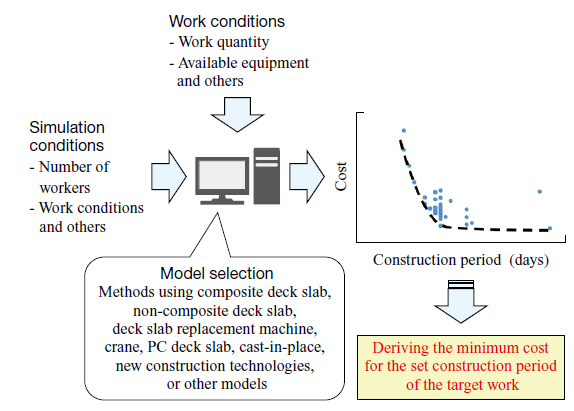
This system simulates deck slab replacement work and constructs a virtual site. Its features are shown below.
- (1)Versatility to adapt to the situation at individual sites
- The details, necessity, and sequence of the tasks for deck slab replacement work differ depending on the equipment to be used, work range, bridge girder type, and other factors. The workflow is reproduced in the virtual site, considering these differences. The system simulates the work after roughly breaking it down into tasks repeated on a daily basis, such as the removal and installation of the deck slab (the upper part of the right figure) and the tasks carried out collectively across the construction area, such as the assembly of reinforcing rods and formwork or concrete placing (the lower part of the right figure).
- (2)Consideration of worker types and staffing levels
- For deck slab replacement work, the necessary workers, the number of workers required for safety, and the number of workers who can work at the same time differ depending on the tasks (work types). Given these conditions, the processing time for each task is adjusted for the virtual site according to the number of assigned workers (the center part of the right figure). In addition, work progress can be simulated more realistically by reassigning workers to tasks, including those engaged in ongoing tasks, each time a task is completed.
- (3)Setting of processing time based on past records
- The man-hours of each task are important when simulating deck slab replacement work at a virtual site. The work quantity and base unit of each task are defined based on the task analysis results and previous work records of past deck slab replacement work. Using such a base unit makes it possible not only to reproduce past work but also to estimate the progress of new work.
Application as a configurator
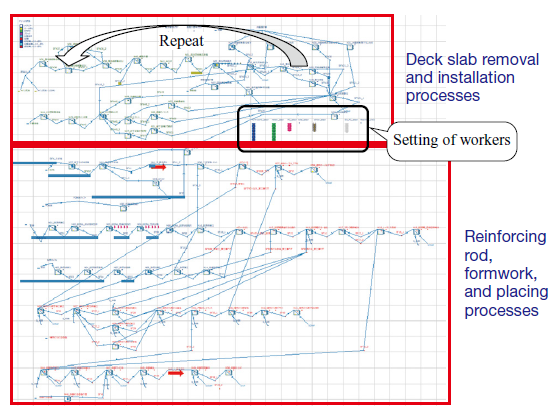
The configurator is a tool to combine products and services based on customer requests. One place this tool is spreading is among car dealerships. In the context of deck slab replacement work, the virtual site constructed through line simulation serves as a configurator, enabling the derivation of the relationship between the number of workers and the construction period by inputting work conditions.
On-site work can be reproduced and the construction period can be estimated in the virtual site by specifying the work quantity and equipment and adjusting the number of workers for each work type. Appropriate staffing can be derived according to the required construction period by aggregating results under different conditions. A work schedule can also be generated using a Gantt chart to create a preliminary work plan. The purpose is to both quickly submit quotations and reduce costs.
Conclusion
A virtual site simulating deck slab replacement work was constructed using line simulation. It offers the prospect of reducing the period required to submit quotations to customers by making advance considerations using this virtual site at the quotation stage.
Although this article introduces the technique when used for line simulation for on-site work, this technique can also be employed to evaluate factory productivity. We will utilize line simulation in various situations, such as selecting the optimal option through comparative evaluation in advance among multiple proposals, to achieve improvements and innovations aimed at reducing the lead time and costs of products and services provided to our customers.