
The Foundation for Value CreationStrengthening Governance and Risk Management
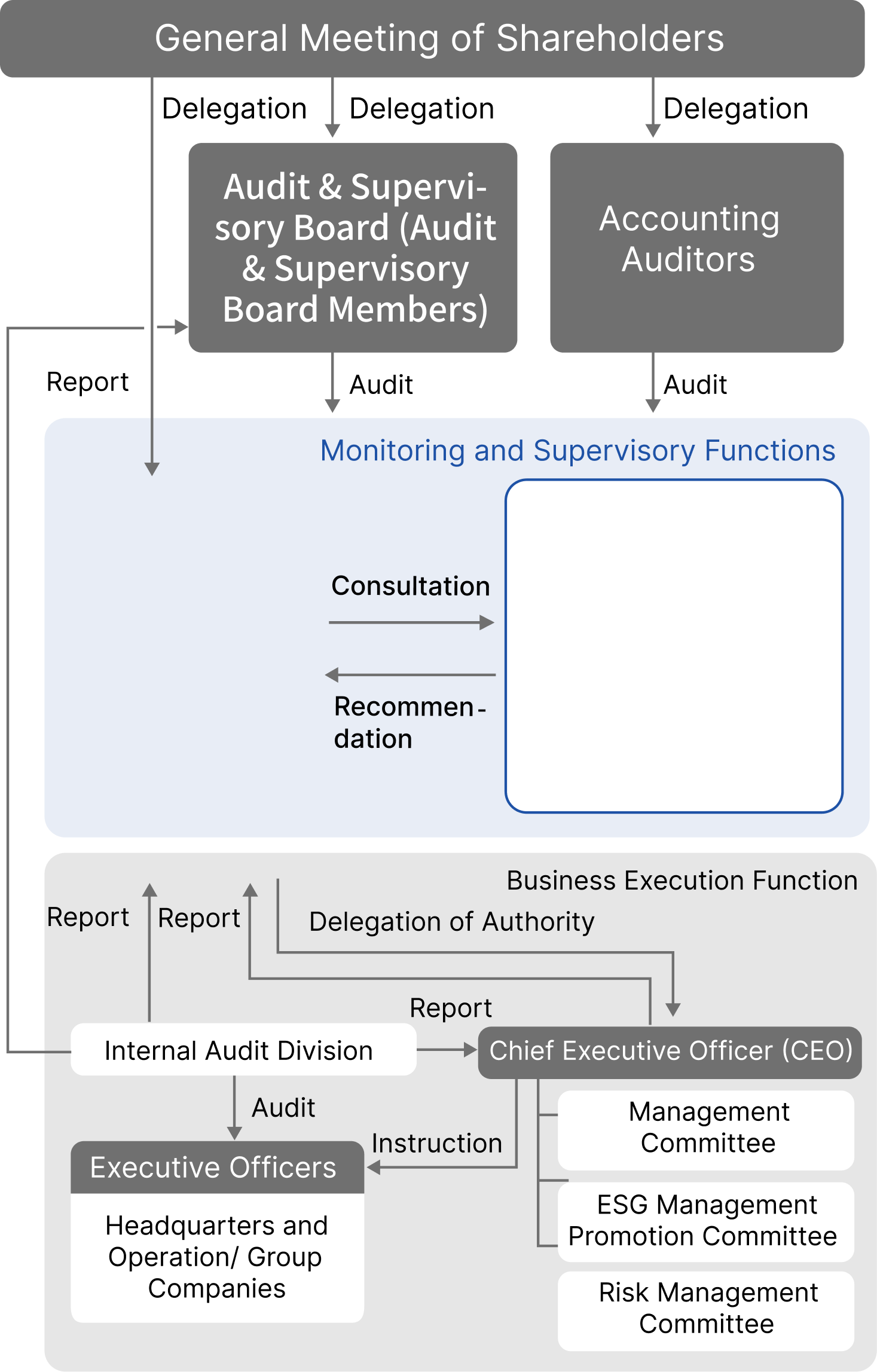
The IHI Group enhances management decision-making and oversight through the Board of Directors and committees. The diagram below shows the overall governance framework and the mechanisms through which its effectiveness is enhanced.
Independent Director Nakanishi discusses the achievements and challenges of the Board of Directors, Nomination Advisory Committee, and Remuneration Advisory Committee.
Perspectives for Understanding Governance
Risk Management
Yoshiyuki Nakanishi
Independent Director
Chairperson of the Nomination Advisory Committee
Chairperson of the Remuneration Advisory Committee
-
*
Titles as of May 2026.
From June 2026:
Independent Director, Chairman of the Board, Member of the Nomination Advisory Committee, and Member of the Remuneration Advisory Committee.
Achievements and Challenges of the Board of Directors in FY2025
-
Achievements
Clarifying the Desired State in 2040 and the Management Direction in the Medium-to-Longer-Term Direction
Progress in business portfolio overhaul and deeper discussions on medium- to long-term value creation and capital allocation
Improvement in the quality of Board discussions through advance briefings and off-site meetings
-
Challenges
Translation of the Medium-to-Longer-Term Direction into business strategies and resource allocation
Early identification of risks and verification of the effectiveness of measures to prevent recurrence
Medium-to-Longer-Term Direction
The Board of Directors discussed several themes related to the Medium-to-Longer-Term Direction toward 2040. In particular, the concept of “For Industry & National Security” was examined with great care, taking into account how it would be perceived by external stakeholders.
Through these discussions, "National Security" was defined not as a concept limited to defense, but as a broader commitment to providing the essential foundation that supports the safety and security of society as a whole. It was consequently positioned as a key pillar of the IHI Group's long-term growth.
Looking ahead, the Board has identified two key areas for oversight: (1) how the Medium-to-Longer-Term Direction will be reflected in efforts to strengthen the competitiveness of each business and in resource allocation decisions, and (2) how the organizational capabilities required to execute the strategy, including through CEO succession planning, will be sustained on an ongoing basis. The Board will continue to oversee both the decision-making process and outcomes to ensure that management objectives and investment decisions remain aligned with the Group's Medium-to-Longer-Term Direction.
Review of FY2025 and Key Challenges
During FY2025, the Board advanced discussions on the Company's business portfolio, with a focus on the growth prospects of both the Company and the industry, as well as the allocation of management resources. As a result, the discussion expanded beyond the divestiture or restructuring of individual businesses to consider which business areas should drive value creation in a manner consistent with the Group's Medium-to-Longer-Term Direction.
At the same time, the challenges for further enhancing the effectiveness of the Board of Directors are also clear. While the quality of Board discussions has improved through briefings prior to the Board meetings for independent directors and more substantive discussions at off-site meetings, there remains room for improvement in clearly defining the key issues for discussion and in providing concise explanations and materials that contain sufficient information for effective deliberation, so that the Board can focus its limited meeting time on the most important matters.
Preventing misconduct and ensuring the timely identification of risks remain among the Board's highest priorities. Executive management is reviewing both the framework for consolidating and monitoring risk information and the internal audit function. The Board of Directors will continue to assess not only whether the necessary structures and rules are in place, but whether risks are being identified and addressed at an early stage in practice, and whether these efforts are helping to build and sustain an organizational culture that prevents similar incidents from recurring. While the Board views these strengthening efforts as a step forward, it will continue to monitor whether they are leading to earlier risk identification and more effective responses. As an independent director, I expect these measures will become firmly established as an effective organizational framework.
Achievements and Challenges of the Nomination Advisory Committee through FY2025
-
Achievements
Systematization of discussions on CEO succession planning
Enhanced objectivity in the evaluation process through CEO candidate shortlisting and the use of external assessments
CEO candidates are evaluated from multiple perspectives through interviews with independent directors.
-
Challenges
Verification of the effectiveness of the CEO succession planning system
Ensuring diversity, including the appointment of female and non-Japanese executives and directors
Discussions on CEO succession have been proceeding systematically in the Nomination Advisory Committee. The Committee considers that progress is being made in developing a structured succession planning process, including defining the talent needed to support the Group's Medium-to-Longer-Term Direction, identifying and maintaining a list of successor candidates, and utilizing external assessments (see note) as part of the evaluation process.
Since 2022, the Committee has also provided opportunities for independent directors to meet directly with executive officers, enabling them to gain a multifaceted understanding of each candidate's character and suitability.
-
Note: Evaluation of candidates by external assessment organizations
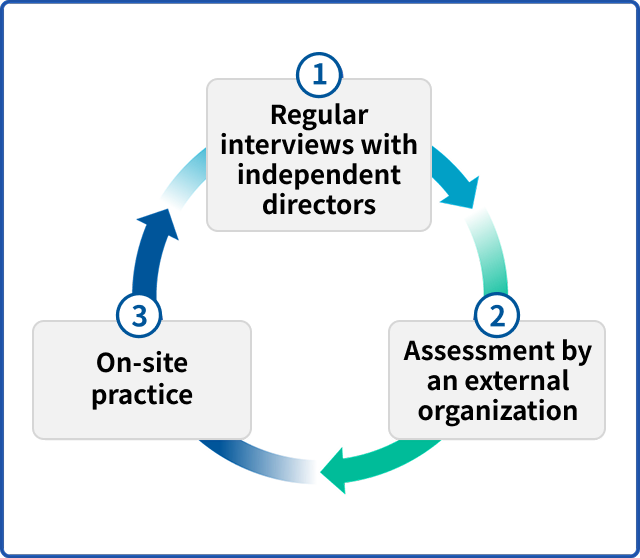
While the framework is becoming more established, regular evaluation is necessary to ensure its effectiveness. The Nomination Advisory Committee believes discussions should be further deepened from the perspective of whether the company is acquiring and developing a sufficient pool of CEO candidates in light of changes in the medium- to long-term business environment. Specifically, the Committee will assess whether succession candidates are systematically gaining the necessary experience and whether the feasibility of the CEO succession plan is being adequately ensured.
In addition, regarding the composition of the Board of Directors, the Nomination Advisory Committee shares the view that, from the standpoint of independence and objectivity, it is desirable to maintain a majority of independent directors on the Board.
With respect to director selection, the Nomination Advisory Committee places greater emphasis on ensuring a diversity of perspectives than on strictly aligning with the defined skills matrix. The Committee is closely monitoring progress in initiatives to enhance diversity, including the appointment of female and non-Japanese directors.
Achievements and Challenges of the Remuneration Advisory Committee through FY2025
-
Achievements
Strengthened incentive function through the revision of performance-based bonuses and share compensation
Enhancement of the evaluation framework through the incorporation of ESG indicators, enabling a more comprehensive and quantitative assessment
-
Challenges
Verification of the appropriateness of the performance indicators
The Remuneration Advisory Committee has been reviewing the executive remuneration system to strengthen its incentive function. As part of the 2025 revision, it restructured both the performance-based bonus and share remuneration programs. Under the previous system, the performance-based bonus did not function sufficiently as an incentive. The evaluation framework has therefore been revised to more appropriately reflect contributions to profit generation and cash generation. In addition, to encourage executives to focus on enhancing medium- to long-term corporate value and to make decisions from a shareholder-oriented perspective, a restricted stock compensation plan has been introduced.
Efforts are underway to establish a quantitative and multidimensional evaluation system by incorporating ESG metrics (greenhouse gas emissions reduction, improvement of employee engagement, and initiatives to promote DE&I) into the evaluation in FY2024. An important issue going forward will be assessing the extent to which these metrics are actually linked to management decision-making and behavioral change. Discussions should continue from the perspective of ensuring that the compensation system functions effectively.
Yoshiyuki Nakanishi
IHI Group Monitoring and Supervisory Functions
Strengthening Compliance in Risk Management
In June 2026, IHI AEROSPACE CO., LTD., a consolidated subsidiary of IHI Corporation, received a five-month suspension of eligibility to participate in competitive bidding from the Japan Aerospace Exploration Agency (JAXA), due to the confirmation of claims for payment based on reports that were inconsistent with the facts in contracts with JAXA relating to maintenance work for tools and equipment.
In response to past incidents of misconduct, the IHI Group has implemented measures to prevent recurrence and reinforced compliance throughout the Group. However, the confirmation of this new case in the course of those efforts has made us keenly aware that our initiatives remain insufficient in certain respects. To ensure that similar incidents never occur again, top management continues to communicate to all employees the message that “Compliance is a core value that each and every one of us must uphold. Without thorough compliance, there will be neither survival nor growth for the IHI Group.” We are also promoting workplace-based dialogue initiatives and enhancing training programs tailored to each employee level, including executives, managers, and new employees. Through these initiatives, we aim to transform our corporate culture from one in which concerns about inappropriate conduct go unspoken to one in which every employee takes personal ownership of compliance, puts it into practice, and resolves issues autonomously.
Through the oversight of its Board of Directors and the Nomination and Remuneration Advisory Committees, the IHI Group works to ensure sound management decisions and enhance medium- to long-term corporate value. This page outlines the achievements and key challenges of each governance body from the perspective of independent directors and explains how the Group evaluates and strengthens strategic execution, management talent development, and the effectiveness of its executive compensation system.