Change
Location

Currently Using The English Site.

Approach

The IHI Group formulated the IHI Group Human Rights Policy in December 2020 based on its management philosophy and its approach to human rights outlined in the Basic Code of Conduct for the IHI Group under the approval of the Board of Directors.
Based on international standards for human rights, the Group will fulfill its responsibility to respect human rights of all by fostering a respectful organizational culture and promoting human rights throughout its business activities.

Participation in Third-party Initiatives for Human Rights

The IHI Group has endorsed the Ten Principles of the United Nations Global Compact. As part of this, the Group has been participating as a member of the Global Compact Network Japan since 2022. Employees participate in various GCNJ subcommittees and continue in various activities related to deepening their comprehension of supply chains, environmental management, human rights due diligence, ESG, and so on.
Since fiscal 2022, the Group has also participated in the Business and Human Rights Academy organized by the United Nations Development Programme. Members of the human rights task team have been systematically learning about human rights due diligence through lectures by experts from Japan and overseas, as well as group work with participating companies.
During fiscal 2023, with the aim of further expediting the implementation of human rights due diligence, Officer in charge of Group ESG participated in a Business and Human Rights Roundtable for Senior Management hosted by the UNDP, where they engaged in deeper discussions of human rights in Japan and around the world with executives from other companies that have demonstrated a strong commitment to human rights due diligence.
In addition, the Group participates in business-oriented regional human rights organizations in Tokyo, Osaka, Hyogo, and Hiroshima. The Group promotes a deeper understanding of region-specific human rights issues through information sharing and exchanges of views.

Policy

IHI Group Human Rights Policy

In 2020, the IHI Group established the IHI Group Human Rights Policy and has since advanced its efforts to respect human rights in accordance with this policy. The Group has undertaken various initiatives, including identifying its material human rights issues, assessing the status of responses to those issues, strengthening its governance and implementation framework, and establishing grievance mechanisms for reporting human rights concerns and violations.
Based on the progress and outcomes of these initiatives, the IHI Group revised its Human Rights Policy in July 2026. In the course of the revision, the Group carefully considered feedback and views received through dialogue with both internal and external stakeholders.

The IHI Group recognizes and contributes to solving global issues based on group management philosophies of “Contribute to the development of society through technology” and “Human resources are our single most valuable asset.”
As the basis of these efforts, we have established the IHI Group Human Rights Policy in accordance with the Basic Code of Conduct for the IHI Group. Based on international human rights standards, we proactively fulfill our responsibility to respect the human rights of all individuals by fostering a corporate culture grounded in respect for human rights and promoting efforts to respect human rights throughout our business activities.

(Scope)

  1. This Policy applies to all officers and employees*1 engaged in the business of the IHI Group.
  2. We respect the human rights of all people connected to our products, services, and other business activities.
  3. We also request our suppliers and business partners*2 to comply with this Policy.

(Compliance with International Standards, Laws and Regulations, and IHI Group Codes)

  1. We support and respect internationally recognized human rights standards, including the International Bill of Human Rights, the International Labour Organization’s Declaration on Fundamental Principles and Rights at Work, and the United Nations Guiding Principles on Business and Human Rights, and proactively implement initiatives based on these standards.
  2. In the countries and regions where we conduct our business, we seek to respect international standards while complying with applicable laws and regulations.
  3. We always act in accordance with the Basic Code of Conduct for the IHI Group.

(Governance and Human Rights Due Diligence)

  1. Under the leadership of the Group Executive Officer in charge of Human Resources, we promote respect for human rights in a planned and continuous manner and proactively address human rights issues.
  2. We establish, continuously implement, and appropriately review a human rights due diligence framework to identify and assess human rights risks and to evaluate and improve the effectiveness of our efforts.
  3. Where we identify potential or actual adverse human rights impacts, we promptly take appropriate measures to prevent, mitigate, and remediate such impacts through appropriate procedures.

(Material Human Rights Issues)
We have identified the material human rights issues that we address on a priority basis. We conduct human rights due diligence across the Group and monitor how these issues are being addressed.

(Training)
We continuously provide our officers and employees with appropriate training to ensure that actions based on this Policy are implemented throughout our business activities.

(Grievance Mechanism and Remedy)
We establish and operate reporting channels to receive concerns from stakeholders who may be subject to adverse human rights impacts in connection with the IHI Group’s business activities and to provide access to remedy. We also draw on lessons learned from such reports to inform our human rights due diligence.

(Dialogue, Consultation, and Information disclosure)

  1. We continuously engage in dialogue and consultation with relevant stakeholders regarding the initiatives under this Policy.
  2. We regularly disclose information on our efforts to respect human rights and the results of those efforts.
  1. Including employees such as dispatched workers, fixed-term employees, rehired retirees, and part-time workers.
  2. Including business partners such as customers, suppliers and subcontractors, as well as partners in business alliances and outsourced service providers.

July 24, 2026
Hiroshi Ide
President and Chief Operating Officer
IHI Corporation

The IHI Group’s Material Human Rights Issues

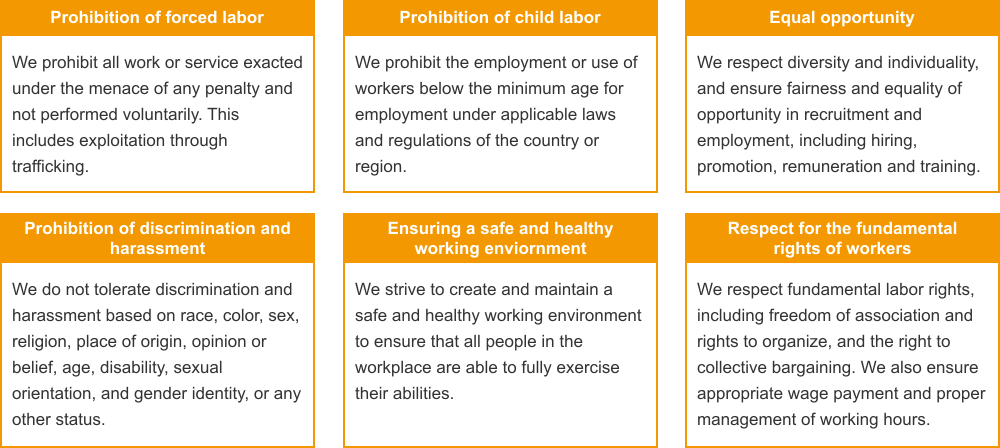
The IHI Group has identified the human rights issues related to the rights of its employees and workers of its business partners as the highest priority human rights issues.

●Prohibition of Forced Labor
We prohibit all work or service exacted under the menace of any penalty and not performed voluntarily. This includes exploitation through human trafficking.

●Prohibition of Child Labor
We prohibit the employment or use of workers below the minimum age for employment under applicable laws and regulations of the country or region.

●Equal Opportunity
We respect diversity and individuality, and ensure fairness and equality of opportunity in recruitment and employment, including hiring, promotion, remuneration and training.

●Prohibition of Discrimination and Harassment
We do not tolerate discrimination and harassment based on race, color, sex, religion, place of origin, opinion or belief, age, disability, sexual orientation, gender identity, or any other status.

●Ensuring a Safe and Healthy Working Environment
We strive to create and maintain a safe and healthy working environment to ensure that all people in the workplace are able to fully exercise their abilities.

●Respect for the Fundamental Rights of Workers
We respect fundamental labor rights, including freedom of association, the right to organize, and the right to collective bargaining. We also ensure appropriate wage payment and proper management of working hours.

Modern Slavery Act

The IHI Group discloses its efforts to prevent slave labor in IHI Group and its supply chain, pursuant to the UK Modern Slavery Act 2015 and the Australian Modern Slavery Act 2018.

Fiscal year 2025 Statement on the UK Modern Slavery Act and Australian Modern Slavery Act

Governance

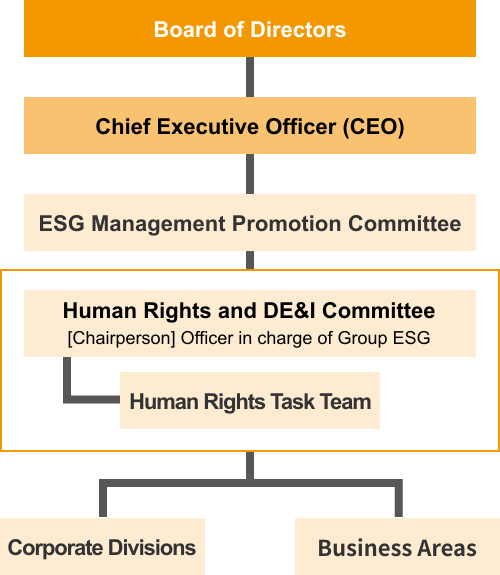
The IHI Group established the Human Rights and DE&I Committee as a Group-wide committee responsible for the “S” part of the ESG Management Promotion Committee.
With the goal of fostering a organizational culture that respects human rights and advancing human rights initiatives, the Committee formulates and deliberates on the details of important policies and activities related to the respect for human rights and the promotion of DE&I, particularly in the areas of human rights respect and collaboration with diverse talent.
The Committee is chaired by the Officer in charge of Group ESG and comprised of members from corporate divisions and business areas.
Important matters such as activity policies, priority measures, and performance evaluations are discussed within the ESG Management Promotion Committee and then reported to the Board of Directors appropriately.
The Group established a Task Team* under the Human Rights and DE&I Committee as the body to promote initiatives with regard to respect for human rights, in cooperation with related divisions and staff in charge of human rights at Group companies.
Concerning the promotion of DE&I, the Group is working in tandem with related divisions and Group companies.

Task Team: Comprised of members from the Human Resources Div., Procurement Div., Corporate Communication Div., Project Risk Management Div., Corporate Secretary Div., Economic Security Div., Legal Div., and Business Development Div.

Human Rights Promotion Framework

Human Rights Promotion Framework

Human Rights and DE&I Committee

Chairperson Officer in charge of Group ESG
Members President of each business area, General Manager of Corporate Research and Development Div., General Manager of Monozukuri System Transformation Div., General Manager of Business Development Div., General Manager of Intelligent Information Management Div., General Manager of Internal Audit Div., General Manager of Secretariat Div., General Manager of Economic Security Div., General Manager of Corporate Secretary Div., General Manager of Corporate Communication Div., General Manager of Legal Div., General Manager of Administration Div., General Manager of Finance & Accounting Div., General Manager of Project Risk Management Div., General Manager of Urban Development Div., General Manager of Intelligent Operation Center, General Manager of Corporate Technology Strategy Office, General Manager of Procurement Div., and General Manager of Human Resources Div.
Secretariat Sustainability Promotion Group of Administration Div.
Number of meetings convened in FY2025 3

Strategy

Risks

In order to maintain the IHI Group’s business foundation and ensure future growth, the Group respects human rights throughout its business activities and strives to foster an organizational culture in which human resources with diverse personalities and values can thrive. However, if a human rights violation or disregard for human rights were to occur under the IHI Group’s business activities, it could lead to a decline in public reputation along with customer business loss, as well as to possible compensation for damages. In addition, a lack of diversity in management decision-making could have a negative impact on the Group’s business performance and financial condition.

Opportunities

The IHI Group believes that preventing and mitigating adverse impacts on stakeholders and rights holders* arising from its business activities throughout the value chain contributes to realizing a better quality of life for all people connected to its business activities. The IHI Group therefore views respect for human rights as an opportunity to enhance business sustainability and increase corporate value.

Rights holders: individuals or groups who hold human rights and may be affected by a company’s business activities

Risk Management

Human Rights Due Diligence

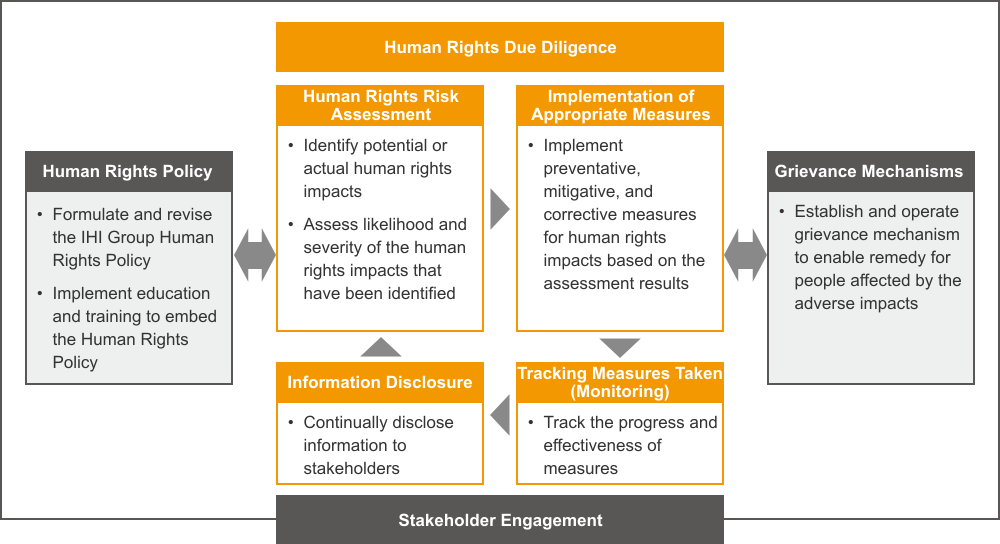
To fulfill its responsibility to respect the human rights of people affected by its business activities, the IHI Group advances its human rights due diligence process in line with the United Nations Guiding Principles on Business and Human Rights.
Human rights due diligence is an ongoing process of 1) conducting human rights risk assessments to identify potential or actual human rights impacts, 2) incorporating appropriate preventative, mitigative, and corrective measures for the identified impacts into work policies and operational processes, 3) monitoring the status and results of implementing these measures, and 4) disclosing their progress and results externally.
The Group recognizes the importance of continual stakeholder engagement throughout its human rights due diligence process in order to understand the impacts of its business activities on people’s rights.

Overview Human Rights Due Diligence

Overview Human Rights Due Diligence

Identifying Material Human Rights Issues

In fiscal 2021, with support from external human rights experts, the IHI Group conducted a human rights risk assessment covering its Group companies within Japan and overseas to identify human rights issues.
Based on the results of the analysis and assessment, important human rights issues in the manufacturing industry, internal monitoring, and global trends, the Group identified material human rights issues.
The Group considers its employees and workers of its business partners as the highest priority rights holder groups.

Material Human Rights Issues

Conducting Human Rights Due Diligence

The IHI Group conducts human rights due diligence at Group sites in Japan and overseas to understand the current status and actual conditions of the Group company sites with a focus on its material human rights issues.
The Group distributes a self-assessment sheet to Group sites and collects responses from each site. The self-assessment sheet includes questions on the implementation framework and management status for human rights due diligence, as well as the status of responses to human rights issues. The results are compiled into feedback sheets and sent back to the respective sites.
Among the questions included in the self-assessment sheet, the Group designates those that are highly prioritized in addressing the IHI Group’s material human rights issues and the five established core labor standards (prohibition of forced labor, prohibition of child labor, eliminating discrimination, recognition of freedom of association and the right to collective bargaining, and a safe and healthy workplace environment) set by the International Labor Organization (ILO) as Red Flags. Where any Red Flags remain unaddressed, improvements are implemented by the respective sites, and the status of those improvement efforts is monitored.
Human rights due diligence for suppliers and business partners is integrated into supply chain management and project risk management initiatives. Through the IHI Group’s risk management activities, the Group also addresses risks related to key ESG management issues, including respect for human rights.

Supply Chain Management
Project Risk Management
Risk Management

Environmental and Human Rights Risk Assessments in New Business Projects

For large-scale projects and major investments that may have a significant impact on the IHI Group’s business, the Group reviews potential human rights concerns related to business partners on both the upstream and downstream sides, as well as the environmental and human rights impacts arising from its business activities as part of the review process conducted prior to contract awards and investments.
In pre-investment reviews, the IHI Group conducts environmental and human rights impact evaluations, encompassing climate change countermeasures, waste, soil contamination, biodiversity, and so on using the ESG Checklist (Environment, Human Rights)*. For human rights violation risks, the Group conducts an internal review from the standpoints of ethnic minority and indigenous people’s rights, prohibition of involuntary relocation of residents, and ensuring occupational health and safety at project sites. In investment and lending projects, the Group also verifies the human rights promotion structure and the status of responses to human rights issues at the investee prior to any acquisition.

The ESG Checklist was created while referencing the International Finance Corporation Performance Standards and the Japan Bank for International Cooperation Guidelines for Confirmation of Environmental and Social Considerations.

Project Risk Management

Operation of Grievance Mechanism

In April 2024, the IHI Group established a grievance mechanism on its corporate website for the Human Rights Grievance Desk that can be utilized by all stakeholders in the Group’s value chain.
Cases reported through this point of contact will be handled fairly and appropriately through the Engagement and Remedy Platform provided by the Japan Center for Engagement and Remedy on Business and Human Rights (JaCER), of which the IHI Group is a regular member. The IHI Group prohibits any retaliation or adverse treatment against whistleblowers and other individuals involved in a report, and is committed to preventing and remediating such actions.

Additionally, the IHI Group provided cards and posters to inform partner companies within IHI Group offices and plants about the reporting desk.
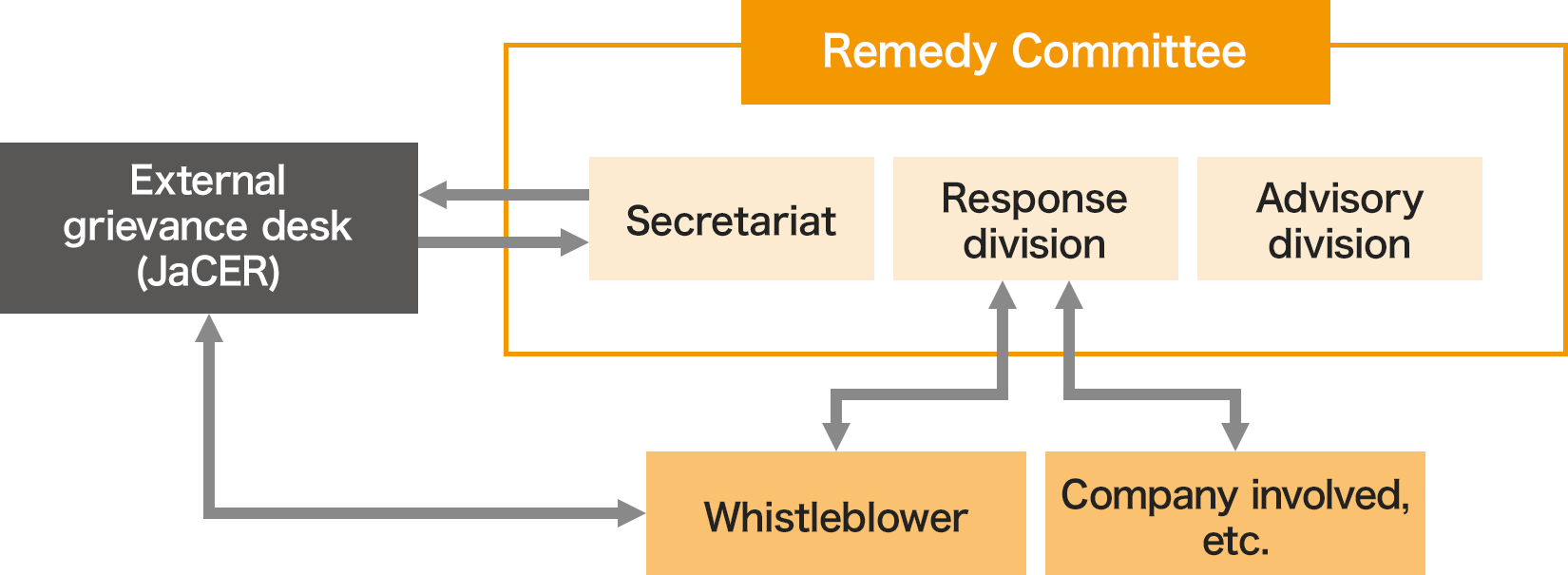
IHI’s secretariat (CSR Procurement Promotion Group, Procurement Division) receives reports from JaCER and strictly manages them as highly confidential information. For each case reported, the secretariat forms a Remedy Committee made up of Advisory divisions (Human Resources Division, Legal Division, etc.) and Operational division (business areas, business units, affiliated companies, etc.). Based on the findings of the investigation, the Remedy Committee organizes and executes remedial actions as well as preventative measures. As needed, the response divisions communicate with the Claimant and the company involved throughout this period. The secretariat reports the progress of the case to JaCER as appropriate, and the progress is disclosed on the case list on the JaCER website.

Human Rights Grievance Desk

Operation System

Metrics and Targets

Human Rights Risk Assessments Implemented

Item Target Unit Year 1 (Second half of FY2021–FY2022) Year 2 (FY2023) Year 3 (FY2024)
Total Implemented Targets Total Implemented Targets Total Implemented Targets
Human Rights Risk Assessments Implemented Implemented at approximately 160 sites of the IHI Group company over 3 years*1, *2 Assessments 59 Affiliated companies overseas 37 Affiliated companies overseas and business units 47 Affiliated companies in Japan (including some affiliated companies overseas)
  1. Figures compiled in FY2021, which exclude companies that have been liquidated or are no longer part of the Group
  2. At companies and sites where one-time implementation is desired, implementation is done all at once, and risk assessments were completed at all sites by the end of FY2024

Number of Human Rights Training Participants

Item Unit FY2025
Targets Participants
e-learning: Harassment Prevention People IHI and affiliated companies in Japan 22,149
e-learning: IHI Group Human Rights Policy (basic) People New employees, mid-career hires, and others who wish to participate 370
e-learning: Business and Human Rights People Those who wish to participate 63
Human rights-related training conducted at headquarters representative’s offices People New employees, managers, foremen and assistant foremen, human rights personnel, etc. 259

Number of Reports Received through the Grievance Mechanism

Item Unit FY2023* FY2024 FY2025
Number of reports received cases 1 8 17

Of which, the number of reports subject to violation of human rights

cases 1 6 14

Harassment

cases 1 2 7

Labor and Employment

cases 0 1 5

Discrimination

cases 0 1 0

Compliance Violations

cases 0 0 1

Others

cases 0 2 1

The FY2023 reporting system was a trial conducted with several business partners before the grievance desk was opened in April 2024.

Initiatives

Education/Awareness Building

In order to foster a organizational culture with respect for human rights, the IHI Group strives to raise awareness at all levels so that initiatives based on the IHI Group Human Rights Policy can be implemented into practice.

Grade-based education

Every year the Group conducts e-learning training aimed at respecting human rights and harassment prevention for all of its employees. In the e-learning training on harassment prevention, it introduces cases that may fall under harassment and contact points for seeking consultation. Additionally, training for new managers includes e-learning on creating a harassment-free workplace.

Training for all employees

In fiscal 2025, the IHI Group held e-learning programs with topics such as Harassment Prevention and Unconscious Bias to have everyone who works at the Group learn how to frame human rights and DE&I and deepen their understanding.

Diversity, Equity, and Inclusion (DE&I) / Metrics and Targets

Communications to all employees

As part of initiatives to encourage employees to take personal ownership of DE&I, a Group-wide key measure, the IHI Group provides ongoing communications to all employees. In fiscal 2025, as part of DE&I Promotion Month (held annually in December) to deepen understanding of human rights and DE&I, the Group launched a month-long initiatives starting on Human Rights Day (December 10). The Chairperson of the Human Rights and DE&I Committee and many other employees collaborated on a dedicated internal website to conduct a month-long message relay, with one employee sharing a message each day. In conjunction with International Women’s Day (March 8), the Group also carried out activities, including (1) sharing messages from female managers, (2) publishing data related to women’s advancement internally, and (3) implementing programs organized by the gender gap elimination working group. Through these initiatives, the Group strives to enhance understanding and awareness of gender issues.

"DE&I Month": December Events Inside and Outside IHI

Diversity, Equity, and Inclusion (DE&I) / Metrics and Targets

Workshop to identify human rights risks

In August 2025, the IHI Group held a workshop to identify risks related to human rights, aiming to prevent and mitigate human rights risks and also to reflect the voices from the frontlines in the development of systems for addressing issues and providing support as necessary.
Participants in the workshop were not limited to personnel in charge of human rights but included various people working on the business frontlines, with a total of 60 participants. They looked across the upstream and downstream value chain, from the planning to the manufacture, sale, and use of products. They examined and identified what kinds of human rights risks were encountered by the different stakeholders involved in business activities, such as employees, business partners, customers, and members of local communities. The Group assessed and prioritized the human rights risks identified through the workshop from the perspectives of severity and likelihood and took the findings into consideration in revising its human rights policies.

Reflects Feedback from the Field to Strengthen Risk Management Structure and Further Promote Respect for Human Rights

Initiatives Regarding Material Human Rights Issues

Measures at Group sites

The IHI Group implemented human rights risk assessments at Group sites worldwide over three years between fiscal 2022 and 2024 to understand the actual state of material human rights issues.
When conducting human rights risk assessments, the Group prioritizes overseas affiliated companies thought to be relatively high risk, targeting 59 companies in fiscal 2022, 37 in fiscal 2023, and 47 in fiscal 2024.
Survey results for fiscal 2022 through 2024 and the identified issues to be addressed are shown in the diagram below.
Additionally, in fiscal 2023 the IHI Group Co., Ltd. Human Rights Policy Implementation Guidelines were developed and written in three languages, Japanese, English, and Chinese. The guidelines were distributed throughout the IHI Group to raise awareness of important human rights issues within the Group among all Group companies.
In fiscal 2025, follow-up monitoring were conducted at nine sites to review the status of measures implemented from fiscal 2022 through 2024. Through these follow-up monitoring , no serious risks related to material human rights issues were identified within the scope of the monitoring . Going forward, the Group will expand the scope of its risk assessment and conduct more in-depth reviews of potential risks.
The status of actions taken within the supply chain is reviewed as part of sustainability assessments of business partners.

Supply Chain Management

Issues Identified through Human Rights Risk Assessments and Countermeasure Status*1
Item Issues Countermeasure Status
Total Trends Insufficient grievance mechanism Establishment of our grievance desk was completed in April 2024 and began operation.
Insufficient stakeholder dialogue In parallel with dialogue held at our corporate divisions, each company is made aware of the importance of labor management dialogue, etc.
Delays in diversity, equity, and inclusion (DE&I) efforts to ensure equal opportunities and treatment for employees We are implementing initiatives to help foster an organizational culture emphasizing diversity.
Red Flags*2 Child labor
  • Internal regulations regarding minimum working age
  • Age verification using verifiable means
We have established internal regulations and rules that comply with the minimum working age in each country.
Discrimination and harassment
Providing equal employment opportunities and promotions and making a statement of no discrimination in employment
We are working to formulate policies that ensure equal employment opportunities and treatment.
Guarantee of safe workplaces ensuring the health of working people
  • Clarification of the health and safety system and system roles
  • Communication regarding our Occupational Health and Safety Policy to all employees
We are establishing our occupational health and safety policy and communicating it to all employees.
  1. The status of responses to identified risks are listed in the “Fiscal year 2024 Statement on the UK Modern Slavery Act and Australian Modern Slavery Act.”
  2. Red Flags: Assessment questions of particular importance in relation to the IHI Group’s material human rights issues and the five established core labor standards (prohibition of forced labor, prohibition of child labor, eliminating discrimination, recognition of freedom of association and the right to collective bargaining, and a safe and healthy workplace environment) set by the International Labor Organization (ILO)

Measures for foreign non-regular workers

In fiscal 2025, the IHI Group conducted a survey of all sites of IHI and its subsidiary companies in Japan regarding the employment status of foreign non-regular workers, who may be vulnerable to human rights risks such as forced labor, discrimination, and harassment. As a result, the Group confirmed there were 317 foreign non-regular workers in 18 companies. Among these companies, the Group conducted on-site assessments at two sites that accept technical intern trainees and has implemented corrective measures to address the issues identified. The Group will maintain appropriate working conditions through continuing to conduct regular surveys.

Supply Chain Management

Measures in recruitment and employment

Prohibition of forced labor

The IHI Group prohibits all forms of forced labor. At IHI, employment is initiated only upon application by the candidate. Prior to employment, applicants are provided with the terms and conditions of employment, including wages, and employment begins only after their agreement has been obtained.

Prohibition of child labor

The IHI Group prohibits the employment or use of workers below the minimum age for employment under applicable laws and regulations of the countries and regions where it operates. At IHI, the Rules of Employment stipulate that applicants must be at least 15 years of age and require the submission of a resume containing age information as part of the application process.

Equal opportunity

Under the IHI Group Human Rights Policy, the IHI Group promotes diversity, equity & inclusion (DE&I), respect diversity and individuality, and works to ensure fair recruitment, fair working conditions, equal opportunities, and a workplace free from harassment.
The Group promotes fair and appropriate treatment by ensuring wage levels at or above minimum wage requirements globally, providing appropriate wages and allowances, including overtime pay, and developing personnel systems based on the principle of equal pay for equal work.

Human Resource Management
Diversity, Equity, and Inclusion (DE&I)

No tolerance for discrimination and harassment

The IHI Group has conducted awareness-raisinging and educational activities to prevent harassment and has taken steps to create an environment in which employees feel comfortable seeking advice and reporting concerns.
Based on these efforts to create a workplacewhere harassment cases can be more readily identified, the IHI Group has clearly communicate to its employees its policy of taking strict and appropriate action against workplace harassment including sexual harassment.

Business Ethics & Compliance

Safe workplaces ensuring the health of workers

The IHI Group believes in ensuring safety and health to be the foundation of its business activities and one of its key management priorities. The Group strives to create and maintain safe and healthy workplaces where people at each workplace are able to fully exercise their abilities.

Occupational Health and Safety

Respect for the basic rights of workers

The IHI Group respects fundamental labor rights, including freedom of association and the right to organize, and the right to collective bargaining. The Group recognizes employees’ rights to engage in labor union activities and prohibits any disadvantageous treatment based on such activities. The Group also engages in collective bargaining with the labor union in good faith, founded in mutual trust.
At IHI, a collective labor agreement has been established with the labor union based on mutual understanding and trust. Regularly meetings between Management and employee representatives, including the Health and Safety Committee, Management Councils, and Production Councils, provide opportunities for open dialogue and contribute to the continuous improvement of workplace conditions.

Occupational Health and Safety

Society Top