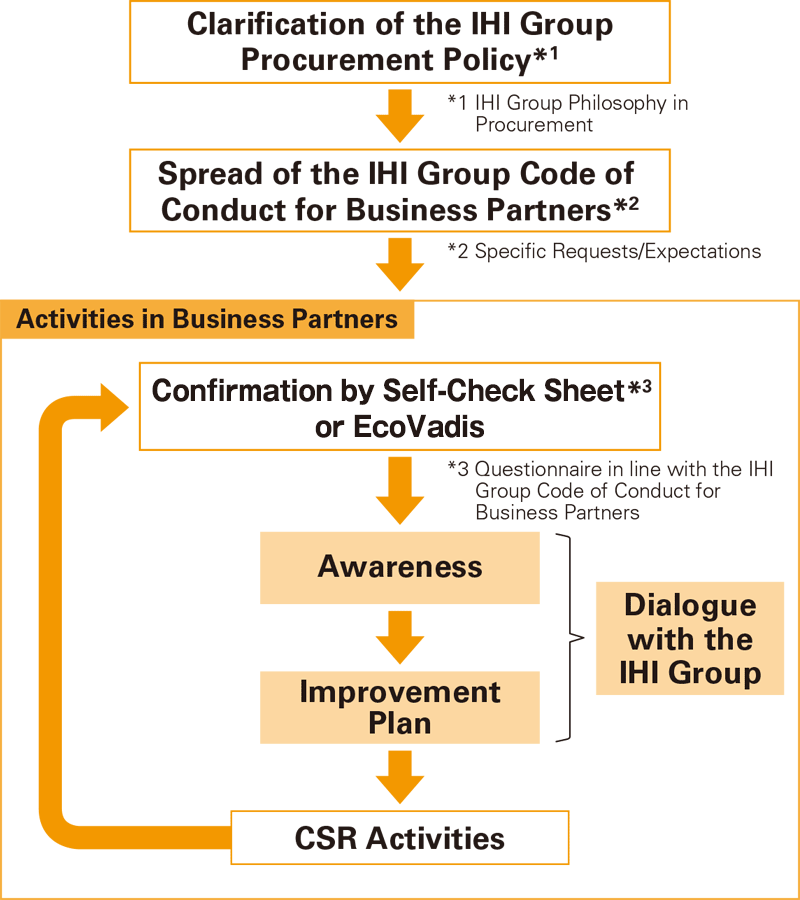
The IHI group’s procurement activities are based upon the IHI Group Procurement Policy, which consists of three pillars: “Fair and Impartial Procurement,” “Mutually Beneficial Partnership with our Business Partners,” and “Approach to Compliance and Social Responsibility.”
In fiscal 2022, the IHI Group formulated the IHI Group Code of Conduct for Business Partners, which sets out specific requests and expectations for its business partners. The IHI Group asks its business partners and their supply chains for considering human rights and labor, health and safety, environment, fair business and ethics, information security, and procurement responsibilities over mineral resources, on top of basic requirements such as compliance, quality, price, and delivery.
Each procurement department in the IHI Group conducts its procurement activities in accordance with the Basic Rules of Procurement for the IHI Group which reflects the procurement policy described in the IHI Group Procurement Policy, and takes its social responsibility by building sustainable supply chains.
Policies
IHI Group Procurement Policy
The IHI Group conducts procurement activities in accordance with the “Basic Code of Conduct for the IHI Group” as set forth below.
Article 1. Fair and Impartial Procurement
We provide business opportunities in an open manner to business partners from around the world, and welcome working with creative and competitive business partners. We also evaluate and select business partners in a comprehensive and fair manner based on factors such as quality, price, delivery schedule, technology development capabilities, and financial conditions.
Article 2. Mutually Beneficial Partnership with Our Business Partners
We regard our business partners as value creators, and through seeking to realize optimal levels for quality, price and delivery, together with procurement reliability, we aim to establish relationships of trust with our business partners and bring about the mutual enhancement of competitiveness and prosperity with them.
Article 3. Approach to Compliance and Social Responsibility
We comply with the related laws that govern our local and global businesses. To fulfill our social responsibility, we shall conduct CSR procurement with due consideration not only of basic requirements such as quality, price and delivery, but also of human rights, labor conditions, health and safety, the environment, and information management.
IHI Group Code of Conduct for Business Partners
Compliance with Laws and Regulations and Respect for International Norms
1.1. Compliance with Laws and Regulations and Respect for International Norms
Human Rights and Labor
2.1. Prohibition of Forced Labor
2.2. Prohibition of Child Labor
2.3. Prohibition of Inhumane Treatment
2.4. Prohibition of Discriminatory Practices
2.5. Appropriate Management of Working Hours
2.6. Appropriate Wages and Allowances
2.7. Freedom of Association and Right to Collective Bargaining
Health and Safety
3.1. Safe Workplaces
3.2. Emergency Preparedness
3.3. Occupational Injury and Illnesses
3.4. Industrial Hygiene
3.5. Consideration for Physically Demanding Work
3.6. Safety Measures for Plant Equipment
3.7. Health and Safety at Facilities
3.8. Health and Safety Communication
3.9. Worker Health Management
Environment
4.1. Climate Change Countermeasures
4.2. Proper Management of Water Resources
4.3. Proper Management of Chemical Substances
4.4. Proper Management of Waste
4.5. Biodiversity Conservation
Fair Business and Ethics
5.1. Prevention of Corruption and Prohibition of Improper Exchange of Benefits
5.2. Information Disclosure
5.3. Respecting Intellectual Property
5.4. Conducting of Fair Business
5.5. Whistleblower Protection
Quality, Safety, and Stable Supply of Products
6.1. Product Safety
6.2. Quality Control
6.3. Stable Supply
6.4. Liability over Product Accidents and Nonconformities
Information Security
7.1. Defense against Cyber Attacks
7.2. Protection of Personal Information
7.3. Protection of Confidential Information
Competitive Edge
8.1. Enhancement of Competitiveness
Proactive Approach for Social Issues
9.1. Contributing to Local Communities
9.2. Reasonable Effort for Global Social Issues
Establishment of Management System
10.1. Establishment of Management System
10.2. Communication with Your Supply Chain
10.3. Procurement Responsibility over Mineral Resources
10.4. Proper Import and Export Controls
10.5. Grievance Mechanism
10.6. Progress Report
The IHI Group takes a broad approach to risk management, including considering country risks and natural disaster risks in the supply chain. After the corporate division formulates measures and business areas implement them, the results are shared and discussed at the Risk Management Conference, chaired by the Chief Executive Officer (CEO).
Activity policies and measures related to human rights issues in the supply chain, as well as their results, are shared and deliberated at the Human Rights and DE&I Committee, chaired by the Officer in charge of Group ESG.
In fiscal 2025, reports were submitted to Risk Management Conference on a quarterly basis and to the Human Rights and DE&I Committee three times during the fiscal year.
While the IHI Group manufactures key components within the Group, it also procures raw materials, parts, and services from suppliers outside the Group. Cost increase and/or delivery delay may be brought about by dramatic fluctuations in material and equipment prices, imbalance between supply and demand for special steel, sudden changes in the international situation, and supply chain disruption due to severe disasters or large-scale spread of infectious diseases.
Additionally, in the process of promoting CSR procurement, procurement costs may rise, consequently causing negative impact on the Group’s business performance and financial condition.
Opportunities
The IHI Group’s firm conviction is that risk mitigation efforts in the supply chain brings edge over strengthening production capabilities, establishing a business structure that is less susceptible to external factors, and ultimately stabilizing business performance and financial conditions, as well as increasing corporate value.
Risk Management
Strengthen Supply Chains
The IHI Group is globally promoting activities to strengthen its supply chain to prevent stagnation of corporate activities possibly caused by natural disasters, infectious diseases, conflicts, and emerged risks from the CSR procurement perspective, and so on.
The IHI Group strives for stable procurement by collecting market trends about raw materials and parts, thoroughly manages quality and delivery of its suppliers to avoid excessive concentration and dependence, and proceeds with multiple source selection. To build a supply chain that is less vulnerable to different risks, the IHI Group identifies important suppliers essential to business continuity and uses a variety of assessment tools to select business partners as targets for strengthening its supply chain.
These assessment tools include ESG risk assessments conducted by third-party organizations, management risk assessments of business partners, and interviews regarding information security and business continuity plans in the event of a disaster.
Selecting Important Business Partners
The IHI Group identifies suppliers that are important to its business from the following criteria and conducts focused risk management.
Importance of ordered materials and processes
Amount of annual orders
Difficulty of substitution, etc.
In fiscal 2025, 510 companies were identified as important business partners from among first-tier business partners, and 102 companies from among second-tier business partners. Of the 8,970 first-tier business partners with which the IHI Group does business, the procurement amount of the 510 important first-tier business partners accounted for 41% of the total.
Number and Ratio of Important Business Partners
Item
Unit
Number of Business Partners
Procurement Amount Ratio
Number of first-tier business partners
Company, Scope: IHI and 29 affiliated companies in Japan
8,970
100%
Number of important first-tier business partners
Company, Scope: IHI and 29 affiliated companies in Japan
510
41.1%
Number of important second-tier business partners
Company, Scope: IHI and 29 affiliated companies in Japan
102
—
Supplier Sustainability Evaluation
Utilization of Sustainability Assessment Service “EcoVadis”
The IHI Group entered into an agreement with EcoVadis, a third-party ESG assessment firm, in June 2024, to establish a system to evaluate supply chain risk properly and fairly.
The IHI Group establishes a risk management system for the entire supply chain where it encourages its business partners to undergo sustainability assessments conducted by EcoVadis: if there are no issues found, the Group manages them as excellent suppliers, and if there are concerns picked up, it conducts additional interviews as necessary for clarification and improvement purpose. EcoVadis system also enables it to promptly pick up publicly opened news such as compliance violations, and to respond to the relevant supplier(s) in little time.
Additionally, EcoVadis sustainability assessments are conducted based on major international standards, including the Ten Principles of the United Nations Global Compact, the International Labour Organization (ILO) Conventions, the Global Reporting Initiative (GRI) Standards, ISO 26000, the Ceres Roadmap, and the United Nations Guiding Principles on Business and Human Rights. According to fiscal 2025 results*, business partners or their parent companies (877 business partners) representing 51% of the total procurement value have provided the IHI Group with the results of their EcoVadis assessments. For 90% of these partners, either the business partner itself or its parent company received an overall score of 45 points or higher. These 877 business partners included 20% (94 companies) of the Group’s important business partners.
For fiscal 2025 procurements. The scope covers IHI and 27 affiliated companies in Japan.
Supplier Management Using Self-Check Sheets
The IHI Group has developed the IHI Group Code of Conduct for Business Partners with reference to the Responsible Business Conduct Guidelines (established by JEITA) and the Responsible Business Alliance (RBA) Code of Conduct, and is distributing it to the Group’s business partners. In addition, some business partners were asked to complete a self-check sheet based on the Code of Conduct, in order to recognize issues and further engage in CSR activities.
To date, self-check sheets have been collected from 381 companies as part of pre-interviews for on-site dialogues and pre-screenings of important business partners for some construction projects. Of which, 136 were important business partners.
At the same time, supplier management using self-check sheets has presented challenges, including managing the workload associated with the surveys, ensuring the validity and transparency of assessments, and aligning with the latest global standards. Accordingly, the IHI Group plans to gradually phase out the use of self-check sheets and transition to the use of EcoVadis, a third-party assessment platform, in order to promote CSR activities more efficiently and appropriately.
ESG Assessments of Business Partners in Pre-order Screening for Large Projects
Since fiscal 2023, the IHI Group has conducted ESG assessments of some supplier candidates for projects with an expected contract amount above a certain threshold. Through fiscal 2024, assessments were conducted using self-check sheets, while in fiscal 2025 the Group introduced assessments using EcoVadis.
In fiscal 2025, ESG assessments were conducted for a cumulative total of 130 companies across 20 projects, including EcoVadis-based assessments for 31 companies. As a result, risks were identified at three companies, and corrective actions have been requested to address the risks. The Group plans to continue the phased transition to assessments utilizing EcoVadis.
CSR Activity Promotion Process
Strengthening Engagement with Business Partners
Permeation of the IHI Group Code of Conduct for Business Partners
The IHI Group not only publishes the IHI Group Code of Conduct for Business Partners on its website, but also distributes it to existing business partners through notification letter and information session for its business partners. For newcomers, each IHI Group procurement department asks them to respect the IHI Group Code of Conduct for Business Partners on the contract.
Additionally, to support the CSR activities of the Group’s business partners, joint seminars on business and human rights, carbon neutrality and the environment, and fair business were held at four locations in Asia. In fiscal 2025, the Group also launched an external e-learning service for important first-tier business partners in Japan with 20 or fewer employees, as well as companies designated by each procurement department, to raise their awareness of ESG and crisis management.
The table below displays the outcomes of the seminars that were held in fiscal 2025.
Number of Companies in the Joint Seminar
Topic
Host Country
Target
FY2025
Topic
Country
Total
Partcipating Important Business Partners
Participation Rate Relative to the Total Number of Important Business Partbers by Country
Business and human rights
South Korea
Business partners in South Korea
Companies
16
1
20%
Carbon neutrality and the environment
Malaysia
Business partners in Malaysia
Companies
13
0
0%
Vietnam
Business partners in Vietnam
Companies
21
2
67%
Fair business
China
Business partners in China
Companies
29
5
50%
Number of Companies in the E-Learning Service for Important First-Tier Business Partners in Japan
Topic
Country
Scope
Unit
FY2025
ESG and crisis management
Japan
Small and medium-sized companies among important first-tier business partners in Japan
Companies
30
Dialogue with Important Business Partners to Strengthen the Supply Chain
To strengthen its supply chain, the IHI Group assesses management, information security, disaster, and other risks of its important business partners through the use of various assessment tools and direct interviews. Based on the assessment results, the Group identifies important business partners that fall below its internally established evaluation criteria and conducts on-site dialogues to identify issues and provide guidance and recommendations for risk mitigation. In fiscal 2025, the Group visited and conducted dialogues with 146 important first-tier business partners in Japan.
The Group also continues the dialogue activities that began in fiscal 2024 to hear about sustainability-related issues faced by its business partners. The purpose of these dialogues is to review the status of business partners’ daily CSR procurement efforts and to have a constructive discussion about cooperation for further improvement.
In fiscal 2025, the Group conducted interviews on such issues with 12 companies*, including important business partners.
Six companies in Japan, three in Vietnam, and three in Malaysia.
Information Sharing Using EcoVadis
Since fiscal 2024, the IHI Group has been utilizing EcoVadis sustainability assessments with the cooperation of its business partners and their parent companies. Beginning in fiscal 2025, to further strengthen collaboration across the supply chain in ESG risk management, the Group started issuing feedback reports to business partners that participated in the sustainability assessments. These reports summarize the status of the IHI Group’s supply chain risk management. The feedback reports have also created opportunities for discussions on CSR procurement, and the Group will continue to promote risk management together with its supply chain partners.
Human Rights Risk Mitigation Activities
Active Dialogue with Foreign Non-Regular Workers
Starting in fiscal 2023, the IHI Group, in cooperation with the Global Alliance for Sustainable Supply Chain (ASSC), engages in proactive dialogue (in-person interviews) for risk mitigation purpose regarding foreign non-regular workers working at sites of IHI and its subsidiary companies in Japan. Through these activities, concerns related to laws, regulations, and international norms, as well as issues associated with health and safety and customary practices, were identified. In response, corrective measures for risk mitigation have been implemented at all sites of IHI and its subsidiary companies in Japan where foreign non-regular workers are working. In fiscal 2025, recognizing that foreign technical intern trainees are in a vulnerable position and may face high human rights risks, the Group selected two sites from among those where on-site partner companies employ foreign technical intern trainees. In addition to the proactive dialogue conducted to date, the Group carried out on-site assessment of workplaces and dormitories for the first time, in the presence of ASSC. The IHI Group engaged in proactive dialogue (in-person interviews) with a cumulative total of 68 foreign non-regular workers at 10 locations in Japan between November 2023 and February 2026. Of these, 49 were foreign non-regular workers employed or accepted by on-site partner companies.
Responding to Anti-social Forces and Anticorruption
The IHI Group contractually requires its business partners to prohibit all relationships with anti-social forces, and commits no acts of bribery toward foreign government officials as prohibited by the “Penal Code and the Unfair Competition Prevention Act” or against the laws enacted in the particular country. If any acts as said above are found, the IHI Group requests the relevant company(s) investigate and report it to the IHI Group.
Education/Awareness Building for Employees
The IHI Group enhances compliance consciousness by focusing on education on procurement-related laws and business regulations, as well as by inspecting compliance status and implementing necessary improvements within its operations. In addition to traditional in-person training, its procurement professional development training, which aims to develop procurement personnel capable of building a sustainable supply chain, uses on-demand video distribution. By enhancing participant convenience, the Group increases learning and relearning opportunities, which helps participants gain a deeper understanding of laws and regulations.
In addition to procurement-related divisions, e-learning training that includes CSR procurement content is provided to employees of IHI and its 36 affiliated companies in Japan. Through this training, the Group aims to enhance understanding of and ability to respond to laws, regulations, and social demands. In fiscal 2025, 85% of eligible employees participated in the e-learning course.
Since fiscal 2024, the Group has been providing training aimed at improving price assessment capabilities in response to rising procurement costs. The Group also plans to introduce supply chain management training for mid-level Group employees in fiscal 2026 in order to build a sustainable supply chain.
By improving the skills required for future procurement operations, the IHI Group is also working to improve employee engagement and satisfaction.
Procurement Responsibility over Mineral Resources including Conflict Minerals
The IHI Group endorses the aims of the Responsible Minerals Initiative (RMI), an international organization leading procurement responsibility regarding mineral resources. The IHI Group, for the time being, conducts activities regarding tin, tantalum, tungsten, and cobalt which have a considerable number of RMI-approved suppliers. The final target is to confirm that all purchases are manufactured through RMI-certified refiners and smelters.
The IHI Group specifies product groups such as aero engine parts that surely contain the targeted mineral resources, and continues to conduct surveys by sending questionnaires designated by RMI to manufacturers which produce the targeted parts. The IHI Group plans to expand the scope of the product group surveyed as needed.
Respecting the guidance of the Organization for Economic Co-operation and Development (OECD)’s “5-Step Framework,” the procurement departments are conducting in-depth activities under the direction of IHI’s Procurement Division. In addition, the IHI Group notifies its business partners of the policy and recommendation about “Procurement Responsibility over Mineral Resources” in Section 10.3 in the IHI Group Code of Conduct for Business Partners.
Metrics and Targets
Participants in Procurement Training
Item
Scope
Unit
FY2022
FY2023
FY2024
FY2025
Lecture on Proper Transactions Act*1 *2 *3
IHI and affiliated companies in Japan
people
379
431
379
1,678
Lecture on Construction Business Act*1
IHI and affiliated companies in Japan
people
354
313
165
93
Lecture on Overseas Procurement*1
IHI and affiliated companies in Japan
people
112
152
115
118
Professional Procurement Training*4
IHI and affiliated companies in Japan
people
1,367
1,534
1,184
626
These three lectures are part of “Professional Procurement Training” and each participant number adds up to the numbers of “Professional Procurement Training.”
Up to FY2024, the course was titled “Lecture on Subcontract Act.” Following the renaming of the law, it has been renamed the “Lecture on Proper Transactions Act ” beginning in FY2025.
In FY2025, following the revision of the legislation, the course was offered as a special program in addition to being included in the Professional Procurement Training curriculum.
Lectures on security trade control has been added since FY2022.
Dialogue with Non-regular Foreign Workers
Item
Scope
Unit
FY2022
FY2023
FY2024
FY2025
Number of locations
IHI and subsidiary companies in Japan
locations
─
4
4
2
Number of people interviewed
Workers at the location (including workers from on-site partner companies)
people
─
22
32
14
Number of on-site partner companies
On-site partner companies
companies
─
8
4
3
Number of Reports Received Through the Grievance Mechanism
Mutually Beneficial Partnership with Our Business Partners
In September 2020, the IHI Group publicized the registration of “Declaration for Building Partnerships.” In March 2026, the Group also updated the declaration following revisions to the standard form associated with the enforcement of the Act on Preventing Delay in Payment to Small and Medium-Sized Entrusted Business Operators in Relation to Manufacturing Consignment (Proper Transactions Act). Based on these initiatives, the IHI Group aims for a mutually beneficial partnership with its business partners.
The IHI Group also regularly reports the status of price pass-through requests from business partners to top management and determines appropriate actions based on these reports.
The IHI Group considers its suppliers as valued partners to proceed with business in collaboration, and hones its competitive edge aiming for mutual prosperity through open dialogue and cooperation.