
Study on Lower-Temperature Process in Yellow Phosphorus Production from Steelmaking Slag
KISHIDA Takuya, MUROFUSHI Shoko, MOCHIZUKI Kyosuke
KISHIDA Takuya : Applied Physics & Chemistry Department, Technology Platform Center, Corporate Research & Development Division
MUROFUSHI Shoko : Manager, Applied Physics & Chemistry Department, Technology Platform Center, Corporate Research & Development Division
MOCHIZUKI Kyosuke : Applied Physics & Chemistry Department, Technology Platform Center, Corporate Research & Development Division
Supply of yellow phosphorus, an industrially important resource, relies entirely on imports, and its domestic production is desired for stable supply in Japan. However, there are two challenges: (1) phosphate rock, the raw material, cannot be mined domestically in Japan, and (2) recovering phosphorus from various phosphorus resources, including phosphate rock, requires enormous electrical consumption with conventional methods. To address these challenges, a method for producing yellow phosphorus at lower temperatures was investigated. This method uses steelmaking slag, the domestically largest unused phosphorus resource, as the raw material, and silicon (Si) as the reducing agent. By using Si instead of the conventional coke (C) as the reducing agent, phosphorus could be effectively recovered from the slag at a lower temperature condition of 1,273 K. Surface analysis (SEM-EDS, elemental analysis) was also conducted to study the mechanism that phosphate (P2O5) in the slag is reduced by the diffusion of Si in this lower-temperature process.
1. Introduction
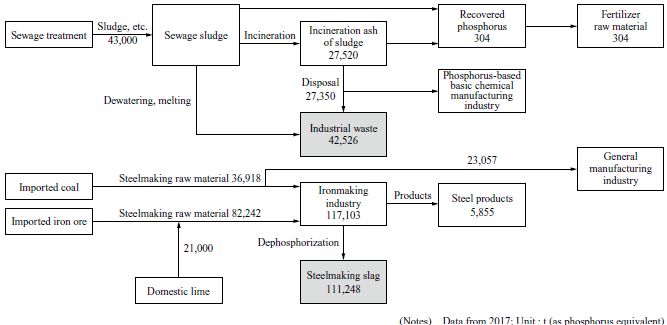
Yellow phosphorus is an industrially important resource, but it is a non-renewable resource entirely dependent on imports for its supply in Japan. As such, there are concerns about the stability of its supply, and domestic production is desirable to ensure a stable supply. Ohtake(1) investigated the material flow of phosphorus in Japan. Part of the findings from this investigation is shown in Fig. 1. According to the figure, industrial waste derived from sewage sludge and steelmaking slag contains approximately 42,000 t and 111,000 t of phosphorus (P), respectively, as a net content annually. Both quantities exceed the total volume of phosphorus imported as phosphate ore, which is approximately 34,000 t. Phosphorus obtained from sludge via wet-process phosphate production has a low purity of 25 to 30% and is mostly used for fertilizer and related applications(2). While there are reports, such as by Yu et al.(3), exploring high-purity yellow phosphorus production via phosphate derived from sludge, challenges such as electricity prices and transportation costs are considered barriers to practical implementation in Japan. Therefore, this study focuses on phosphorus production from steelmaking slag, which is the largest untapped domestic phosphorus resource. In steelmaking slag, phosphorus exists in the form of oxides, and it is expected that reduction processes will be able to generate high-value-added yellow phosphorus.
The challenges of conventional technology and the advantages of the method proposed in this study are summarized in Table 1. In conventional technologies that use coke (C) as a reducing agent, the reaction temperature exceeds 1,473 K(4), (5), and the process requires an enormous amount of electric power, 14,000 kW·h/t of phosphorus produced(2). This poses a major challenge to the practical implementation of the technology. To address this issue, this study investigated the use of silicon (Si), a stronger reducing agent than C, to enable phosphorus production at lower temperatures. This stronger reducing power is attributed to Si’s larger atomic radius, lower electronegativity, and its stronger tendency to release electrons. Furthermore, Si can be easily obtained as silicon sludge, an underutilized domestic resource in Japan. Fujimura et al.(6) used powdered Si reagent as a reducing agent for the slag simulant material and found that yellow phosphorus was produced at 1,273 K. They also reported that the grinding (milling) of the slag simulant material and Si improved the reactivity.

In this study, with industrialization in mind, we examined the feasibility of producing phosphorus from low-concentration sources by changing the raw material from calcium phosphate, a slag simulant containing 20 wt% phosphorus, to a slag-like composition containing approximately 3 wt% phosphorus (hereinafter referred to as slag). Additionally, to simplify the process, we explored a method that omits the pretreatment involving milling of the raw material with a Si reagent, which had been found effective in the study by Fujimura et al. Phosphorus production experiments were conducted at a reaction temperature of 1,273 K, which is lower than that used in conventional methods, and the reaction mechanism was examined.
2. Experimental Method
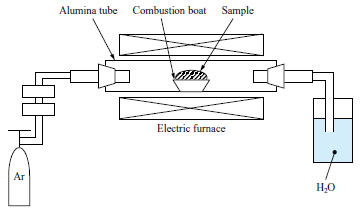
Three types of samples were prepared by mixing slag with a Si reagent (99.9%). The slag used in this experiment contains 2.89 wt% phosphorus in the form of P2O5. The experimental apparatus used is shown in Fig. 2. Each sample was placed in an alumina combustion boat, positioned at the center of an alumina tube, and heated in an electric furnace. After reaching the target reaction temperature, the sample was held at that temperature for a specified duration. The detailed experimental conditions are presented in Table 2. A silicone stopper was attached to the alumina tube, and argon (Ar) gas (99%) was passed through the system at a flow rate of 4 L/min during heating. The reduced and gasified yellow phosphorus was carried with the Ar gas into a subsequent water (H₂O) trap, where it solidified and was recovered. The processed samples were weighed, and their chemical composition was analyzed using an X-ray fluorescence (XRF) analyzer.
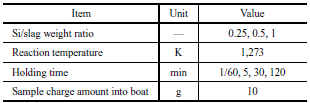
To investigate the mechanism of phosphorus reduction reactions in the slag-Si system, SEM-EDS (scanning electron microscopy with energy-dispersive X-ray spectroscopy) analysis was conducted on samples treated under the condition where the ratio of the weight of Si to that of slag (hereinafter referred to as “Si/slag weight ratio”) was set to 0.25. After reaching the target temperature of 1,273 K, the temperature was maintained constant while varying the holding time.
3. Results
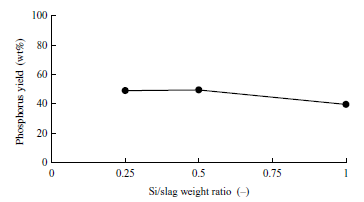
Figure 3 shows the phosphorus yield obtained when a mixed sample of slag and Si was held for four hours after reaching a temperature of 1,273 K. Here, the phosphorus yield Y was defined by Equation (1) using the sample weights before and after heating, Wa and Wb, respectively, and the weight fractions of P2O5 in the samples before and after heating, xa and xb, as determined by XRF analysis.

As shown in Fig. 3, within the range of the collected data, the phosphorus yield was highest when the Si/slag weight ratio was 0.25, and no further increase in phosphorus yield was observed even when the amount of Si added was increased.
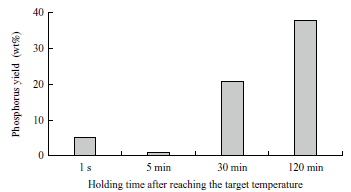
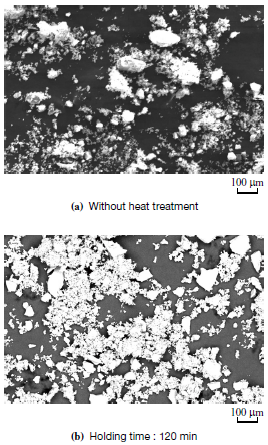
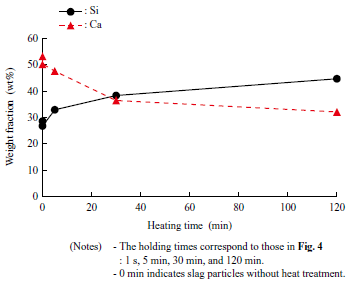
The results of the SEM-EDS analysis are shown in Figs. 4 to 6. For comparison, SEM observations were also conducted on a sample that was not subjected to heating. As shown in Fig. 4, the phosphorus yield increased with longer holding times. A particularly significant increase was observed when the holding time was between 5 and 30 min. Furthermore, based on the SEM observation results in Fig. 5, in the case without heat treatment, the particles were dispersed, whereas in the case with a holding time of 120 min, the particles appeared to be agglomerated due to sintering. Figure 6 presents the results of the elemental weight fraction analysis conducted on the surface of a single sintered particle in Fig. 5-(a) and -(b). It was confirmed that as the holding time increased, the weight fraction of Si in the slag increased, while the weight fraction of calcium (Ca) decreased.
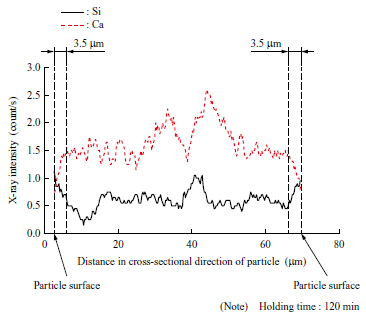
A cross section of a sample with a Si/slag weight ratio of 0.25, a temperature of 1,273 K, and a holding time of 120 min was subjected to SEM-EDS analysis. The results are shown in Fig. 7. As seen in Fig. 7, the area near the particle surface had a lower Ca concentration and a higher Si concentration compared to the center. This suggests that the diffusion of Si, which serves as the reducing agent, into the slag increased the Si concentration and consequently decreased the Ca concentration. This tendency was particularly pronounced within 3.5 μm from the particle surface, which is considered to support the mechanism described later.
4. Discussion
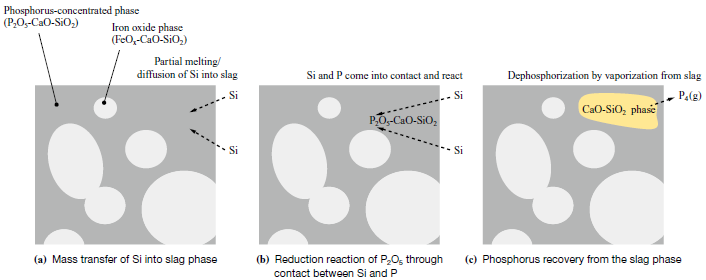
The reaction mechanism of the slag-Si system was examined based on the results shown in Fig. 6. In the SEM image in Fig. 5-(b), there was no indication that the entire sample had melted. Therefore, it is presumed that the reduction reaction proceeded from the contact interface where phosphorus in the slag and the reducing agent Si came into contact through partial melting or sintering of the solid phase (in particular, solid-state bulk diffusion). The melting point of the phosphorus-concentrated phase in the slag (a solid solution of CaO-P2O5-SiO2) is approximately 2,273 K(7). Accordingly, it is considered that partial melting of Si, which has a melting point of 1,687 K, or its diffusion from the interface caused Si to migrate into the slag phase, initiating the reduction reaction.
From the above, the results in Fig. 6 can be interpreted as indicating that, over the course of the holding time, Si partially melted or diffused, migrated into the slag, and diluted the Ca within the slag particles. The reaction mechanism inferred from the above discussion is illustrated in Fig. 8. Mass transfer occurs as Si partially melts or diffuses into the phosphorus-concentrated phase in the slag (P2O5-CaO-SiO2)(7). The reaction temperature of 1,273 K used in this study is approximately 0.75 times the melting point of Si, which is 1,687 K. Under these conditions, if the mass transfer of Si is diffusion-controlled, grain boundary diffusion or bulk (lattice) diffusion is presumed to be the dominant diffusion mode(8). It is thought that a reduction reaction occurred in the slag as the reactant P2O5 came into contact with diffused Si, resulting in the recovery of phosphorus from the slag in the form of yellow phosphorus, P4(g). The results shown in Fig. 7 are considered to indicate a mechanism in which Si particles diffuse to the surface of the slag particles and along the grain boundaries.
5. Conclusion
The following findings were obtained from this experiment:
- By using silicon (Si), which has a stronger reducing power than coke (C), phosphorus was successfully generated from slag at a lower temperature of 1,273 K compared to conventional coke reduction. The new process developed in this study has the potential to reduce power consumption compared to conventional methods.
- The fact that phosphorus could be generated under certain treatment conditions even without milling, as shown in this study, suggests the possibility of simplifying the process, which could in turn help reduce capital investment costs.
- At 1,273 K, partial melting of Si or diffusion from the particle interface occurred between the slag and Si particles. Analysis results confirmed the mechanism by which Si diffuses into the slag.
- Progress in this study is expected to enhance the resource value of raw materials such as slag and silicon sludge. In addition, it is anticipated to contribute to the realization of a circular economy for phosphorus resources, for which Japan currently relies on imports, not only within Japan, but also on a global scale.
- — Acknowledgments —
- The authors would like to express their sincere gratitude to Professor Eiji Yamasue, Associate Professor Shunsuke Kashiwakura, and Mr. Haruki Okamura of the Laboratory of Energy and Resource Circulation, Department of Mechanical Engineering, College of Science and Engineering, Ritsumeikan University, for their valuable advice and support in the course of this study.
REFERENCES
(1) H. Ohtake : Overview of the Phosphorus Problem: Phosphorus Recycling and Supply Risks, Kinzoku Materials Science & Technology, Vol. 91, No. 11, 2021, pp. 4-11 (in Japanese)
(2) E. Yamasue et al. : Historical Transitions in Yellow Phosphorus Production and Future Issues, Kinzoku Materials Science & Technology, Vol. 91, No. 11, 2021, pp. 12-16 (in Japanese)
(3) H. Yu et al. : Production of Yellow Phosphorus from Crude Phosphoric Acid Derived from Secondary Phosphorus Resources, Kinzoku Materials Science & Technology, Vol. 91, No. 11, 2021, pp. 23-29 (in Japanese)
(4) S. Takeuchi et al. : Separate Recovery of Iron and Phosphorus from BOF Slags by Using Fe-Si Alloys, Tetsu-to-Hagané, Vol. 66, No. 14, 1980, pp. 30-37 (in Japanese)
(5) A. Matsui et al. : Phosphorus Separation from Steelmaking Slag by High Temperature Reduction with Mechanical Stirring, Tetsu-to-Hagané, Vol. 97, No. 8, 2011, pp. 10-16 (in Japanese)
(6) S. Fujimura et al. : A Novel Process for Yellow Phosphorus Formation from a Steelmaking Slag Using Silicon Sludge, CAMP-ISIJ, Vol. 33, No. 1, 2020, PS-6 (in Japanese)
(7) H. Kubo : Phosphorus Recovery from Steelmaking Slag Generated in the Steel Industry, Kinzoku Materials Science & Technology, Vol. 91, No. 11, 2021, pp. 51-55 (in Japanese)
(8) A. Kamegawa : Lecture Materials on Materials Science, https://u.muroran-it.ac.jp/hydrogen/lec/zaika_file/zaikab_1_8.pdf, accessed 2024-08-22 (in Japanese)