
Introduction of Demonstration Facility Utilizing a Compact Methanation System
— The Production of e-methane Utilizing CO₂ Derived from Biogas and Its First Use as a Raw Feedstock for City Gas in Japan —
SUWABE Masato, FUKUSHIMA Naomi, YANO Akihisa, ENDO Takumi

SUWABE Masato : Process Engineering Department, Life Cycle Business Center, IHI Plant Service Corporation
FUKUSHIMA Naomi : Manager, Project Department, Life Cycle Business Center, IHI Plant Service Corporation
YANO Akihisa : Manager, Process Engineering Department, Life Cycle Business Center, IHI Plant Service Corporation
ENDO Takumi : Manager, Production Engineering Department, Aioi Works, Carbon Solution Business Unit, Resources, Energy & Environment Business Area
As a carbon-neutral solution, IHI Corporation is adopting the methanation technologies. IHI is expanding the sales of a Compact Methanation System (e-methane production : 12.5 Nm3/h) with the aim of promoting methanation demonstration tests by customers. In addition, IHI is also promoting the introduction of MEDICUS NAVI® system in order to remotely monitor the operating status of the facility and manage environmental value. This article introduces the construction achievements of delivering the Compact Methanation System and related equipment and implementing MEDICUS NAVI system.
1. Introduction
The Japanese government has declared its goal to reduce greenhouse gas emissions to net zero, that is, to achieve carbon neutrality by 2050. As one of the carbon-neutral solutions, IHI Corporation (IHI) is working on establishing and implementing methanation to produce e-methane.
Methanation is a technology for synthesizing methane, one of the main components of city gas, from renewable energy-derived hydrogen (H₂) and carbon dioxide (CO₂), which is a greenhouse gas. This technology is presented as one of the specific measures to achieve carbon neutrality in the next-generation heat energy industry in the “Green Growth Strategy Through Achieving Carbon Neutrality in 2050” (Ministry of Economy, Trade and Industry). The methane synthesized through methanation is called e-methane, which is expected to be a key application of captured CO₂.
There is a movement to accredit the amount of CO₂ emission reduction as environmental value to achieve carbon neutrality. To support this accreditation, IHI offers an operation and maintenance support system, the MEDICUS NAVI service(1). This service provides the environmental value management and remote monitoring screens using a web browser on the Internet based on the operational data of each device and instrument, from customers’ hydrogen production systems and off-gas compression facilities to the supply of e-methane. MEDICUS NAVI uses customers’ operational data collected by ILIPS(2) (IHI group Lifecycle Partner System). ILIPS is an IoT system for the entire IHI Group to accumulate data on IHI Group products and devices in a cloud server and use the data for the lifecycle business.
In June 2022, TOHO GAS Co., Ltd. announced in a press release that the company would work with Chita City in Aichi Prefecture to conduct a demonstration test of methanation using biogas-derived CO₂ generated at the Chita City Southern Purification Center(3). IHI delivered a Compact Methanation System and related equipment used in this demonstration test. This was IHI’s first commercial methanation device. TOHO GAS became the first company to use e-methane as city gas feedstock in Japan.
2. Work overview
2.1 Methanation demonstration facility
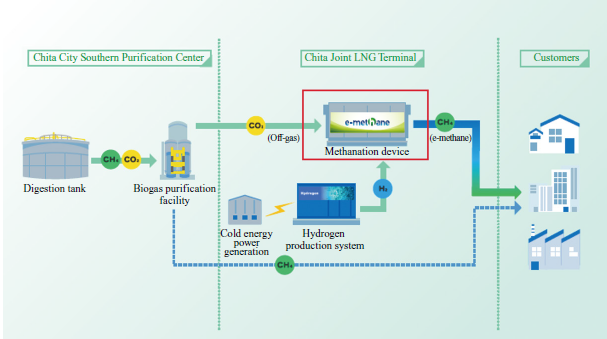
Figure 1 shows the process flow of the methanation demonstration test that TOHO GAS and Chita City are conducting(4). IHI delivered a Compact Methanation System (labeled as “Methanation device” in Fig. 1) and related equipment (except for the hydrogen production system) to the TOHO GAS Chita Joint LNG Terminal.
2.2 Process overview
This section provides an overview of the processes of the delivered methanation demonstration facility.
2.2.1 Off-gas compression facility
The off-gas compression facility compresses off-gas emitted from a biogas purification facility. This facility consists of an inlet tank, compressor, heat exchanger, condenser, KO drum (knockout drum: drum for separating gas and liquid), and off-gas tank. The compressor installed at the Chita joint LNG terminal accumulates the off-gas containing a large amount of CO₂ generated during the operation of the biogas purification facility at the Chita City Southern Purification Center in the off-gas tank. Then, the condenser cools the off-gas to condense the water in the off-gas.
2.2.2 Compact Methanation System
The Compact Methanation System reacts CO₂ and H₂ using a methanation catalyst to produce e-methane. As the amount of e-methane produced in this methanation demonstration facility is 5 Nm3/h, the Compact Methanation System launched by IHI, with a rated production amount of e-methane of 12.5 Nm3/h, can be used.
The CO₂ concentration in the off-gas generated during biogas purification facility operation fluctuates from moment to moment. The device provides control to efficiently convert CO₂ into e-methane by changing the flow rates of off-gas and hydrogen required for the reaction in proportion to changes in the CO₂ concentration(6).
2.2.3 Synthetic methane compression facility
The synthetic methane compression facility consists of a synthetic methane tank, compressor, heat exchanger, condenser, and KO drum. This facility compresses the e-methane, which is generated by the Compact Methanation System, in the compressor and then removes water from the e-methane. The condenser cools the e-methane to condense and remove water to the dew point level at which the e-methane can be used as city gas.
2.3 MEDICUS NAVI
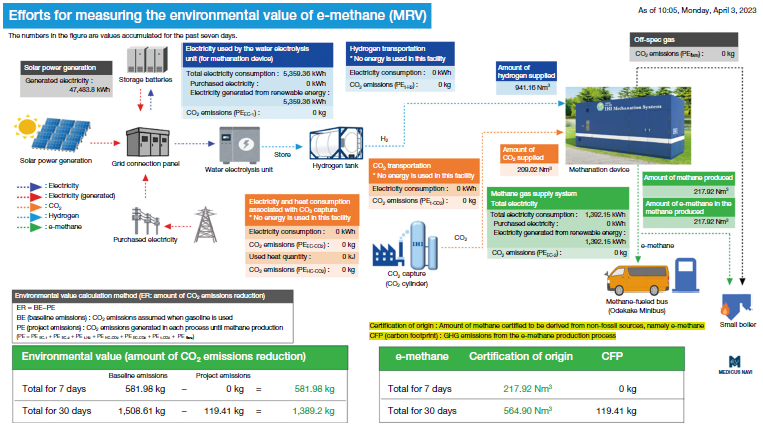
The methanation demonstration facility incorporates MEDICUS NAVI(1). By using this system, the user can manage data such as the amount of CO₂ reduced by the methanation demonstration facility on the environmental value management screen and remotely monitor the methanation demonstration facility on the remote monitoring screen. IHI can also take advantage of this system to quickly analyze causes and consider actions if the methanation demonstration facility fails. Figure 2 shows the environmental value management screen(6).
2.4 Characteristics of this project
The characteristics of this project are (1) design of the off-gas compression facility using dynamic simulation, (2) skid mounting (integration) of facilities, and (3) control design considering variations in off-gas components.
2.4.1 Design of the off-gas facility using dynamic simulation
The off-gas generated from the biogas purification facility at the Chita City Southern Purification Center is approximately atmospheric pressure. The pressure and flow rate of the off-gas periodically change (pulsation). In addition, the biogas purification facility operates intermittently. It is therefore critical to consider starting and stopping of the biogas purification facility in the design.
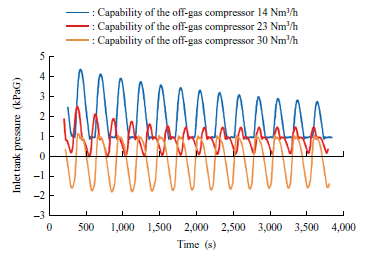
IHI examined the specifications of the off-gas facility using dynamic simulation for design. Dynamic simulation assumes unsteady states such as start and stop. Figure 3 shows the result of dynamic simulation of variations in the inlet tank pressure due to differences in the capability of the off-gas compressors. IHI optimally designed the facility, including the capacity of the inlet tank, by using the dynamic simulation results.
2.4.2 Skid mounting of facility
The footprint of the entire demonstration facility is approximately equivalent to two tennis courts. In addition, the space available for the work is limited on the site. IHI mounted the off-gas compression facility and synthetic methane compression facility, which consist of many different devices, on a skid at our factory before delivery to the site to reduce the on-site work and work period.
2.4.3 Control design considering variations in off-gas components
The off-gas contains methane and nitrogen in addition to CO₂. The Composition of off-gas is not constant but fluctuate from moment to moment. In other words, the amount of CO₂ in the off-gas input to the Compact Methanation System as the feedstock fluctuates from moment to moment. Therefore, H₂ must be supplied in proportion to the amount of CO₂. To produce high-purity e-methane, IHI designed controls that account for variations in off-gas composition.
3. Result of commissioning, use as a city gas feedstock, opening of the Chita e-methane production demonstration facility, and use of MEDICUS NAVI
3.1 Result of commissioning
After installing the methanation demonstration facility on the site, IHI conducted a commissioning. We conducted performance tests on the delivered facility and confirmed that the following guarantee items were achieved.
(1) Dew point temperature, flow rate, and pressure of e-methane
(2) Purity of e-methane
The expected effects of each characteristic of this project described in Section 2.4 were also achieved. In particular, we confirmed that the performance of the off-gas facility almost matched the simulation results during the commissioning regarding the design of the off-gas facility using dynamic simulation.
3.2 Use as a city gas feedstock
After the performance test of the delivered facility, TOHO GAS started using the e-methane produced at the methanation demonstration facility as a city gas feedstock for the first time in Japan.
3.3 Opening of the Chita e-methane production demonstration facility
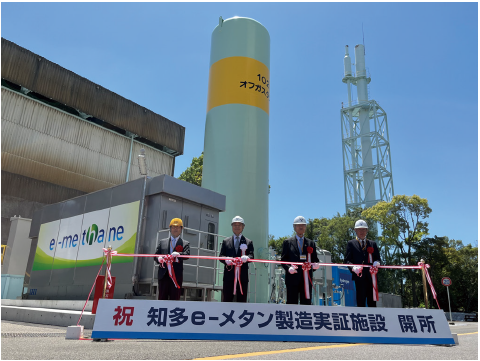
In May 2024, TOHO GAS opened the Chita e-methane production demonstration facility(4). Figure 4 shows the opening ceremony.
The achievements and insights obtained from this demonstration facility are expected to be useful for considering the expansion and cost reduction of facility production, as well as for promoting the wider adoption of e-methane toward its full-scale introduction in the future.
3.4 Use of MEDICUS NAVI
The delivered methanation demonstration facility has been in operation since the opening of the Chita e-methane production demonstration facility. IHI is also remotely monitoring the operating status.
In addition, IHI evaluates operation efficiency and other items, while obtaining operation data, and shares and discusses evaluation results with TOHO GAS mainly in the view of scaling-up.
4. Future prospects
This article reports the work to deliver the Compact Methanation System and related equipment to the Chita e-methane production demonstration facility. The delivered device is the first commercial Compact Methanation System of IHI. IHI has adopted methanation as one of the carbon-neutral solutions. For further scale-up, we are considering methanation facilities that produce several hundred to several tens of thousands of Nm3/h of e-methane.
Regarding Compact Methanation System, we are working on expanding sales, including rentals, to promote methanation demonstration tests by delivering devices to customers. We are also facilitating linkage with small-scale CO₂ capture devices launched in FY2023. As of November 2024, three Compact Methanation System are operating and work for four Compact Methanation System is in progress. We have also received many inquiries.
Medium-scale methanation facilities are also already at the stage of practical application. IHI plans to deliver a methanation facility to capture 24 t of CO₂from blast furnace gas per day and produce 500 Nm3/h of e-methane for the carbon recycling blast furnace at the East Japan Works Chiba District of JFE Steel Corporation in FY2025(7) (development of the hydrogen reduction technology using a blast furnace and development of technologies such as the low-carbon technology using external hydrogen or CO₂ in blast furnace gas from a blast furnace in a research and development commission and grant project of New Energy and Industrial Technology Development Organization (NEDO) (JPNP21019), Green Innovation in Steelmaking (GREINS) (Utilizing Hydrogen in Steelmaking Process)).
Furthermore, IHI is developing large-scale methanation facilities that produce several thousand to several tens of thousands of Nm3/h of e-methane, mainly focusing on the advancement of catalysts, the scale-up of the reactor, and the effective use of reaction heat, aiming for their commercialization by the end of FY2030.
IHI will contribute to the reduction in CO₂ emissions by promoting methanation to realize carbon neutrality.
- — Acknowledgments —
- We express our deep gratitude for the significant understanding and cooperation of TOHO GAS Co., Ltd. and Toho Gas Energy Engineering Co., Ltd. in promoting this project.
REFERENCES
(1) IHI Corporation : Efforts of Maintenance and Operation Support for Thermal Power Boilers, IHI Engineering Review, Vol. 56, No. 2, 2023
(2) IHI Corporation : Deployment of the ILIPS Environmental Value Management Platform, IHI Engineering Review, Vol. 56, No. 2, 2023
(3) TOHO GAS Co., Ltd. : Press Release “Demonstration Test of Methanation Using Biogas-derived CO₂ in Collaboration with Chita City,” https://www.tohogas.co.jp/corporate-n/press/1229823_1342.html, accessed 2024-08-26 (in Japanese)
(4) TOHO GAS Co., Ltd. : Press Release “Start of the Demonstration of e-methane Production Using Biogas-derived CO2 in Collaboration with Chita City — First Use of Produced e-methane as a city gas feedstock in Japan —,” https://www.tohogas.co.jp/corporate-n/press/1243273_1342.html, accessed 2024-08-26 (in Japanese)
(5) IHI Corporation : Effective Utilization of Captured CO₂ with Compact Methanation Devices, Journal of IHI Technologies, Vol. 63, No. 2, 2023 (in Japanese)
(6) IHI Corporation : Press Release “Delivery of a Standard Methanation Device for the TOHO GAS Chita e-methane Production Demonstration Facility,” https://www.ihi.co.jp/all_news/2024/resources_energy_environment/1200833_13676.html, accessed 2024-08-27 (in Japanese)
(7) IHI Corporation : Press Release “IHI Group to Contribute Further to Carbon Dioxide Recycling from Exhaust Gases through New JFE Steel Order for World’s Largest Methanation Unit”, https://www.ihi.co.jp/en/all_news/2022/resources_energy_environment/1198177_3488.html, accessed 2024-08-27