
Development of High Speed SiC Coating Process for CMC
KUBOTA Wataru, TANAKA Yasutomo, FUKUSHIMA Yasuyuki, KOTANI Masahiro
KUBOTA Wataru : Materials & Structural Engineering Department, Technology Platform Center, Corporate Research & Development Division
TANAKA Yasutomo : Manager, Materials & Structural Engineering Department, Technology Platform Center, Corporate Research & Development Division
FUKUSHIMA Yasuyuki : Doctor of Engineering, Manager, Applied Physics & Chemistry Department, Technology Platform Center, Corporate Research & Development Division
KOTANI Masahiro : Doctor of Engineering, Manager, Materials & Structural Engineering Department, Technology Platform Center, Corporate Research & Development Division
Ceramic matrix composites (CMC) are desirable for use in high-temperature components of aeroengines due to their light weight and superior high-temperature properties. The chemical vapor infiltration (CVI) process gives the SiC matrix excellent high-temperature properties, but it takes the long process time. In this study, we have developed a high-speed CVI process using a reaction mechanism different from conventional CVI and evaluated the new CVI process’s functions. As a result, we established conditions that give high growth rate and coating uniformity, and achieved good results in terms of film crystallinity, film composition, and the mechanical properties of CMC.
1. Introduction
The CO₂ emissions from the international aviation sector account for approximately 1.8% (620 Mt) of global emissions. The International Civil Aviation Organization (ICAO) estimates that if no countermeasures are taken to reduce CO₂ emissions, the CO₂ emissions from international aviation will increase by approximately 2.5 times compared to 2019. Against this background, the ICAO adopted a long-term goal of achieving carbon neutrality by 2050 at its 2022 Assembly(1). In this way, to reduce CO₂ emissions as a measure against climate change, the aviation industry has been advancing the development of technologies for weight reduction and fuel efficiency improvements. In the case of aircraft engines, materials that are lightweight and highly heat-resistant have been developed, as improving the heat resistance of turbine materials enables higher turbine inlet temperatures and reduced cooling air, leading to improved fuel efficiency. Nickel-based alloys, which are currently the mainstream engine materials, are already being used at temperatures close to their heat resistance limit. As an alternative, ceramic matrix composites (CMC) have been developed, which leverage the lightweight and heat resistance advantages of ceramics while overcoming their inherent brittleness(2).
There are two types of ceramics: oxide-based and non-oxide-based. Among these, non-oxide-SiCf /SiC-based CMC, consisting of silicon carbide (SiC) fibers and a SiC matrix, are currently expected to offer the highest operational temperature resistance. SiCf /SiC-based CMC is manufactured through many production processes. In the manufacturing process of SiCf /SiC-based CMC, the chemical vapor infiltration (CVI) process, which uses methyltrichlorosilane (MTS) as the main raw material, is employed to form a SiC matrix with fewer voids in a SiC fiber laminate. The CVI process is generally characterized by its ability to form dense, high-purity films, though it is also known for longer processing times.
The key feature of the CVI process is its ability to form a film on the fiber surfaces inside the fiber laminate (film deposition uniformity). To achieve this, it is necessary to maintain diffusion paths for MTS into the laminate until the process is complete. When increasing reactivity for faster film formation, occlusion may occur due to film deposition near the entrance of paths, which hinders MTS diffusion into the laminate and degrades film deposition uniformity. On the other hand, enhancing diffusion requires selecting conditions with slower reactivity. Thus, reactivity and diffusibility are in a trade-off relationship. As a result of prioritizing diffusibility, conventional CVI is considered to be a time-consuming process(3).
This study proposed a novel CVI process (hereinafter referred to as the “high-speed CVI process”) that utilizes a reaction mechanism different from conventional CVI, and evaluated its functions required for the CVI process.
2. Proposal of the high-speed CVI process
Figure 1 shows a conceptual diagram comparing the conventional CVI process and the high-speed CVI process. According to recent reports on the reaction mechanism of the conventional CVI process, MTS, used as a raw material, generates two main types of film-forming species in the gas phase: one with low diffusivity and the other with high diffusivity(4). Low-diffusivity film-forming species, such as methyl radicals (CH3•), immediately deposit on the surface layer of the fiber laminate and block the diffusion paths inside the laminate. As a result, they reduce the diffusion rate and become a limiting factor for the film deposition rate in the CVI process.
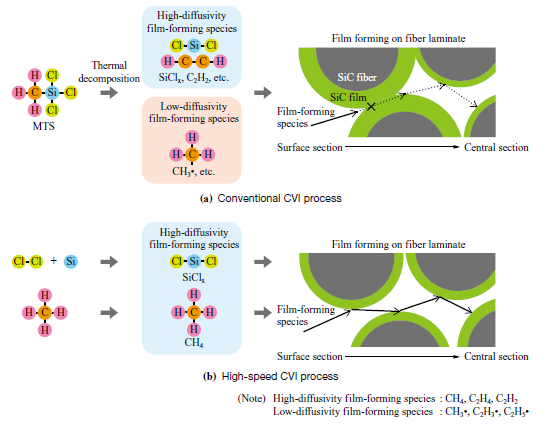
On the other hand, the high-speed CVI process forms SiC film using only high-diffusivity film-forming species. The high-diffusivity film-forming species used in this study were CH4 as the carbon source and SiClx as the silicon source. Because these film-forming species have high diffusivity, they can suppress occlusion of the diffusion paths even when reactivity is increased. Therefore, they are expected to enable high-speed film formation while maintaining film deposition uniformity(5).
Figure 2 shows a schematic diagram of the CVI process equipment. The high-speed CVI process equipment consists of three zones: the gas generation zone, the gas mixing zone, and the film deposition zone. The chemical equation for the gas generation zone is shown in Equation (1).
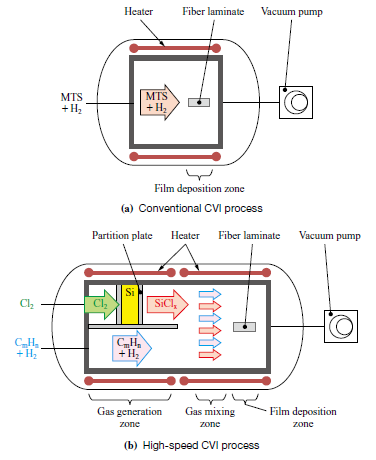
Si (powder) + Cl2 (gas) → SiClx (gas) (1)
SiClx gas, a high-diffusivity film-forming species, is selectively generated by supplying Cl2 gas to silicon powder. A similar process is the Hydride Vapor Phase Epitaxy (HVPE) method, which has been reported to achieve high growth rates of gallium nitride (GaN) crystals exceeding 50 nm/h(6). The HVPE method is a film deposition technique in which raw materials for the film-forming species are converted into chlorinated gases, transported in the gas phase, and deposited onto the substrate. This technique is applied in the high-speed CVI process. What differentiates the high-speed CVI process from the HVPE method is its focus on film deposition on the surfaces of fibers within a fiber laminate. By selectively generating only high-diffusivity film-forming species, the process achieves high-speed film deposition inside the fiber laminate.
3. Test method
3.1 Concept verification
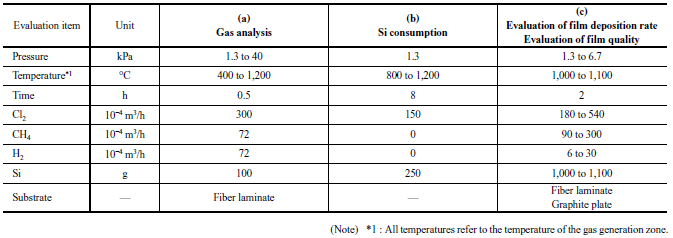
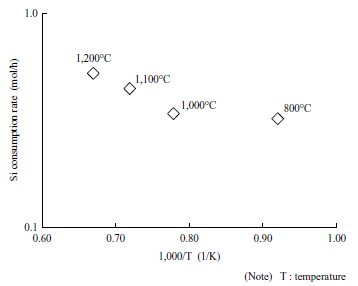
First, we verified whether the concept of the high-speed CVI process presented in Chapter 2 is valid. Among the film deposition conditions for the high-speed CVI process shown in Table 1, conditions -(a) and -(b) were used to verify the concept. To confirm that SiClx gas was selectively generated, a quadrupole mass spectrometer (QMS) was connected to the exhaust piping to analyze the post-reaction gases. Next, to identify the factors affecting the amount of SiClx gas generated, tests were conducted at different temperatures in the gas generation zone, and the Si consumption rate was calculated based on the weight of the Si powder before and after the tests.
3.2 Evaluation of film deposition rate
Based on the results obtained in Section 3.1, the film deposition rate of the high-speed CVI process on the fiber laminate was evaluated. The film deposition conditions used for this evaluation are shown in Table 1-(c). After film deposition, the cross section of the fiber laminate was observed using a scanning electron microscope (SEM). The film deposition rate was calculated based on the thickness of the SiC film formed on the fibers and compared with that of the conventional CVI process.
3.3 Evaluation of film quality
The roles of the matrix in CMC are to maintain stiffness in the elastic deformation region and to prevent oxidation of the fibers and interfacial layers in high-temperature oxidizing atmospheres. A change in the reaction mechanism may alter the film quality and potentially degrade the functionality of the matrix. Therefore, it is necessary to evaluate the film quality, which is considered essential for the proper manifestation of the matrix’s functions. In this research, the film-forming uniformity, crystallinity, composition, and mechanical properties of the SiC film obtained by the high-speed CVI process were evaluated. The film deposition conditions used for evaluating film quality were the same as those in Section 3.2 and are shown in Table 1-(c). Film-forming uniformity was evaluated by observing cross sections of the fiber laminate using a SEM. Crystallinity and composition were analyzed using graphite plates as substrates by X-ray diffraction (XRD) and X-ray photoelectron spectroscopy (XPS), respectively. In evaluating the mechanical properties, a SiCf /SiC system CMC test specimen with a dense matrix was prepared by applying a high-speed CVI process to the fiber laminate, followed by a low-temperature melt impregnation process(7). The mechanical properties were evaluated using the test specimen through static tensile tests conducted in air at room temperature and at 1,100°C.
4. Results and discussion
4.1 Concept verification
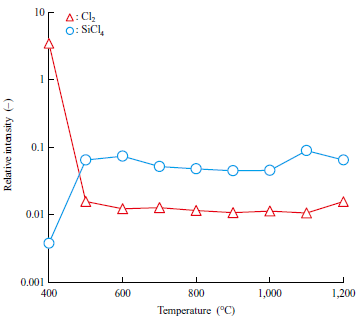
Figure 3 shows the temperature dependence of the gas composition after the reaction, obtained from the QMS. Only Cl2 gas and SiCl4 gas are shown as representative examples. At 400°C, Cl2 was the dominant component, while at temperatures above 500°C, SiCl4 became the main component. Based on the above, it has been shown that a Si source can be transported to the film deposition zone in the form of SiClx gas, and that a temperature of 500°C or higher is required for film deposition to occur. Figure 4 shows an Arrhenius plot for the Si consumption rate in the gas generation zone. Around the film deposition temperature of 1,000°C, a distinct change in the rate of Si consumption was observed. From the obtained Arrhenius plot, the calculated activation energies were 1.0 kJ/mol in the region from 800 to 1,000°C, and 14.1 kJ/mol in the region from 1,000 to 1,200°C, where relatively high Si reactivity was observed. This result suggests that, at around 1,000°C, there is a change in the reaction path for SiClx generation and in the types of generated gases. Since the activation energy of 14 kJ/mol is comparable to the Van der Waals force, it can be inferred that the process in which SiClx generated on the surface of Si powder sequentially desorbs is the rate-limiting step in SiClx generation. Based on the above, maintaining the temperature of the gas generation zone at 1,000°C or higher is expected to allow a larger supply of raw material gas, thereby increasing reactivity and the film deposition rate.
4.2 Evaluation of film deposition rates
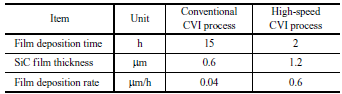
Table 2 shows the SiC film deposition rates for the conventional CVI process and the high-speed CVI process. In the high-speed CVI process, a large amount of SiC film was successfully formed in a short time, and it was confirmed that the deposition rate was more than 10 times faster than that of the conventional CVI process.
4.3 Evaluation of film quality
4.3.1 Film deposition uniformity
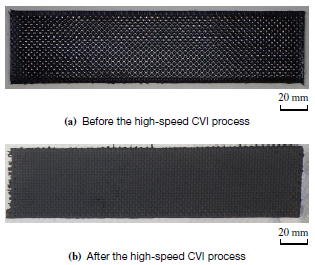
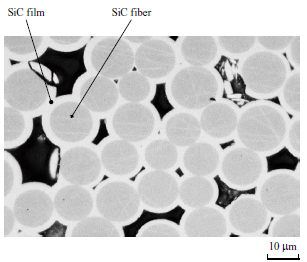
Figure 5 shows the appearance of the fiber laminate before and after the high-speed CVI process. After the process, the fiber laminate exhibited a uniform gray color, indicating the formation of a dense matrix. Figure 6 shows the cross-sectional SEM image of the interior of the fiber laminate. It was confirmed that the film thickness inside the fiber bundle, where the fibers were densely packed, was equivalent to that of the surface layer of the laminate. These results demonstrate that a film with good uniformity can be formed without occlusion, even at a high film deposition rate.
4.3.2 Crystallinity
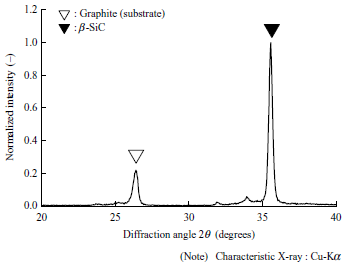
Figure 7 shows the X-ray diffraction pattern of the SiC film formed by the high-speed CVI process. The peak position of the SiC film in the obtained diffraction pattern was 35.56°, and the full width at half maximum (FWHM) of the diffraction angle 2θ was 0.28°. This confirms that a highly crystalline β-SiC film can be obtained through the high-speed CVI process. Having a highly crystalline β-SiC matrix is expected to provide excellent high-temperature stability.
4.3.3 Composition
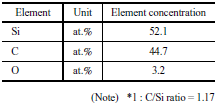
Table 3 shows the composition ratio of the SiC film formed through the high-speed CVI process, as obtained from XPS analysis. After forming a SiC film with a thickness of at least 1 μm on a substrate, composition analysis was performed at a depth of approximately 200 nm from the surface using argon ion beam sputtering. According to the analysis results, the composition ratio was close to Si:C = 1:1, indicating a stoichiometric composition with few impurities. As with high crystallinity, having a matrix with a stoichiometric composition implies that excellent high-temperature stability can be expected.
4.3.4 Mechanical properties
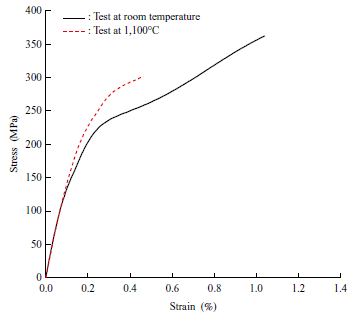
Figure 8 shows the results of static tensile tests conducted at room temperature and at 1,100°C in air for the SiCf /SiC CMC. The SiC matrix formed through the CVI process, due to its high stiffness and high heat resistance, is crucial for exhibiting the mechanical properties of CMC, and has a particularly significant impact on the initial stiffness and fracture behavior. The test results show that high initial stiffness, around 170 GPa, and pseudo-ductile behavior were observed both at room temperature and in a high-temperature environment, similar to general CMC. Additionally, it was confirmed that the mechanical properties were equivalent to those of CMC produced using the conventional CVI process. Based on the above, it has been shown that the matrix formed through the high-speed CVI process contributes to the manifestation of the mechanical properties of CMC.
5. Conclusion
In this study, a high-speed CVI process utilizing a reaction mechanism different from the conventional CVI was proposed. After evaluating the functions required for the CVI process, the following conclusions were obtained.
- The film deposition conditions necessary for the high-speed CVI process were identified.
- The high-speed CVI process is capable of maintaining film deposition uniformity while having a film deposition rate more than 10 times faster than that of conventional CVI process.
- The crystallinity and composition of the SiC film formed through the high-speed CVI process, as well as the mechanical properties of the CMC manufactured using the high-speed CVI process, were both confirmed to be excellent.
For the practical application of the high-speed CVI process, it will be necessary to acquire further basic characteristics and assess the manufacturing capabilities in the future.
REFERENCES
(1) ICAO:Environmental Trends,https://www.icao.int/environmental-protection/Pages/environmental-trends.aspx, accessed 2024-11-18
(2) T. Nakamura, T. Oka, K. Imanari, K. Shinohara and M. Ishizaki : Development of CMC Turbine Parts for Aero Engines, IHI Engineering Review, Vol. 47, No. 1, 2014
(3) R. Naslain : Design, preparation and properties of non-oxide CMCs for application in engines and nuclear reactors: an overview, Composites Science and Technology, Vol. 64, No. 2, 2004, pp. 155-170
(4) Y. Fukushima, N. Sato, Y. Funato, H. Sugiura, K. Hotozuka, T. Momose and Y. Shimogaki : Multi-Scale Analysis and Elementary Reaction Simulation of SiC-CVD Using CH3SiCl3/H2: I. Effect of Reaction Temperature, ECS Journal of Solid State Science and Technology, Vol. 2, No. 11, 2013, pp. 492-497
(5) IHI Corporation : Method for Manufacturing Composite Materials, Patent No. 7052570 (in Japanese)
(6) K. Fujito, S. Kubo, H. Nagaoka, T. Mochizuki, H. Namita and S. Nagao : Bulk GaN crystals grown by HVPE, Journal of Crystal Growth, Vol. 311, No. 10, 2009, pp. 3,011-3,014
(7) S. Kanazawa, N. Yamazaki, Y. Asakura, K. Kubushiro, T. Ishikawa and T. Ogasawara : Development of Orthogonal 3-D Woven Amorphous SiC Fiber/SiC/YSi2-Si Matrix Composites, Journal of the Society of Materials Science, Japan, Vol. 70, No. 2, 2021, pp. 86-92 (in Japanese)