
Technology Development of Aircraft System Electrification and Hybrid Electric Propulsion
SEKI Naoki, HIRUMA Atsushi, KOBAYASHI Toshikazu
SEKI Naoki : Manager, Control Systems Engineering Department, Research & Engineering Division, Aero Engine, Space & Defense Business Area
HIRUMA Atsushi : Manager, Control Systems Engineering Department, Research & Engineering Division, Aero Engine, Space & Defense Business Area
KOBAYASHI Toshikazu : Manager, Control Systems Engineering Department, Research & Engineering Division, Aero Engine, Space & Defense Business Area
To achieve the decarbonization of air transportation in 2050, the aviation industry must pursue all options and it is essential to introduce more energy-efficient systems to air transportation. One method to improve system efficiency is electrification of the aircraft. IHI has been conducting research and development activities under the contract of New Energy and Industrial Technology Development Organization (NEDO) Green Innovation Fund Project to improve energy efficiency by applying hybrid electric propulsion and aircraft system electrification. In this paper, the concept, expected benefits, technical issues, and technical development efforts for the aircraft electrification systems in IHI, leveraging IHI’s strengths in high heat resistance technology and high-speed rotating machinery technology will be presented.
1. Decarbonization of air transportation and corresponding measures
At the 41st Session of the International Civil Aviation Organization (ICAO) Assembly, the long-term global aspirational goal (LTAG) for international aviation was adopted, making the decarbonization of air transportation by 2050 a global commitment. The main means of achieving this goal is the adoption of sustainable aviation fuel (SAF), and in some cases, the application of hydrogen is also expected. In any case, the key to decarbonization of air transportation is believed to be the shift to alternative fuels that do not emit carbon.
Apart from the adoption of alternative energy storage solutions such as alternative fuels and batteries, there are no measures to directly reduce carbon dioxide (CO₂) emissions to near zero during flight. While this is a logical conclusion, unfortunately, alternative fuels are not a universal solution. The LTAG Report presented at the ICAO Assembly concludes that the CO₂ reduction potential of SAF, derived from biomass and waste materials, is limited to approximately 75% when considering its entire life cycle, including manufacturing and transportation processes(1). Hydrogen fuel is expected to achieve a reduction of approximately 94% in CO₂ emissions over its life cycle(1). However, due to the low volumetric energy density of hydrogen fuel, its application would require larger fuel tanks, making it difficult to maintain the same cruising range as conventional aircraft. Therefore, hydrogen-powered aircraft are expected to be introduced primarily for intra-regional aircraft with relatively short operating ranges(2).
Given these facts, in addition to the application of alternative fuels, it is important to continue improving aircraft fuel efficiency. There is also a desire for the development of technologies that can lead to efficiency improvements and be applied to various aircraft, regardless of their size. In the LTAG Report, while it depends on the scenario, fuel efficiency improvement through technology is expected to be approximately 20% compared to 2020. The electrification of aircraft systems, including hybrid electric propulsion, is a technology that is perfectly suited to this, and IHI has been engaged in this research and development for more than 10 years.
In research and development, it is important to set appropriate development targets. Considering the expected timing of the introduction of next-generation aircraft based on market forecasts and the proportion of CO₂ emissions by aircraft sector, IHI has focused its technological development on small and medium-sized passenger aircraft with one aisle in the cabin, commonly referred to as single-aisle aircraft. The sector served by single-aisle aircraft accounts for approximately 50% of CO₂ emissions in air passenger transport(3). Developing technologies that can be applied to this sector is crucial for achieving the decarbonization of air transportation by 2050.
2. Overview of IHI’s aircraft system electrification concept
2.1 Methodology of implementing electrification in aircraft
While various methods of electrification can be considered, for single-aisle aircraft with a cruising range of over 2,000 km and more than 150 passengers, the only currently feasible approach involves electrifying the aircraft systems and combining this with hybrid electric propulsion. At altitudes above 10,000 m, where general aircraft operate, the lower pressure environment increases the likelihood of discharge phenomena. As a result, the voltage that can be applied to aircraft is currently limited to ± 270 VDC. Looking ahead, the implementation of the 800 VDC system (± 400 VDC), which is increasingly being adopted in the automotive industry, or the 1,080 VDC system (± 540 VDC), which is twice the current voltage, is under discussion. However, the application of voltages higher than the 1,080 VDC system seems unlikely for aircraft in the 2030s. The voltage limitation leads to a restriction on output size, so many companies and organizations are setting the development target for the motor capacity at an upper limit of approximately 1 MW.
The output power of a single-aisle aircraft, assuming a twin-engine configuration, is approximately 20 MW per engine at takeoff and approximately 5 MW when cruising. Even if 1 MW-class electric motors are combined, it is difficult to meet the required power primarily with electricity, resulting in a low electrification rate. In the case of hybrid electric propulsion with a high electrification rate, a reduction in fuel consumption can be achieved through the direct use of electric energy, with the majority of the propulsion power supplied by batteries or fuel cells. In contrast, in the case of hybrid electric propulsion with a low electrification rate, the targeted benefits include improving the engine thermal efficiency, as well as extending the service life and reducing maintenance costs of high-temperature components such as combustors and turbines by reducing the load during high-output conditions.
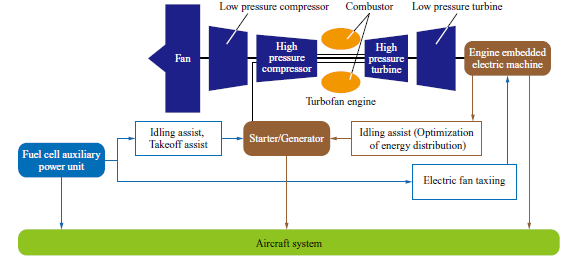
Turbofan engines used in single-aisle aircraft have low thermal efficiency when idling, but idling is performed for relatively long periods during self-powered ground movement (taxiing) and descent. If an electric motor is connected to the low-pressure shaft, which drives the fan of the engine, fuel consumption can be reduced through electric fan taxiing, where the engine is turned off on the ground and the fan is powered by a high-efficiency auxiliary power source such as batteries. While flying, engines cannot be turned off even when idling, such as during descent. However, fuel consumption can still be reduced through engine assist via electric energy from an auxiliary power source and optimizing the internal energy distribution within the engine using electric power (hereinafter collectively referred to as “idling assist”). During takeoff, when the engines are operating at maximum output, takeoff assist, which involves assisting the engines with electric energy from an auxiliary power source, can help lower exhaust temperatures, thereby extending engine lifespan and reducing maintenance costs. These are the benefits that can also be achieved even with hybrid electric propulsion, which has a low electrification rate.
Based on advancements in battery technology, it is considered feasible for aircraft with up to 100 seats and flight times of 90 min or less to be equipped with batteries, potentially providing all or part of the main propulsion through electric propulsion(4). The above flight time corresponds to a cruising range of just under 1,000 km, but flights exceeding this range and flight time are not feasible, because the weight of the batteries exceeds the aircraft’s maximum load capacity. Even with a hybrid approach, the issue of battery weight negatively impacting fuel efficiency remains unchanged. When considering single-aisle aircraft, batteries are not a suitable energy source for the main propulsion.
2.2 IHI’s aircraft electrification concept
Based on these preliminary studies, IHI set the following aircraft electrification concept.
- Combining aircraft system electrification with hybrid electric propulsion featuring a low electrification rate.
- Considering the application of hybrid electric propulsion for idling assist, electric fan taxiing, and takeoff assist.
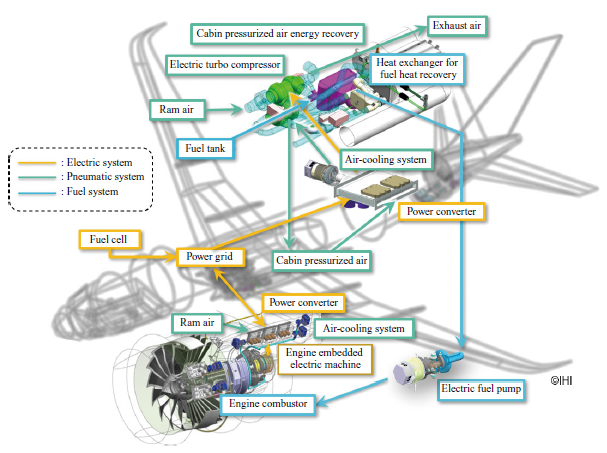
- Considering the application of fuel cells to the auxiliary power unit (APU), which offers higher efficiency than the conventional turbine-based APU.
- Considering lithium-ion secondary batteries for propulsion or aircraft system power supply, but not as the primary energy source for either. Their application is considered in the system design only to meet safety requirements and to smooth out the output for short durations.
- Cooling of the electric system is primarily achieved through air cooling, and a thermal and air management system is applied that considers both heat recovery via air and thermal coupling with the engine through the fuel.
Figures 1 and 2 illustrate the IHI’s aircraft electrification concept and the hybrid electric propulsion concept, respectively. IHI is currently conducting a project for technological development based on the aircraft electrification concept and system-level demonstration titled “Development of Power Control, Thermal and Air Management System, and Electrification Rate Improvement Technology/Development of Power Control and Thermal and Air Management System Technology” as part of the “Green Innovation Fund Project/Next-Generation Aircraft Development,” commissioned by the New Energy and Industrial Technology Development Organization (NEDO). In this project, system-level demonstration tests are being conducted along with the development of core technologies in line with the electrification concept, such as MW-class electric motors and high-output electric turbo machinery. Additionally, among the nine stages of Technology Readiness Levels (TRLs), the project is being developed with the goal of achieving TRL 6 (system-level demonstration), which is required at the stage immediately prior to product development. The details of this research and development are presented in Chapter 5.
2.3 Expected benefits
Based on the concept mentioned in Section 2.2, IHI conducted preliminary estimation of CO₂ emissions. As a premise for estimation of fuel consumption, it was assumed that a currently in-use 200-seat class single-aisle aircraft would be equipped with turbofan engines reflecting the expected technology level of the 2030s, and the electric system described in Section 2.2 would be applied. Additionally, it was assumed that conventional jet fuel would be used for the main engines, while hydrogen would be carried and used as fuel for the APU. Under these assumptions, IHI has projected that a total reduction of approximately 5% in CO₂ emissions can be achieved compared to current aircraft — approximately 3% from the introduction of hybrid electric propulsion, and approximately 2% from the electrification of aircraft systems, primarily the thermal and air management systems.
What is important to note here is the fact that these benefits are extremely limited when each equipment is implemented individually. Although electric power system equipment has seen dramatic improvements in output per unit weight (hereinafter referred to as “power density”) over the past 20 years, it remains heavy when considered for aircraft installation. When a full set of electric drive systems — ranging from power generation and distribution to energy storage and motor drives on the load side — is installed for a single purpose, the increase in fuel consumption due to the added weight of the electric power system equipment tends to offset the fuel-saving benefits gained from implementing and utilizing the system in almost all use cases. However, if various electrification methods and devices, each used during different phases of operation, can be combined and share a common power supply system, the increase in weight can be minimized. In aircraft electrification, it is necessary to attempt to solve this difficult task of systems integration.
3. Technical challenges and main focus of development
3.1 Technology development of high heat-resistant electric motor
In aircraft flying through the low-pressure environment at high altitudes, the electrical discharge phenomena greatly constrain the applicable voltage of electrical systems. In particular, the partial discharge resistance characteristics of electric motors are a limiting factor, and it is assumed that even in the 2030s, the applicable voltage will remain at or below ± 540 V, in terms of the supply voltage to the inverter (DC link voltage). Due to this voltage constraint, a current exceeding 1,000 A is required in the 1 MW-class electric motor that supports aircraft electrification, and this results in significant power loss. Additionally, as a result of pursuing higher power density for aircraft installation, the loss density also increases, causing the interior of the electric motor to become extremely hot. Furthermore, high heat resistance of the electric motor is crucial for realizing the concept of an engine-embedded generator that enables system integration of the engine and the high-power electric motor. The realization of a high heat-resistant electric motor that can be embedded within an engine requires both advanced cooling technologies and the application of high-temperature-resistant materials. Therefore, IHI is promoting the application of advanced cooling technologies cultivated through aircraft engine development to electric motors, and is also developing motors that use insulation coatings with a heat resistance of 300°C, significantly higher than the conventional 180°C used for motor windings.
3.2 Technology development of ultra-high speed motor with gas bearings
To improve the overall efficiency of aircraft systems, it is essential to enhance the efficiency of air systems — such as pressurization, air conditioning, and anti-icing that consume large amounts of energy through the use of compressed air. At the same time, it is also important to develop more advanced and efficient thermal management system to cope with the increased heat load in the aircraft due to the increase in electric power equipment. In many cases, the thermal management system has been regarded as a secondary system. The conventional approach has been to first design the equipment needed to fulfill the required functions of the primary systems, and then design the cooling system afterward to accommodate them. As a result, coolers were often added later in a patchwork manner, like retrofitted components. In IHI’s aircraft electrification concept, rather than relying on conventional retrofit measures, the approach is to first expand the limits of air cooling and standardize air cooling across all onboard equipment. Then, IHI established a thermal and air management system concept that collects all exhaust heat into the exhaust air from the pressurized cabin and integrates the management of thermal and air within the aircraft by combining it with energy recovery using turbines. At the core of this concept is an air-conditioning system integrated with fuel-based exhaust heat management. It combines: an air-cooling system for the power electronics (which handle motor control and power conversion such as voltage transformation and rectification), energy recovery using an electric turbo compressor, and fuel cooling, which uses fuel as a coolant to absorb heat and transport the aircraft’s exhaust heat to the engines. All of these systems use compressed air and rely on ultra-high-speed motors with gas bearings as their core technology to achieve the miniaturization required for aircraft installation. Gas bearings inherently have low bearing load because they support the shaft using a film of air, and this load further decreases in low-pressure environments. Therefore, to increase the output of electric motors, it is essential to reduce the weight of the rotor. As a basic strategy, IHI is pursuing technology development by leveraging its advanced rotating machinery technologies — including those used in automotive turbochargers — through multi-polarization and high-speed rotation, which in electrical terms constitutes ultra-high-speed operation.
3.3 Technology development at system level
In aircraft electrification, in order to fully realize the expected benefits, it is critical not only to develop technologies at the component and individual equipment levels, but also to carry out proper system-level design and to verify its validity. The CO₂ reduction effect presented in Section 2.3 was calculated based on a typical flight mission profile; however, the effectiveness of electrification is significantly affected by the overall operational pattern, including ground operations. It is therefore expected that the optimal system configuration will vary depending on specific operational scenarios, including maintenance and failure response. Additionally, since high-power electrification systems have not yet been applied to aircraft, new protection systems are required to ensure safety, which can have a significant impact on the overall system weight. Therefore, in order to suppress additional weight while ensuring safety, it is important to conduct test demonstrations that take failure scenarios into account. The development and enhancement of test facilities to accommodate these needs is also one of the key focus areas in technology development.
4. Technology development to date for the NEDO commissioned project and remaining technical challenges
IHI has carried out three commissioned projects from NEDO to date and has been engaged in technology development. An overview of these efforts is presented below.
4.1 Research and Development of Advanced Aircraft Systems for Practical Application Project / Research and Development for Next Generation More-Electric Engine System
In the research and development conducted from 2016 to 2020, IHI developed a 250 kW engine embedded electric machine incorporating high heat resistance technology. Concept verification was completed through component-level testing and standalone motor testing for the cooling structure and the 300°C heat-resistant insulation coating, both essential for enhancing the motor’s heat resistance. The 250 kW engine embedded electric machine is shown in Fig. 3. Additionally, the following activities were conducted: elemental testing of a heat exchanger for recovering exhaust heat into the fuel system in the thermal and air management system; concept verification of thermal integration between the airframe and engine via fuel using a simulator; and elemental testing for air cooling of the power converter. The air-cooling power electronics system applied to the elemental testing is shown in Fig. 4.
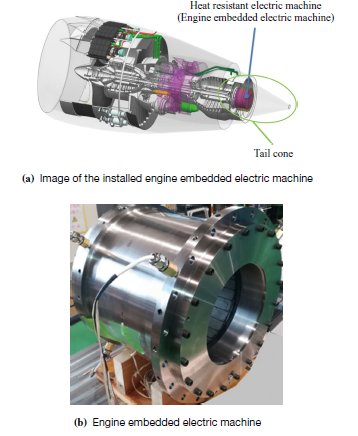
embedded electric machine (5)
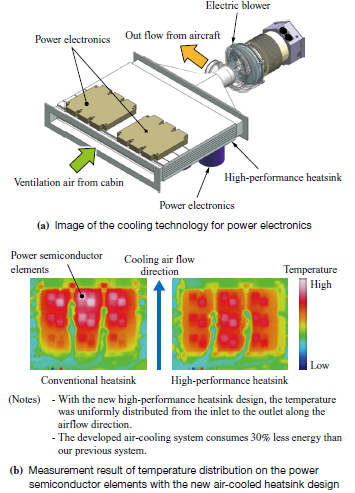
4.2 NEDO Leading Research Program / Research Program for New Technology Leadership in Energy and Environmental / Research and Development of Innovative Hybrid Flight System
In the research and development conducted from 2018 to 2020, a feasibility study was conducted on the mounting structure of an engine embedded electric machine. It was confirmed that an engine embedded generator of up to 2 MW can be installed within the tail cone. Additionally, a concept validation study on energy recovery in the thermal and air management system was conducted. Using a simulator, it was confirmed that in-aircraft thermal management that includes MW-class hybrid electric propulsion is feasible when combining an air-cooling system, energy recovery system, and fuel cooling system.
4.3 Advanced Aircraft Systems Implementation Project / Research and Development of Next Generation Electric Propulsion Systems / Electric Hybrid System
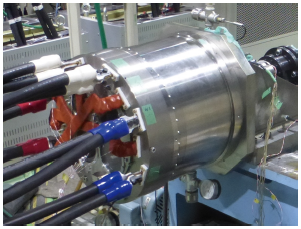
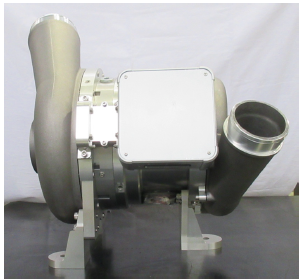
In the research and development conducted from 2020 to 2024, IHI developed an MW-class engine embedded electric machine applying high heat resistance technology. Based on the basic design of a 2 MW output generator, a 1 MW output prototype was manufactured by halving the axial length. Test evaluations were conducted, including component tests for performance verification, as well as operational tests based on assumed actual power system operational patterns for hybrid electric propulsion. The stability of power control during these operations was also evaluated. As a result, the validity of the generator design covering outputs up to 2 MW was confirmed. The MW-class engine embedded electric machine is shown in Fig. 5. In addition, as part of the concept validation of the thermal and air management system, IHI developed a high-altitude simulation air-conditioning test facility that reproduces the temperature and pressure conditions inside and outside the cabin of an aircraft flying at altitudes above 10,000 m. Using this facility, it was confirmed that more than 40% of the compressor drive power could be recovered by the turbine. Regarding the electric turbo compressor itself, development was carried out based on automotive turbocharger technology to further reduce the weight of the rotating components and to increase the load capacity of the gas bearings. A 70 kW-class electric turbo compressor, the largest in the world among those using gas bearings, was prototyped, and its performance was verified through system testing as part of a fuel cell air supply system. The 70 kW-class electric turbo compressor is shown in Fig. 6. Furthermore, an air-cooling system test was conducted assuming an aircraft power converter as the cooling target, and it was confirmed that the system provides sufficient cooling performance even under extremely hot conditions.
Through these three programs, the concept verification of aircraft system electrification, including the hybrid electric propulsion proposed by IHI, has been largely completed. In addition, the test verification for the supporting elemental technologies has also been completed. On the other hand, the following technological challenges remain.
- Due to limitations of the testing facility, full-scale demonstration of 1 MW has not been carried out for the electric power system and the generator.
- Due to limitations of the testing facility, full-scale demonstration of the thermal and air management system has not been conducted.
- Integrated system demonstration tests have not yet been conducted for the electrification system, which has incorporated various improvement measures.
- Durability and environmental compatibility demonstrations in both system and components have not been completed yet.
To overcome these technical challenges and pave the way for installation on actual aircraft, the following projects were launched under the Green Innovation Fund Project (hereinafter referred to as the “GI Fund Project”).
5. Electrification technology development under the GI Fund Project
5.1 Overview of the GI Fund Project and electrification technology development
The Ministry of Economy, Trade and Industry (METI) established a 2 trillion yen “Green Innovation Fund” within NEDO under the third supplementary budget for fiscal year 2020, in support of the 2050 carbon neutrality goal. Under this Fund, continuous support is provided over a 10-year period — from research and development and demonstration to social implementation — in priority areas identified in the Green Growth Strategy, an industrial policy aimed at creating a “virtuous cycle of the economy and the environment.” The support targets companies and other entities that demonstrate a commitment to specific goals and initiatives in areas where policy impact is particularly significant and long-term efforts toward social implementation are required. As part of this, the “Green Innovation Fund Project / Next-generation Aircraft Development / Development of technology for power control and thermal and air management systems” started in April 2024. As the primary contractor for the commissioned project, IHI is conducting the research and development. The development items under this R&D initiative are shown in Fig. 7, and their details are described below.
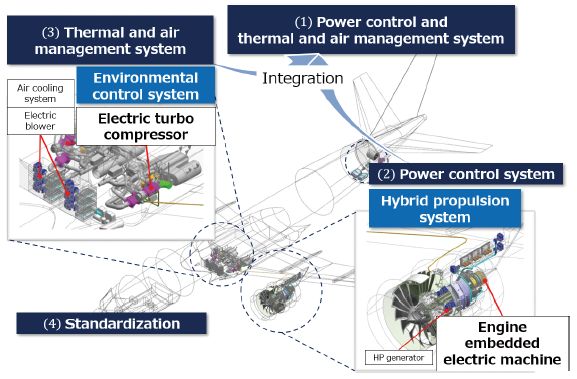
“Development of Power Control and Thermal and Air Management System Technology” (9)
In the GI Fund Project, both the development of key component-level technologies and system-level technology demonstrations are carried out. In the development of key component-level technologies, MW-class generators applicable to hybrid electric propulsion, as well as high-output electric turbomachinery suitable for thermal and air management systems and air supply systems for fuel cells, have been selected as the primary development targets. In addition to performance verification, tests will be conducted to evaluate their environmental compatibility and durability. In addition, full-scale system demonstrations of the power control system and the thermal and air management system using these components will be conducted individually. Ultimately, an integrated system demonstration combining both systems is planned to be carried out by fiscal year 2030.
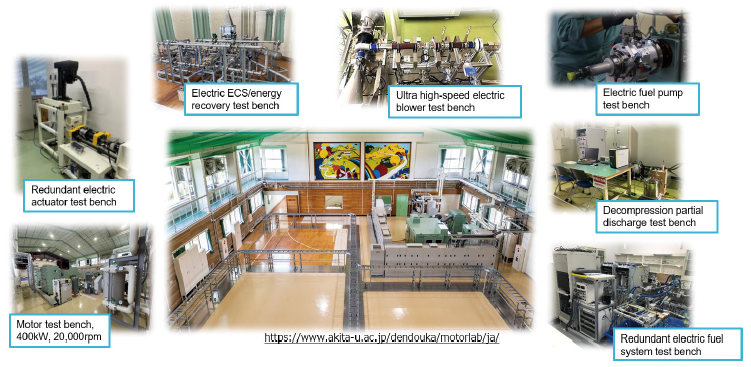
In the GI Fund Project, support is planned to be provided not only for technology development but also for the development and enhancement of the facilities that support it. In introducing the testing facilities, discussions led by the Ministry of Economy, Trade and Industry are underway on how to implement infrastructure in coordination with the aircraft industry strategy in the future. In alignment with these discussions, a plan is being developed to introduce full-scale demonstration infrastructure for aircraft electrification systems. A candidate site for the installation is the Joint Research Center for Electric Architecture, jointly operated by Akita University and Akita Prefectural University. IHI is advancing discussions in collaboration with both universities. Figure 8 shows the Evaluation Laboratory for Next Generation Motors at the Joint Research Center for Electric Architecture.
Another major pillar of the GI Fund Project is standardization. Reflecting on the insufficient promotion of standardization in past aircraft and system development efforts in Japan, the project implementation plan includes the promotion of standardization as a means to facilitate the social implementation of new technologies and to enhance the competitiveness of the Japanese aviation industry. Regarding standardization activities, preparations are underway in Public-Private Committee on New Technologies toward Decarbonization of Aircraft, co-hosted by the Ministry of Economy, Trade and Industry and the Civil Aviation Bureau, Ministry of Land, Infrastructure, Transport and Tourism, to formulate an international standardization strategy and establish domestic coordinating organizations. Standardization activities will be promoted in step with these efforts.
Through these activities, the goal is to achieve TRL 6 for the power control system and the thermal and air management system. By advancing development in alignment with the technology development roadmaps published by various countries, the initiative aims to facilitate the introduction of these technologies into next-generation aircraft.
5.2 Expected future vision
The aircraft electrification system envisioned by IHI, as described above, represents only incremental improvements that do not significantly alter the current form of aircraft. However, it should be noted that this does not represent the future form of aircraft. Electrification technologies are applicable regardless of aircraft configuration and can be widely adapted, from incremental improvements to revolutionary aircraft such as those powered by hydrogen electric propulsion. Electrification is a crucial supporting technology for all types of aircraft and is expected to become an essential foundational technology for future aviation. IHI will advance research and development toward the day when electrification systems based on Japanese technology are widely applied and installed on aircraft flying worldwide, and are recognized as reliably reducing CO₂ emissions.
6. Conclusion
To achieve decarbonization of air transportation by 2050, it is necessary to pursue all options for reducing fuel consumption. Electrification is one of the promising means, and analytical studies have confirmed that a combination of hybrid electric propulsion, including IHI’s proposed fuel cell auxiliary power unit (APU), and a thermal and air management system can improve fuel efficiency by 5%. For these constituent technological elements, IHI’s strengths — namely, its high heat-resistant electric machine technology and ultra-high-speed motor technology incorporating gas bearings — have been applied, and performance evaluations through testing have been completed. At IHI, through the NEDO GI Fund Project, technology development for the constituent elements of the system and system-level technology demonstrations are underway. We have launched efforts aiming to achieve TRL 6 at the system level, with the goal of social implementation through application to next-generation single-aisle aircraft expected to enter service in the 2030s.
- — Acknowledgments —
- Part of the results presented in this paper were obtained through the commissioned project JPNP15005 by the New Energy and Industrial Technology Development Organization (NEDO).
REFERENCES
(1) ICAO Committee on Aviation Environmental Protection : Report on the feasibility of a long-term aspirational goal (LTAG) for international civil aviation CO₂ emission reductions, 2022
(2) Royal Netherlands Aerospace Centre (NLR) and SEO Amsterdam Economics : Destination 2050 – A route to net zero European aviation, 2021
(3) B. Graver, D. Rutherford and S. Zheng : CO₂ EMISSIONS FROM COMMERCIAL AVIATION: 2013, 2018, AND 2019, International Council on Clean Transportation, 2020, p. 6
(4) Air Transport Action Group : WAYPOINT 2050 Second Edition: September 2021, p. 46
(5) IHI Corporation : Press Release “Development of the world’s first Aircraft jet engine-embedded electric machine with high power density and heat resistant — For optimizing the energy management of aircraft system to reduce CO₂ emission —”, https://www.ihi.co.jp/en/all_news/2019/aeroengine_space_defense/1191910_2025.html, accessed 2024-08-30
(6) IHI Corporation : Press Release “Development of the world’s first air-cooling system for aircraft onboard 100 kW-class power electronics — The “liquid-less”, clean cooling technology enlarges applicability of the power electronics —”, https://www.ihi.co.jp/en/all_news/2020/aeroengine_space_defense/1196479_2038.html, accessed 2024-08-30
(7) IHI Corporation : Press Release “IHI Brings Planet Closer to a Carbon-Free Future by Developing World’s First Aircraft Engine-Embedded Megawatt-Class Electric Motor”, https://www.ihi.co.jp/en/all_news/2023/aeroengine_space_defense/1200552_3529.html, accessed 2024-08-30
(8) IHI Corporation : Press Release “IHI Develops One of World’s Lightest and Most Compact Electric Turbo Compressors Incorporating Proprietary Air Bearing Technology that Could Help Materialize Aircraft Fuel Cell Propulsion Systems”, https://www.ihi.co.jp/en/all_news/2023/technology/1199839_3531.html, accessed 2024-08-30
(9) The New Energy and Industrial Technology Development Organization : Business overview explanation materials, https://www.nedo.go.jp/content/100975498.pdf, accessed 2024-08-30 (in Japanese)