
Reduce CO₂ Emissions with -160°C LNG Cold Energy
Delivery of world's largest scale LNG cold power generation unit
IHI Plant Services Corporation

IHI Plant Services Corporation (IPC) delivered an LNG cold power generation unit to Shanghai LNG Company Ltd. in China. This unit is the first of its kind in China. Its introduction has made it possible to reduce CO₂ emissions by up to 10,000 t per year. This article presents an overview of the cold power generation project, including the specifications of the delivered unit, the knowledge obtained through the project, and the unit’s operational track record.
Introduction
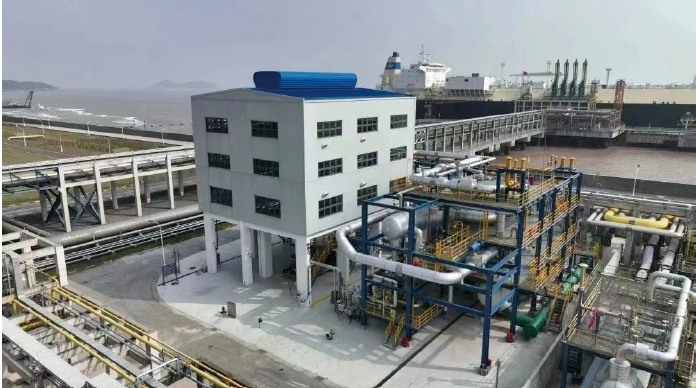
In December 2023, a cold power generation unit was completed and handed over to Shanghai LNG Company Ltd. at the Shanghai LNG Terminal in Yangshan Port, Shanghai, China.
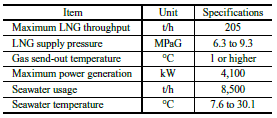
The unit is a Rankine cycle cold power generation unit that uses propane as the working fluid. It has the world’s largest liquefied natural gas (LNG) throughput and reaches a maximum power output of 4,100 kW.
Cold power generation effectively utilizes the cold energy of LNG, which is typically wasted by releasing it into the ocean when LNG is vaporized and its temperature warms up to ambient temperature, to generate electricity. The IHI Group constructed five LNG cold power generation units in Japan between the late 1970s and early 1990s, so this project marks the first delivery in over 30 years and the first-ever installation outside Japan. During this project, IHI Plant Services Corporation (IPC) provided the cold power generation process engineering and control system engineering, procured the main equipment, and commissioned the unit, while a Chinese company conducted the construction work.
What is an LNG cold power generation unit?
To reduce transportation costs, natural gas is cooled to approximately −160°C using enormous amounts of energy to liquefy it into LNG. Liquefaction reduces the volume of natural gas to 1/600. During this process, LNG stores some of the energy from liquefaction as cold energy. LNG is transported to the area of consumption, where it is regasified using air or seawater heat, discharging the stored cold energy into the atmosphere or ocean. The LNG cold power generation unit utilizes this cold energy to generate electricity.
This system generates electricity using LNG, a fossil fuel. However, the system does not burn LNG. As described above, what it does is to recover the energy used for liquefaction without generating carbon dioxide (CO₂) anew in the power generation process.
Cold power generation is broadly classified into two types: (1) the direct expansion method and (2) the Rankine cycle method. An overview of each is provided below.
- (1)Direct expansion method
- The direct expansion method regasifies LNG using a heat source such as seawater, then expands it to rotate a turbine and generate electricity. This system is simple and highly reliable as it only adds a turbine to the conventional LNG regasification process. In this method, the lower the gas discharge pressure at the turbine outlet, the greater the pressure difference across the turbine, and the greater the amount of electricity generated, making it more economical. However, in recent years, the gas send-out pressure (gas discharge pressure at the turbine outlet) from LNG terminals has been increasing, making it difficult to secure sufficient power generation. This type of cold power generation unit was once common in Japan. However, as the required gas send-out pressure increased, it became difficult to operate them economically, forcing many to close.
- (2)Rankine cycle method
- The Rankine cycle method condenses the working fluid using the cold energy of LNG, heats and regasifies it using a heat source such as seawater, then uses the regasified working fluid to drive a turbine and generate electricity. Organic compounds such as propane and fluorocarbons are used as the working fluid. Selecting an appropriate working fluid requires evaluating the amount of power, fluid properties, and safety. In many cases, a single-component working fluid is selected to simplify equipment configuration and operation.
Shanghai LNG Terminal overview
The Shanghai LNG Terminal is located in the Yangshan Port, Shanghai, China, and is the largest LNG receiving terminal in the region. LNG received from overseas is vaporized and the resulting city gas is supplied mainly to Shanghai City. The joint venture, including IHI, designed, procured, and constructed the entire terminal, which includes three 165,000-kL LNG tanks and LNG vaporization facilities. The commercial operations of this terminal began in 2009. Expansion work, including the construction of two LNG tanks, began in 2016. The construction of this cold power generation unit is also part of this expansion work. IPC was awarded the basic design work for this facility at the end of 2016, followed by the detailed design and procurement of the main equipment from 2019, maintaining continuous involvement in the project.
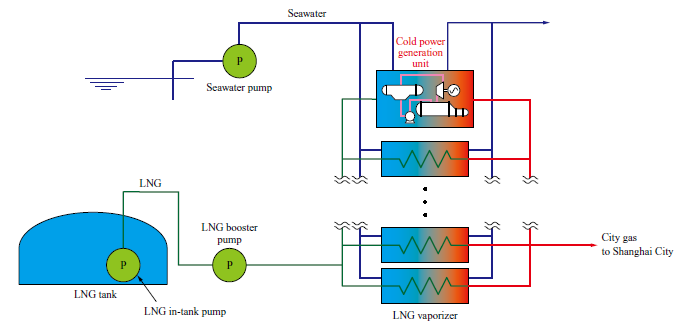
The LNG vaporization facility consists of eight LNG vaporizers that use seawater as the heat source and are arranged in a parallel configuration. One of them is the cold power generation unit constructed this time. This cold power generation unit is not only a power generation facility, but also a part of the important infrastructure to supply city gas in Shanghai City.
About the cold power generation unit
The cold power generation unit constructed this time is a Rankine cycle system that uses single-component propane as the working fluid. This method was selected because the Shanghai LNG Terminal has a high gas send-out pressure of approximately 6 to 9 MPaG, which precludes the use of a direct expansion system, and it is suited to a simple configuration that is easy to operate and maintain.
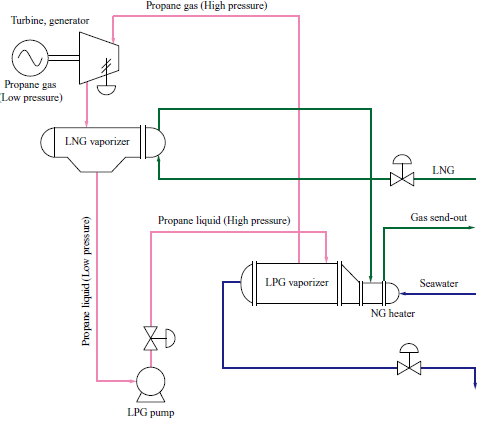
This unit primarily consists of a turbine, a generator, a liquefied propane gas (LPG) pump, and three shell & tube heat exchangers. The working fluid, propane liquid, is pressurized by the LPG pump and then vaporized into propane gas through heat exchange with seawater in the LPG vaporizer. This propane gas is used to drive the turbine and generate electricity. The low-pressure, low-temperature propane gas discharged from the turbine is recondensed through heat exchange with LNG at −160°C in the LNG vaporizer, then fed back into the LPG pump.
The natural gas (NG) heated and vaporized through heat exchange with propane in the LNG vaporizer is still too cold to be sent out. Therefore, it is heated through heat exchange with seawater in the NG heater until it is warm enough to be sent out.
The unit is controlled by a dedicated control system for the cold power generation unit, which is independent of the plant’s overall DCS (distributed control system). This control system was newly developed for the execution of this project.
Toward zero flammable gas leakage
This cold power generation unit uses propane as the working fluid and methane-based LNG as the cold heat source, both of which are combustible gases, so the unit is designed to minimize leakage to the outside of the system. Most of the pipes are welded together to minimize the risk of flammable gas leakage due to loose bolts and similar faults. In addition, the following measures are taken to prevent continuous leakage of flammable gas from the bearings of rotating equipment, such as pumps and turbines.
- ・LPG pump
- A submersible pump, with both the pump body and motor fully immersed in the process liquid, was selected and housed in a pressure vessel. This keeps the rotating shaft from being exposed to the outside of the equipment, resulting in zero risk of flammable gas leakage.
- ・Turbine
- The turbine must be designed not only to prevent propane from leaking out of the system from the bearings to the outside, but also to prevent lubricating oil from entering the propane system. This is because the propane system of this unit is a closed circulation system, which means that once lubricating oil gets mixed in, it will not flow out or disappear naturally over time, but will accumulate within the system. To simultaneously prevent propane from leaking out of the process system and lubricating oil from entering it, a three-stage shaft seal structure consisting of a nitrogen seal, an oil seal, and a process gas seal is used.
Improved unit reliability
As described above, this cold power generation unit works as a part of Shanghai LNG Terminal’s gas send-out system. Therefore, it needs to be made to continuously send out gas, not only during normal operation, but also during emergencies such as equipment malfunction to the extent possible.
This unit requires complex start-up and shutdown procedures, such as simultaneously operating several devices and valves, or conversely, gradually depressurizing the system over several tens of minutes. Therefore, it is difficult for an operator to operate the system manually. Furthermore, all operations must be performed without cutting off any of the gas send-out, while maintaining a good balance of temperature, pressure, and vapor-liquid equilibrium among the LNG/gas send-out system, the seawater system, and the propane circulation system. For this reason, everything is incorporated into an automatic sequence in the control system, allowing one-touch operation. In the event of a malfunction in the rotating equipment (pumps and turbines), it is also designed to automatically and immediately shut down the rotating equipment to stop power generation and switch to an operation mode where only LNG vaporization is performed, allowing at least the gas send-out to continue.
These automatic sequences were established through dynamic analysis of the unit during the design stage. The sequences were then repeatedly verified to minimize the need for adjustments during on-site commissioning.
For stable operation of unit
In cold power generation, seawater serves as the heat source for the working fluid, and its temperature varies widely depending on the season. The Shanghai LNG Terminal is located at the mouth of the Yangtze River, where seawater temperatures exceed 30°C in the summer and drop to nearly 5°C in the winter. Accordingly, the propane pressure at the turbine inlet varies significantly. Consequently, the process conditions, operating conditions, and power generation amount differ significantly between summer and winter. The equipment and instrumentation are selected to ensure stable power generation and gas send-out under all anticipated operating conditions.
The aspect most affected by changes in process conditions due to variations in seawater temperature is the synchronization of the generator connected to the turbine to the grid. The turbine rotational speed must be precisely matched to the grid’s frequency and phase. However, because the gas pressure at the turbine’s inlet varies significantly with seawater temperature, typical control parameter settings cannot be applied to all conditions, raising concerns about turbine overspeed or equipment damage due to sudden drops in rotational speed. For this reason, control logic that adapts to fluctuations in process conditions during synchronization was implemented to prevent sudden changes in turbine speed. This has enabled stable synchronization with the grid, even under different process conditions.
Verification through on-site commissioning
Installation of the cold power generation unit began in April 2022, and stand-alone commissioning of each equipment and control sequence tests began in February 2023. On April 1, 2023, the cold power generation unit began power generation operation for the first time in China. Starting from April 24, a 168-hour reliability run test was conducted to confirm that there were no problems with reliability or safety. Following this, the system was put into commercial operation. While continuing commercial operation over the next several months, control and equipment performance tests at different seawater temperatures were conducted. After confirming the prescribed performance, the equipment was officially handed over to the customer in December 2023.
Conclusion
This unit can generate approximately 4,100 kW in summer and approximately 2,500 kW even in a harsh winter, with an average annual output of 3,000 kW. This amounts to a total of approximately 24,000 MWh of electricity per year, which reduces CO₂ emissions by approximately 10,000 t per year compared to generating the same amount of electricity at a conventional thermal power plant.
Since this unit began operating, plans to build additional cold power generation facilities have been launched one after another in China, and there has also been much interest outside of China, especially in Asia.
IPC will continue to aim for the widespread use of cold power generation units at LNG terminals, where significant global demand is anticipated, thereby contributing to the realization of a carbon-free, carbon-neutral society.